TSBy The Standard Newspaper25 September 2026 4 min read25 September 2026 4 min read
NHIA seeks stronger health insurance plan as stakeholders review 2026–2030 strategy
By Aminata Kuyateh
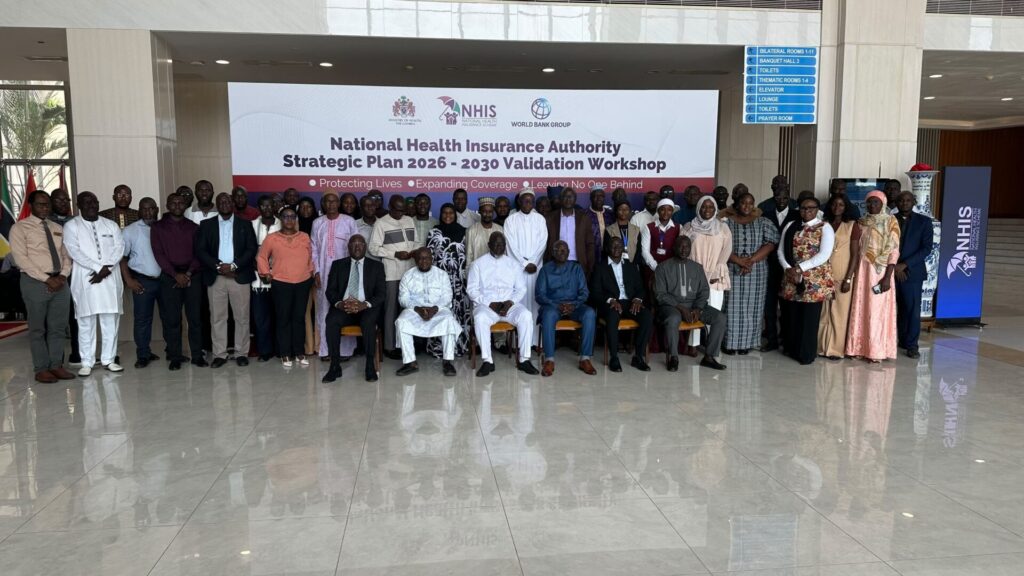
The National Health Insurance Authority (NHIA) ended a two-day stakeholder validation of its 2026–2030 Strategic Plan yesterday, with calls for stronger health financing, wider coverage and greater protection for Gambians from the cost of healthcare.
The convergence brought together government officials, health providers, development partners and other stakeholders to review the NHIA’s strategic priorities and implementation arrangements towards universal health coverage.
The Gambia introduced the National Health Insurance Scheme (NHIS) in 2021 to reduce out-of-pocket healthcare spending, particularly for low- and middle-income earners. The NHIA, established under the National Health Insurance Act, is also mandated to regulate and license private health insurance schemes.
Chairman of the NHIA Board, Dr Melville George, said the value of the new strategic plan would ultimately depend on its relevance and practicality during implementation.
He urged the authority to draw lessons from the implementation of its previous plan, identifying what worked, what failed and what needed to change.
He said the strategy must remain aligned with the national health sector plan and take into account programmes including malaria, RAMCA and standard treatment guidelines, while allowing for regular reviews.
Dr George also called for the strategy to account for public health emergencies and strengthen operational efficiency, data systems and coordination among health sector actors. He urged the NHIA to develop solutions based on The Gambia’s disease burden, healthcare facilities and people’s incomes, while expanding the benefits package and improving communication at household level.
He also cited the D7,000 cost of a caesarean section operation as an example of healthcare costs that should be reviewed against ordinary Gambians’ incomes.
Permanent Secretary at the Ministry of Health, Dr Yusupha Touray, said the validation of the strategic plan represents an important step towards improving healthcare financing and advancing universal health coverage.
He said the exercise should go beyond formality and ensure that the strategy has clear priorities, realistic implementation arrangements, adequate resources and strong accountability. Dr Touray said government remains committed to strengthening the health sector, describing health as both a public good and an investment in the country’s productivity and future development.
He said the NHIA must expand its benefits package and coverage, particularly for vulnerable and underserved populations, while improving provider accreditation, quality assurance, claims reimbursement, digitalisation and performance management.
He also called for better coordination of health financing currently spread across programmes such as malaria, HIV and tuberculosis to reduce duplication and wastage.
Acting CEO of the NHIA, Hassan Njie, said the National Health Insurance Act 2021 established the National Health Insurance Authority (NHIA), the National Health Insurance Scheme(NHIS) and the National Health Insurance Fund(NHIF) as key components of the country’s health insurance system.
Njie presented an overview of the NHIS implementation journey, highlighting key milestones achieved since the pilot phase. He recalled that the scheme was first tested in July 2023 at the Bundung Maternal and Child Hospital before expanding to 12 public health facilities and later to 69 facilities across the country’s seven health regions. According to Njie, the scheme recorded 72,199 people between July 2023 and July 2026.
Together, he said, these structures are designed to move the country steadily towards universal health coverage by 2030, with a focus on equity, access to quality service and financial protection, particularly for vulnerable groups.
Njie urged stakeholders to ensure that the strategic plan remains focused on people rather than statistics. He illustrated this through the case of “Numbe,” a 30-year-old subsistence farmer, mother of three and expecting her fourth child, whose unstable income makes it difficult to meet healthcare costs while supporting her family.
He said such beneficiaries should remain at the centre of the NHIA’s planning and implementation.
Enjoyed this story?
Applaud it for the newsroom — one clap per reader, per story.