The November 10 crowd: Incumbency advantage or organisational transformation? From the 2021 presidential election to 5th December, 2026: Understanding grassroots mobilisation, development politics, political pragmatism, and the limits of crowd-based electoral predictions.
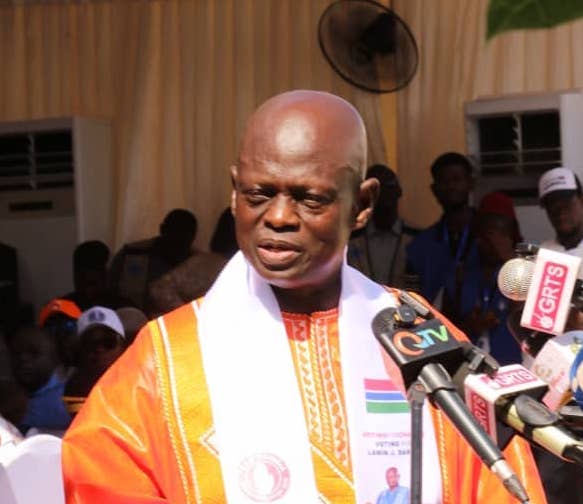
The NPP’s preparations for Barrow’s nomination suggest that the event was conceived as a major demonstration of political organisation. On 9th November, The Standard and The Point newspapers reported that the party expected more than 100,000 supporters to accompany the president to the IEC. This was a pre-event projection, not an independently verified attendance count. The party also identified Sting Corner as an assembly point and coordinated the gathering around a scheduled nomination time. This distinction matters. A large gathering can be produced through several overlapping mechanisms: established party networks, coalition participation, a candidate’s personal appeal, effective communication, transportation arrangements, and the political visibility associated with incumbency. The NPP’s nomination gathering can therefore be interpreted as a potential indicator of organisational consolidation, although the strength of that interpretation depends on evidence extending beyond a single event. The question of incumbency also raises an important accountability issue. Incumbent parties can benefit from their access to political visibility and established governing networks.
However, incumbency advantage is not synonymous with the misuse of state resources. Whether public resources were used for partisan mobilization requires separate investigation, including evidence of campaign financing, transportation arrangements, and the distinction between official government functions and party activities.
A changing political landscape, but the ballot remains the test
President Barrow’s 10th November nomination gathering offers an important opportunity to reconsider the NPP’s organisational character and the changing nature of political competition in The Gambia. The event raises questions about coalition-building, incumbency, grassroots coordination, development-oriented campaigning, and the political appeal of leadership narratives grounded in compassion, religion, and public service. It also invites a reconsideration of the perception, sometimes expressed during the 2021 campaign, that the UDP possessed a more visible grassroots mobilisation structure than the relatively new NPP.
Nevertheless, the political meaning of a large crowd should neither be exaggerated nor dismissed. The NPP’s public mobilisation is relevant evidence of organisational activity, just as the UDP’s longstanding networks remain relevant to understanding Gambian opposition politics. Neither observation, however, establishes the distribution of electoral preferences across the country.
In African electoral politics, the size of a political crowd may demonstrate organisational strength, but it does not necessarily reveal the electoral preferences of an entire nation. President Adama Barrow’s reported large gathering of National People’s Party (NPP) supporters at the Independent Electoral Commission (IEC) on 10th November, 2026, raises important questions about the changing dynamics of political competition in The Gambia.
The gathering, described by observers as larger than those accompanying the United Democratic Party (UDP) and Unite, provides an opportunity to examine the NPP’s mobilisational capacity, incumbency advantage, and evolving electoral strategy. Yet crowd-size comparisons drawn from videos and eyewitness accounts require caution, particularly without independently verified attendance figures. The central question is not simply whether Barrow attracted a larger crowd, but what political, organisational, and institutional mechanisms may explain such participation and whether visible enthusiasm can reliably indicate electoral support on 5th December.
From 2021 to 2026: The changing character of NPP mobilisation
The 2021 presidential election provides an important baseline for understanding the NPP’s organisational development. Barrow contested that election as an incumbent whose political organisation was relatively new compared with the UDP, a party with longstanding opposition networks and grassroots structures. The NPP’s electoral organisation therefore developed under different historical circumstances from those of established opposition parties.
Five years later, the reported scale of participation at Barrow’s IEC nomination suggests that the NPP’s capacity to organise large public political events warrants closer examination. However, it would be analytically premature to conclude that its grassroots organisation has surpassed that of the UDP without comparable evidence from constituency-level activities, membership networks, and election results.
The distinction between organisational visibility and institutional development is particularly relevant to Rachel Beatty Riedl’s scholarship on African political parties. In Authoritarian Origins of Democratic Party Systems in Africa, Riedl demonstrates how political histories and organisational structures shape party systems and their durability. Applied to The Gambia, this assessment suggests that the UDP’s historical grassroots networks and the NPP’s access to incumbency-related political opportunities represent different pathways to party organisation. The NPP’s contemporary mobilisation should be understood not simply as a measure of personal popularity but as a possible reflection of accumulated organizational experience, coalition relationships, local political networks, and the advantages associated with holding executive office.
Incumbency, political resources, and the pragmatism of electoral mobilisation
One of the most important mechanisms to examine is the relationship between incumbency and political mobilisation. Across African democracies, incumbent parties frequently possess advantages associated with public visibility, access to political networks, administrative experience, and the ability to communicate government achievements. These advantages do not automatically imply the misuse of public resources, but they create organisational opportunities that opposition parties may not possess to the same degree. Nic Cheeseman’s Democracy in Africa presents a useful framework for understanding how incumbency, institutional competition, and unequal political resources influence electoral politics. Similarly, Staffan Lindberg’s Democracy and Elections in Africa emphasises the significance of repeated electoral competition in shaping political participation and institutional development.
For the NPP, the relevant analytical question is how party organisation, coalition networks, development messaging, and incumbency-related visibility interact to generate public participation. The ability to organise transportation, coordinate supporters across regions, activate constituency networks, and publicise a major nomination event can influence crowd attendance. However, these are mechanisms to examine rather than activities that can be attributed to the NPP without supporting evidence. Equally significant is distinguishing legitimate party fundraising and mobilisation from any alleged use of state resources for partisan purposes. Demonstrating the latter would require credible evidence of public expenditure, official directives, or the deployment of state assets for campaign activities.
Development politics: Roads, electrification, and the electoral appeal of infrastructure
A second dimension of Barrow’s political strategy concerns the relationship between development promises and electoral support. During his 10th November nomination speech, Barrow announced plans for major road projects, including a proposed six-lane dual carriageway along Kairaba Avenue from Westfield to Fajara, extending toward Bakau and Cape Point. These announcements were reported by Kerr Fatou online media. Such promises can be understood through the political economy of infrastructure development, in which roads, electricity, and public services become observable symbols of government performance. For communities that have historically experienced inadequate public investment, infrastructure projects may carry political significance beyond their immediate economic benefits. Roads can improve market access, transportation, and connections to public services, while electrification can transform household activities and local economic opportunities. Nevertheless, development announcements must be separated from completed projects, and claims about their electoral effects require evidence of how citizens actually evaluate government performance.
This dynamic connects with Leonard Wantchekon’s research on clientelism and voting behaviour in Benin and Eric Kramon’s analysis of electoral clientelism in Africa. Their scholarship provides tools for understanding programmatic appeals, particularistic benefits, and the material incentives that can shape political relationships. Barrow’s emphasis on infrastructure can be seen as performance-based or development-oriented campaigning, especially when projects are presented as evidence of government responsiveness. However, public infrastructure is not inherently clientelistic: a road serving an entire community differs from a selective benefit offered in exchange for political support. The central question is whether Gambian voters view these projects as credible public commitments, evidence of the NPP government’s effectiveness, or campaign promises whose implementation remains uncertain.
The argument that Barrow’s development agenda seeks to connect peripheral communities with major economic and administrative centres is especially relevant. In places such as Foñi Berefet, Kabada, and other locations where inadequate roads and electricity have historically constrained mobility and opportunity, development may become an important part of political discussion. Yet describing this agenda as a successful effort to overcome marginalisation requires a critical examination of how infrastructure is distributed, which communities are reached, and the quality of completed projects. The political significance of development is therefore best assessed through both government performance and citizens’ experiences, rather than campaign rhetoric alone.
Political language, religious symbolism, and Barrow’s public image
Another interesting feature of Barrow’s political communication is the reported use of religious and moral language. References to the campaign as a jihad, if accurately attributed to the president, deserve careful contextual interpretation. In political discourse, the term may be used metaphorically to describe an intense struggle, a moral undertaking, or a collective effort toward a particular objective. It should not automatically be interpreted as a call to religious violence. Nevertheless, its political meaning depends on the precise wording, audience, and context of the statement. I have not independently verified the reported leaked audio, so the attribution should remain provisional until the original recording is authenticated.
Similarly, the expression “Heeno and Deeno” described as conveying sympathy, religious commitment, and tolerance, illustrates how Barrow’s political leadership may be evaluated through locally meaningful moral and cultural categories. Supporters may associate a leader with humility, compassion, accessibility, or religious devotion, but such perceptions should be treated as attributed political evaluations rather than objective assessments of character. The reported contrast between Barrow’s leadership style and that of former President Yahya Jammeh or contemporary opposition figures also requires careful analysis. Perceptions of tolerance and compassion are politically significant because they shape public narratives of leadership, yet they do not replace systematic assessment of democratic accountability, civil liberties, and institutional performance.
Scholarly debates about political legitimacy in Africa provide a useful framework for understanding these dynamics. Political authority may draw legitimacy from formal institutions, perceived performance, social relationships, and culturally resonant ideas of moral leadership. The political importance of such language lies not in proving that one leader possesses particular virtues, but in understanding how supporters construct and communicate their expectations of legitimate authority.
The political arithmetic of 2021: What has changed in 2026?
The 2021 presidential election provides a valuable empirical benchmark for examining the relationship between campaign visibility and actual electoral outcomes. This presents a useful corrective to the assumption that the party attracting the most visible crowds necessarily commands the largest electoral constituency. The 2021 results demonstrate why campaign attendance, organisational enthusiasm, and electoral performance must be examined as distinct measures of political strength. The NPP’s reported mobilization in 2026 may indicate developments in its organizational capacity, but establishing whether its support base has expanded since 2021 would require comparable voter surveys, constituency-level evidence, and ultimately election results.
Does the NPP crowd translate into a December 5th victory?
The central analytical distinction is between mobilisation capacity and electoral conversion. A nomination crowd demonstrates that a political organisation can bring people together at a particular time and place. An election measures the preferences of registered voters who actually cast valid ballots across the country. These are fundamentally different observations. The political significance of the November 10th gathering is therefore best understood through three questions. First, how representative were those attending of the wider electorate, including less politically active citizens? Second, to what extent did attendance reflect enduring party identification, coalition mobilisation, enthusiasm for Barrow, or the symbolic importance of the nomination? Third, how do these patterns compare with evidence from the 2021 election and the political activities of competing parties? Eric Kramon’s study on electoral clientelism reminds us that participation in African electoral politics may reflect multiple motivations, including political identification, social relationships, and material considerations. Likewise, Leonard Wantchekon’s research illustrates the importance of distinguishing different forms of electoral appeals and examining their effects empirically. Neither framework supports treating crowd size as a direct measure of future votes.
The broader lesson is that electoral politics must be analysed through evidence rather than spectacle. Crowds reveal who is willing and able to participate in a political event; election results reveal how participating voters distribute their ballots. Understanding the relationship between these two forms of participation is essential to a serious assessment of The Gambia’s December 5th presidential election.
By Lamin Keita