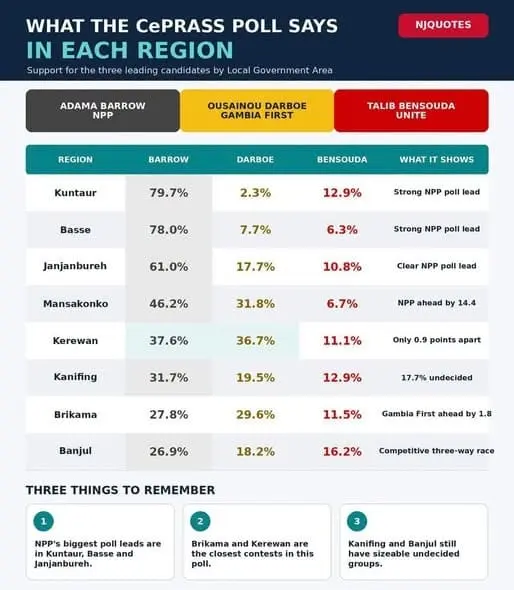
However, the geographical breakdown presents a more varied picture. The NPP-led alliance records particularly high stated support in Kuntaur, Basse, and Janjangbureh.
In Brikama, the Gambia First Coalition records 29.6 per cent against 27.8 per cent for the NPP-led alliance. In Kerewan, the two political formations – Barrow’s NPP-led alliance and Darboe’s Gambia First Coalition – are almost level, with 37.6 per cent for Adama Barrow’s alliance and 36.7 per cent for Ousainu Darboe’s coalition.
These findings have prompted discussion about the West Coast Region, particularly because the reported Brikama figures place the Gambia First Coalition slightly ahead of the incumbent’s alliance.
Yet the following questions arise: What exactly do these local figures tell us? Can the Brikama result be interpreted as a reflection of the entire West Coast Region? How should the figures be understood when the public does not yet have a complete demographic breakdown of the 2026 voter register across all 53 constituencies? And how much confidence should political observers place in differences of less than two percentage points?
These questions deserve careful consideration. The CepRass poll provides useful evidence about stated voting intentions, but interpreting its local findings requires an understanding of The Gambia’s electoral geography and the limitations of the available data.
The question now arises: What does the CEPRASS poll tell us about the different areas?
The survey reports substantial geographical variation in stated voting intentions. In Kuntaur, the NPP-led alliance records 79.7 per cent, compared with 12.9 per cent for Talib Bensouda’s Coalition 2026. In Basse, Adama Barrow’s NPP-led alliance records 78 per cent, while Ousainu Darboe’s coalition records 7.7 per cent and Talib Bensouda’s coalition 6.3 per cent.
In Janjangbureh, the Barrow’s NPP-led alliance records 61 per cent, compared with 17.7 per cent for Darboe’s Gambia First Coalition and 10.8 per cent for Bensouda’s Coalition 2026.
The figures are considerably closer in some other areas. In Brikama, Darboe’s Gambia First Coalition records 29.6 per cent, compared with 27.8 per cent for Barrow’s NPP-led alliance. In Kerewan, the respective figures are 36.7 per cent and 37.6 per cent.
In Kanifing, incumbent leader President Adama Barrow’s alliance records 31.7 per cent, Ousainu Darboe’s coalition 19.5 per cent and Talib Bensouda’s coalition 12.9 per cent. However, 22 per cent of respondents in the area are reported as undecided.
In Banjul, Adama Barrow’s NPP-led alliance records 26.9 per cent, Ousainu Darboe’s Gambia First Coalition records 18.2 per cent and Talib Bensouda’s Coalition 2026 records 16.2 per cent. The undecided category stands at 18.9 per cent.
In Mansakonko, Barrow’s NPP-led alliance records 46.2 per cent, compared with 31.8 per cent for Darboe’s Gambia First Coalition and 6.7 per cent for Bensouda’s Coalition 2026.
These figures demonstrate that national voting intention does not tell the entire story. The distribution of stated preferences varies considerably between geographical areas. Nevertheless, the figures should not be interpreted as final electoral outcomes. They represent respondents’ stated preferences during the survey period, not votes already cast or verified election results.
For Brikama and the West Coast Region, why does the distinction matter?
One geographical distinction needs particular attention. In reporting the CepRass findings, the term “Brikama” is used for the wider administrative area. In other discussions, the same broad geographical area is commonly referred to as the West Coast Region (WCR).
It is important not to confuse this administrative area with Brikama town itself. The IEC’s 2026 registration statistics identify Brikama as an administrative area containing 12 constituencies. These 12 constituencies form part of The Gambia’s national total of 53 constituencies.
Consequently, when the CepRass poll reports 29.6 per cent for Ousainu Darboe’s Gambia First Coalition and 27.8 per cent for Adama Barrow’s NPP-led alliance in Brikama, the figures should not be interpreted as applying exclusively to Brikama town.
They represent an aggregate result for the wider area. This distinction is significant because the West Coast Region is geographically and politically diverse. It includes communities in the Kombo areas, Brikama and the Foñi constituencies. These communities differ in settlement patterns, population characteristics, economic activities and political histories.
It would therefore be misleading to assume that the voting preferences recorded in one part of the area necessarily reflect those of every other constituency.
The 12 constituencies should not be treated as one politically uniform community. A more detailed constituency-level analysis would be needed to establish whether the reported Brikama aggregate reflects similar patterns across the Kombo constituencies, the Foñi constituencies and the more urban and peri-urban communities. This is precisely why constituency-level electoral and demographic information matters. The question now arises: What is the West Coast Region’s electoral significance in the December 2026 presidential election?
The IEC’s published registration statistics show that the Brikama administrative area has 437,020 registered voters. That represents approximately 38.1 per cent of the national register of 1,146,474 voters.
The Brikama administrative area is the largest registered electorate among the seven administrative areas listed by the IEC. The Brikama administrative area also contains 12 of the Gambia’s 53 constituencies, approximately 22.6 per cent of all constituencies.
These figures illustrate why the West Coast Region deserves close attention in any serious examination of the 2026 electoral landscape.
However, the number of registered voters and the number of constituencies are two different measures. A region may have a large electorate without all its constituencies having similar numbers of registered voters.
The aggregate figure of 437,020 does not tell us how those voters are distributed among the 12 constituencies. Nor does it tell us how many are women, young people or first-time eligible voters in each constituency.
Without that information, it is difficult to assess the precise demographic composition of the area’s electorate. The importance of the West Coast Region should therefore be understood in terms of both its overall electoral size and the considerable diversity within its constituent communities.
Another question arises: Why should Brikama’s 1.8-percentage-point difference be interpreted with caution?
The CepRass poll records Darboe’s Gambia First Coalition at 29.6 per cent in Brikama and Barrow’s NPP-led alliance at 27.8 per cent. The difference is 1.8 percentage points. That is a relatively narrow difference, and it requires careful interpretation.
The CepRass survey interviewed 1,180 respondents nationally across 118 enumeration areas, covering all eight Local Government Areas and 53 constituencies. The reported nominal margin of error is approximately plus or minus three percentage points at a 95 per cent confidence level.
However, the national margin of error should not simply be applied to every local government area or constituency.
The number of respondents interviewed in Brikama is smaller than the national sample, and the effective uncertainty around its local estimates depends on the actual subgroup sample size, sampling design, weighting and other methodological considerations.
The publicly reported figures do not provide sufficient information to calculate a reliable Brikama-specific margin of error. It would therefore be premature to conclude that the 1.8-point difference establishes a statistically significant advantage for either formation.
The same caution applies to Kerewan, where the difference between the NPP-led alliance and Gambia First Coalition is just 0.9 percentage points. For me, the appropriate interpretation is that the poll records very close stated voting intentions between the two leading formations in these areas.
This is not the same as establishing which formation will receive more votes on election day. For Ousainu Darboe’s Gambia First Coalition, the Brikama figure should not be treated as a secure or settled advantage.
For Adama Barrow’s NPP-led alliance, the national lead should not be interpreted as evidence that its support is equally distributed across all areas. No political formation should mistake a narrow polling difference for a final electoral verdict.
As it relates to the demographic information gap, the question arises: what do we know about the Gambia’s 2026 electorate?
The IEC has confirmed that the final voter register contains 1,146,474 registered voters. It has also published the number of registered voters across the administrative areas, together with the number of constituencies, registration centres and polling stations.
However, constituency-level demographic information remains important for understanding the composition of this electorate.
For example, how many registered women are in each of the 12 Brikama constituencies? How many voters are aged between 18 and 25? What proportion of the electorate is aged below 35? How many people became eligible to vote for the first time since the 2021 presidential election?
These questions cannot be answered simply by looking at the national total or the aggregate number of registered voters in Brikama. There has, however, been a useful development.
The IEC’s official registration statistics webpage now displays male and female percentages for the IEC’s seven administrative areas.
For Brikama, the figures are 44.26 per cent male and 55.74 per cent female. This is useful information, but it is not the same as a constituency-level gender breakdown.
The published figures do not establish how women and men are distributed among the 12 constituencies. Nor do they provide the age composition of the registered electorate.
The distinction is important: having a gender breakdown for an administrative area does not mean that the public has access to the same information for every constituency within that area.
Which begs the question: What should we expect from the possible 20th November 2026 IEC release?
There is an expectation that the IEC may publish further demographic information on 20th November 2026. In any case, the IEC confirmed that it will release the new 2026 voter register to political parties and the wider public on 20th November 2026.
But it is unclear to me if the forthcoming IEC data, expected to be released on 20th November 2026, will necessarily include age, gender and first-time-voter statistics for all 53 constituencies. Several important questions remain.
Will the information include gender statistics? The IEC already displays gender percentages at administrative-area level. The next question is whether it will provide more detailed figures for each constituency.
A constituency-level breakdown would allow researchers like me to understand how registered women and men are distributed across the country rather than relying on regional averages.
Will it include age statistics? An age breakdown would be particularly useful. It could show the number of registered voters in different age categories and establish the proportion of the electorate made up of younger and older citizens. However, the public should not assume that the IEC will publish such information unless it is included in the official release.
Will the information cover all 53 constituencies? This is one of the most important questions. A national or administrative-area breakdown would be useful, but it would not fully address the need for detailed constituency-level analysis.
For example, the 12 constituencies in the Brikama Administrative Area should not be treated as having identical demographic characteristics. The same applies to the seven constituencies in Kanifing and the constituencies in the other administrative areas.
Will the new IEC data, expected on 20th November 2026, identify first-time voters? This question requires a further distinction. A person who registered during the 2026 supplementary registration exercise is not necessarily a first-time eligible voter. Some may have been eligible for several years but had not previously registered.
Similarly, someone who has recently reached the voting age of 18 years old may be a first-time eligible voter, but that does not necessarily establish whether the person has ever participated in another election.
The IEC could potentially identify newly eligible voters through date-of-birth records, subject to the quality and availability of its data. It could also report newly registered voters separately.
These categories should not be confused. If the IEC publishes first-time-voter statistics, it should explain precisely how the category is defined and how the figures were calculated.
The most useful release would provide aggregated statistics for all 53 constituencies, with clear definitions, accessible tables and an explanation of the methodology.
The question now arises: Why do constituency-level demographics matter when interpreting the CepRass survey findings? The absence of detailed demographic information creates an important limitation when interpreting the local polling results.
Consider Brikama: The CepRass survey reports a narrow difference between Gambia First Coalition and the NPP-led alliance. But the final voter register tells us that the wider administrative area contains 437,020 registered voters.
What we do not yet know from the publicly available constituency-level statistics is how those voters are distributed by age and gender across the 12 constituencies.
The national CepRass poll reports that Barrow records 37.5 per cent support among women and 38.4 per cent among men. Ousainu Darboe records 21.2 per cent among women and 27.7 per cent among men.
These are national survey figures. They should not be presented as the gender-specific voting preferences of people in Brikama.
It would be incorrect, for example, to assume that because women constitute 55.74 per cent of Brikama’s registered electorate, their national voting-intention pattern can simply be applied to the area.
The same caution applies to age. The poll reports different levels of support among younger age groups, but those national figures do not establish the political preferences of young voters in each Brikama constituency. To answer those questions properly, researchers would need reliable constituency-level demographic data and sufficiently detailed survey cross-tabulations.
The voter register and the opinion poll provide different kinds of evidence. One tells us who is registered and where. The other estimates stated political preferences among surveyed respondents. Combining them can improve electoral analysis, but only when their geographical units, definitions and limitations are clearly understood.
Why should the West Coast Region not be treated as a single, politically uniform constituency? Another important point concerns political history and local variation.
The West Coast Region (WCR) has often attracted particular attention in presidential elections because of its electoral significance and the different political patterns recorded across its communities. However, it should not be described as though it were a single constituency with one political identity.
The 12 constituencies cover communities with different social, economic and demographic characteristics. Their political preferences may also vary.
The latest CepRass poll provides an aggregate indication of the balance of stated preferences across Brikama. It does not tell us whether the Gambia First Coalition is ahead in all 12 constituencies or whether the NPP-led alliance has stronger support in particular parts of the area.
Nor does it establish how the support for Talib Bensouda’s Coalition 2026 or other political formations is distributed across those constituencies. The same principle applies to Kanifing, Kerewan and the other administrative areas.
A local government area is a useful unit for understanding broad geographical patterns. But it is not a substitute for constituency-level evidence. This is particularly important when commentators use a single regional figure to make broad claims about the political preferences of thousands of voters living in different communities.
Another question arises: What can the CepRass poll tell us, and what does it not establish about the outcome of the presidential election?
The CepRass findings are a snapshot of public opinion collected between 17 October and 1st November 2026. The CepRass findings do not establish how every respondent will vote on 5 December 2026.
The survey also reports that 11.6 per cent of respondents nationally were undecided and 4.2 per cent preferred not to disclose their voting intention. These categories should be kept separate, but together they demonstrate that a proportion of the electorate had not publicly settled on a stated preference during the survey period.
There is also a methodological issue that deserves further explanation. The CepRass report itself indicates that the household head answered the voting-intention section in 77.4 per cent of interviews, rather than the individual originally selected for interview.
This disclosure raises questions about respondent selection and the interpretation of individual voting intentions.
It does not automatically invalidate the survey, but it reinforces the importance of examining the full technical report, including the sampling procedure, weighting and design-adjusted margins of error. The local figures should therefore be treated as useful indicators of opinion, not definitive measurements of constituency-level electoral outcomes.
Why is an informed and critical interpretation of the poll essential? The Gambia’s 2026 presidential election is taking place in an electorate that has grown substantially since the presidential election in 2021.
The final register contains 1,146,474 voters, an increase of 184,317 compared with the 962,157 registered in 2021. But understanding the size of the electorate is only one part of understanding its political geography.
The distribution of voters across the 53 constituencies, their age and gender composition, and the differences between communities all matter when interpreting national and local polling results.
The CepRass poll has provided an important snapshot of stated voting intentions across the Gambia. Its local findings show that political preferences vary between administrative areas.
Brikama is particularly interesting because Ousainu Darboe’s Gambia First Coalition records a narrow numerical advantage over the NPP-led alliance. Yet the difference is too small, and the publicly available subgroup information too limited, to justify treating that figure as a settled local result.
The IEC’s publication of further demographic information would help address some of these limitations. If the anticipated 20 November 2026 release takes place, the public should examine not only whether new figures are published, but also their level of geographical detail, definitions and accessibility.
For researchers and journalists, the objective should be to distinguish between what is known, what can reasonably be inferred and what remains uncertain.
For the public, the important point is that a national polling lead does not mean every administrative area shares the same political pattern. Equally, a narrow numerical lead in one area does not establish the outcome in that area.
The 53 constituencies contain different communities and different electoral experiences. Understanding those differences requires more than national percentages and broad regional labels.
In conclusion, the CepRass poll has brought renewed attention to the West Coast Region and the wider geographical differences in The Gambia’s presidential contest.
Its Brikama findings are noteworthy, but they should be interpreted with restraint. A difference of 1.8 percentage points is not a secure electoral verdict, particularly when the subgroup sample size and local margin of error have not been made clear.
The Gambia First Coalition should not treat the reported figure as grounds for complacency, just as the NPP-led alliance should not assume that its national polling advantage applies uniformly across the Gambia. The larger issue is the need for more detailed and accessible electoral information.
The IEC has already published administrative-area gender statistics. Further publication of age and constituency-level demographic information would provide a more complete picture of the electorate, particularly across the 12 constituencies in Brikama.
If the expected release on 20 November 2026 takes place, it will be important to establish exactly what information it contains rather than assume in advance that every question will be answered.
Ultimately, The Gambia’s presidential 2026 election should be understood through a combination of reliable registration data, carefully interpreted opinion polls, verified election results and an appreciation of the diversity of the communities that make up The Gambia.
The purpose of electoral analysis is not to declare outcomes before voters have spoken. It is to help the public understand the evidence, recognise its limitations and appreciate the complexity of the democratic process.
Words of wisdom: A regional polling figure can open a window into public opinion, but it cannot tell the whole story of 53 constituencies. Democracy deserves analysis that is as precise as the evidence allows, and honest enough to acknowledge what remains unknown.
By Dr Ebrima Ceesay
The author is a former Gambian newspaper editor now academic based in the UK.