From fighting other people’s battles as a girl in Banjul to confronting Washington and Israel at the International Criminal Court, the former ICC chief prosecutor reflects on threats against her family, her controversial years under The Gambia’s exiled ex-ruler Yahya Jammeh and why she `refused to back down.
The Americans cancelled her visa and froze access to her bank accounts. Strangers turned up at her home in the Netherlands. Her family feared for her safety, and some urged her to quit. For Fatou Bensouda, the former chief prosecutor of the International Criminal Court (ICC), investigating alleged war crimes involving powerful countries came at a heavy personal price.
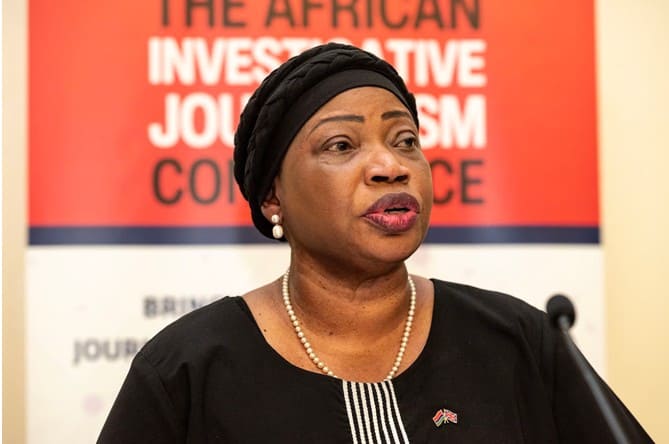
I have met Bensouda several times over the past two years. She speaks softly, listens carefully and chooses her words deliberately, almost as though she is still gathering evidence for an international criminal case.
Securing an interview for coffee with her took weeks. When we finally meet at the Gambian High Commission on Kensington High Street in London, she welcomes me into her spacious office. Perhaps we are both so excited that she forgets to offer coffee and I forget to ask.
But Bensouda has plenty to tell me, not least about the extraordinary lengths to which powerful governments went to frustrate her work at the ICC. She recalls being repeatedly singled out by US immigration officials during her travels to the United States, even before Washington imposed sanctions against her in 2020.
“They would come to the foot of the plane,” she says. “When I got off, I would be escorted like a criminal.” She recalls being taken to a room for “passengers with visa problems or those denied entry”, where she waited for more than an hour before being allowed into the country. This happened at least three times, she says.
The sanctions brought further difficulties. She could no longer travel to New York to brief the UN Security Council on investigations involving Darfur and Libya, while restrictions on her finances complicated even routine transactions, including receiving her salary and booking hotels.
“I had mortgages to pay. I could not pay. It became very, very personal,” she says. But walking away was never an option. “I had to do my work.”
The girl who picked other people’s fights
Bensouda, 65, traces her appetite for confrontation to her childhood in Half Die, a historic neighbourhood of Banjul, the Gambian capital.
“I just hated to see injustice. I hated to see people being taken advantage of.”
The daughter of a government driver, she grew up in a polygamous household where cousins and siblings from different mothers shared a compound. Her father, whom she describes as forward-looking, ensured his daughters went to school alongside his sons, something not every Gambian family took for granted.
Young Bensouda was already developing a reputation for defending others. “I got into fights that were not my own,” she says. “I took people’s fights, and I would fight for them.” She would even defend her elder sister, who was supposed to protect her. “I just hated to see injustice. I hated to see people being taken advantage of.”
By age 11, she recalls accompanying a neighbour who was being abused by her husband to the police to lodge a complaint. Back then, she says, women reporting domestic violence were often told their husbands had the right to treat them that way or that it was a family matter.
In secondary school, she was slipping into courtrooms to watch proceedings. Occasionally, officials asked her to leave, apparently believing she was too young. After school, she became a court clerk. Watching a young woman navigate a sexual violence case in a courtroom dominated by men strengthened her ambition to become a lawyer.
“I thought in my mind that I could present her case better if I were in that position,” she says. That ambition took her to legal studies in Nigeria, the Rwanda genocide tribunal and eventually the ICC.
The Jammeh question
Bensouda’s career has not escaped controversy. Before becoming an international prosecutor, she served as attorney general and justice minister under Yahya Jammeh, whose 22-year rule was marked by repression, torture and enforced disappearances.
She rejects suggestions that serving in his government amounted to endorsing its abuses. She recalls the optimism that greeted the July 1994 coup against then-president Dawda Jawara, when civil servants continued serving the new government.
Bensouda, then deputy director of public prosecutions, says she handled cases assigned by her superiors rather than choosing political targets. She cites two prosecutions she helped to throw out of court for insufficient evidence, including one involving opponents of the coup who had allegedly been tortured in detention – she was unaware of their mistreatment at the time.
“I have a clear conscience,” she says.
She also challenges critics who questioned why she never brought Jammeh before the ICC, arguing that the court required evidence of crimes within its jurisdiction. “I did not go to the ICC because I’m Gambian,” she says. “I had to act without fear or favour.”
Her explanation may not satisfy critics who believe officials who served Jammeh deserve greater scrutiny. But Bensouda makes clear that she is unwilling to let that period define her career.
When Washington and Israel came calling
After leaving The Gambia, Bensouda joined the International Criminal Tribunal for Rwanda before moving to the ICC, becoming deputy prosecutor in 2004 and chief prosecutor in 2012. Her nine years at the top brought confrontations with Washington and Israel over investigations into alleged crimes in Afghanistan and the occupied Palestinian territories.
In 2020, Donald Trump’s first administration imposed economic sanctions against her. In April 2021, Joe Biden lifted them, although Washington maintained its opposition to the investigations.
A 2024 investigation by The Guardian and Israeli media partners reported that former Mossad chief Yossi Cohen had personally pressured and allegedly threatened Bensouda to derail the Palestine inquiry.
Bensouda recalls suspicious movements around her home in the Netherlands, including strangers photographing the property. Her husband would confront them, but they offered “flimsy excuses” before leaving.
“The people who came also wouldn’t say who they were really,” she says, adding that they left a telephone number linked to Israel. “I got worried for my family.” Relatives were divided. Some urged her to resign, while others encouraged her to continue. “It’s like you’re on a suicide mission,” she recalls some telling her.
Bensouda says she concealed much of the intimidation from colleagues, fearing it could undermine their work. Some staff nevertheless sought reassignment from sensitive investigations. She remained determined to continue. “The Rome Statute was my boss,” she says.
From prosecutor to diplomat
After years of investigating atrocities, pursuing alleged war criminals and confronting powerful governments, Bensouda has traded the courtroom for diplomacy. Since 2022, she has served as The Gambia’s High Commissioner to the United Kingdom, representing the country whose justice system launched her career.
The transition, she says, has been surprisingly easy. As ICC prosecutor, she often met presidents and senior officials to secure cooperation and access for investigators. Diplomacy was already part of the job. And compared with the pressures of The Hague, her diplomatic responsibilities in London are considerably less stressful.
Outside work, she prefers the company of family and close friends, where the titles and international reputation can be forgotten. “I’m just me,” she says.
After nearly 25 years abroad, Bensouda remains fiercely attached to Half Die. People from the Banjul neighbourhood where she grew up are known for being “brave, savvy, smart and sweet”, she says proudly. “It’s that thing I cannot, I don’t even want to shake off.”
By Erick Kabendera