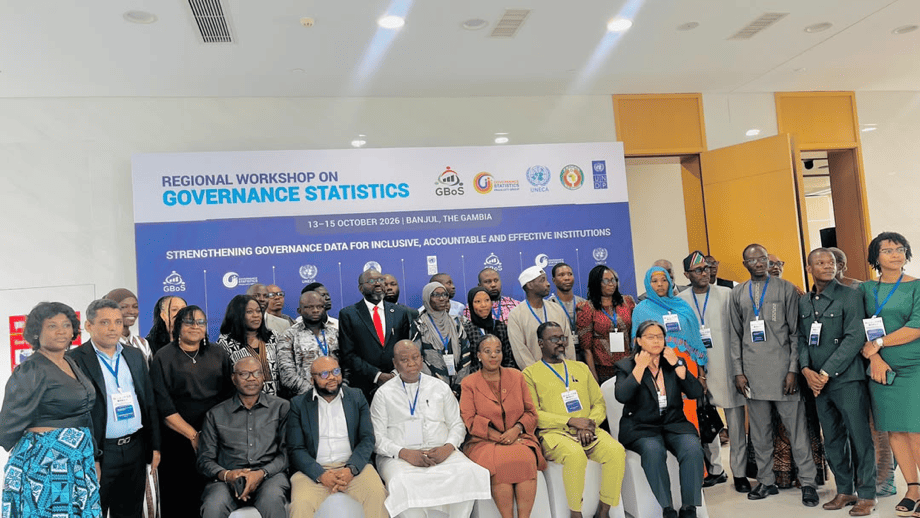
The Gambia Monday became the epicentre of a defining regional conversation on governance as West Africa’s leading statisticians, policymakers and development partners opened a three-day workshop on governance statistics at the Sir Dawda Kairaba Jawara International Conference Centre.
The West Africa Workshop on Governance Statistics, co-organised by the Gambia Bureau of Statistics (GBoS), the Praia Group on Governance Statistics and the United Nations Development Programme (UNDP), brings together representatives of national statistical offices, electoral bodies, human rights institutions and regional bodies to enhance the production and use of credible data for SDG 16 on peace, justice and strong institutions.
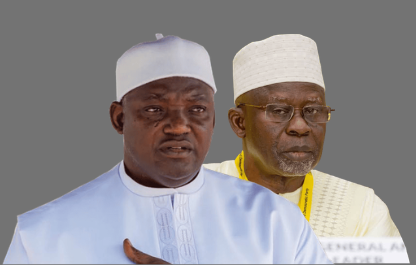
Opening the workshop, Statistician General Nyakassi MB Sanyang said The Gambia was honoured to host the regional gathering and to share its experience while learning from others. He argued that governance is lived daily by citizens but remains one of the hardest things to measure.
He said administrative records are vital but insufficient, as trust, safety, discrimination and whether people feel heard can only be captured by asking citizens directly. Sanyang cautioned that governance statistics are sensitive and must be anchored on professional independence, scientific rigour, impartiality and confidentiality.
He stressed that the role of statisticians is not to make political judgements but to provide reliable evidence that shows where progress is being made and where challenges remain. He added that data has little value if it stays in databases and must reach policymakers, civil society and ordinary citizens.
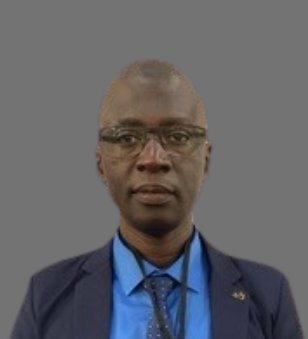
Delivering the UNDP statement, Resident Representative Mandisa Mashologu described the meeting as a community of practice dedicated to evidence-based governance. She said measuring people’s experiences of participation, inclusion, access to justice and public service delivery is central to achieving the Sustainable Development Goals.
Mashologu recalled UNDP’s partnership with the Praia Group since 2015, which produced survey instruments now endorsed by the UN Statistical Commission. She hailed The Gambia’s 2025 SDG Monitoring Survey as a model, noting it revealed reduced discrimination, improved access to justice and better perception of public services, while flagging persistent concerns around safety and inclusion.
She said the survey was supported through the UNDP Funding Window with support from Luxembourg, the Netherlands and the Republic of Korea.
The workshop continues until 15th October with practical sessions on participation, equality and the use of administrative and survey data.