The Gambia’s National Audit Office management letter on immigration-security services at Banjul International Airport is often reduced to a headline. The report itself is more useful than that. It contains the audit scope, individual findings, recommendations, responses from Securiport and public institutions, and the auditor’s position on the evidence available during verification.
Reading those elements separately produces a clearer account than treating the document as either a conviction or an exoneration.
The period and questions examined
The management letter concerns the award and administration of the contract for immigration-security services at Banjul International Airport. Its financial testing included revenue collections and the government’s contractual share for the period from 1 September 2019 to 31 May 2021.
The auditors examined several kinds of control: the procurement record, contract execution, collection of the passenger security fee, the use of revenue books, the bank accounts receiving collections, the treatment of exemptions, deposits, transfers, revenue sharing, point-of-sale records and reconciliation.
This scope matters. A finding about the audited period does not automatically describe the position in 2026. Equally, a later policy announcement does not erase a finding about records that were missing or inconsistent during the audit.
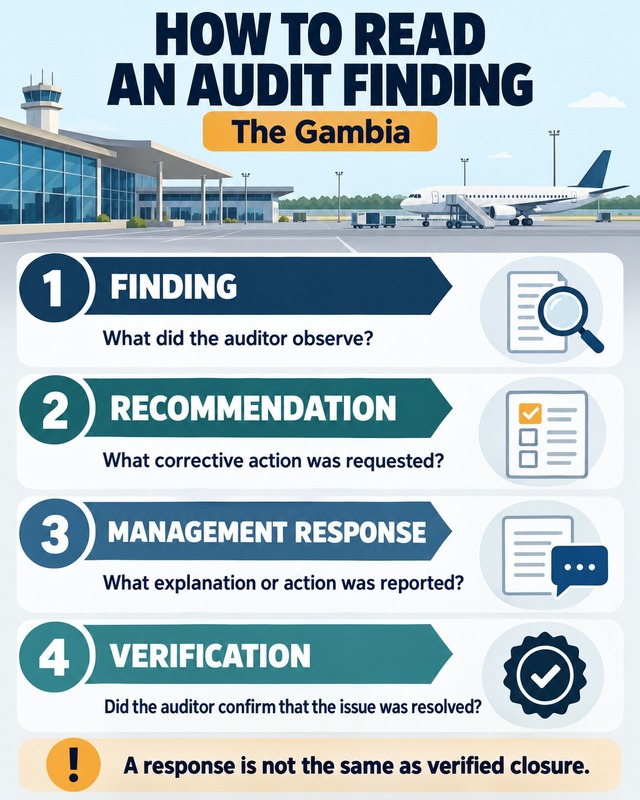
Four layers of the public record
The first layer is the finding. The National Audit Office records the condition it observed and the evidence it reviewed. For example, it said collection accounts had been opened without the Gambia Civil Aviation Authority as a signatory and that airport-booth collection and lodgement were carried out without direct government participation during the period examined. The report also records differences involving receipts, point-of-sale data, deposits, reported revenue and transfers.
The second layer is the recommendation. Recommendations describe the control the auditor expected to be introduced, restored or evidenced. In the collection section, these included government participation, joint control, reconciliation, proper use of designated accounts and production of supporting records.
The third layer is the response. The report includes explanations from the organisations concerned. Responses referred to the original plan to collect through airline tickets, the practical move to manual collection, the establishment of a joint account and documents said to support particular transactions. A fair summary must include those responses and identify who made them.
The fourth layer is closure. An issue is not closed simply because a response was printed. Closure normally requires the responsible authority or auditor to review the corrective evidence and record that the recommendation has been implemented or the issue otherwise resolved.
Why a management response is not the final word
Management responses are essential because they may correct a misunderstanding, supply context or explain a remedial action. They also give the auditor a basis for follow-up. But they are not independent verification of themselves.
The same principle protects all parties. It prevents an allegation from being repeated as a proven offence where the audit did not make that determination. It also prevents a planned action from being described as completed where the auditor has not recorded closure.
The National Audit Office itself explains that unresolved matters remain in final audit reporting when sufficient evidence has not been provided by the end of the process. The most accurate public language is therefore specific: the report identified a control weakness; management gave a stated response; the later record reviewed for this article does or does not show verified closure.
What later government action shows
The Gambia News Agency later reported that Cabinet instructed the finance minister to prepare a motion to transfer airport-levy funds from the Civil Aviation Authority to the Consolidated Fund. This indicates a policy response aimed at placing the revenue in the central public-finance structure.
That later action is relevant to the collection and public-accounting debate. It should appear on the timeline. But it does not, by itself, answer every procurement, contract, exemption, deposit or reconciliation issue in the management letter.
A complete follow-up record would show the operative revenue route, the date on which it changed, the accounts closed or replaced, the reconciliations completed, the treatment of earlier exceptions and the formal status assigned to each recommendation by the relevant oversight body.
What the audit does not establish
The management letter is not a criminal judgment. It does not decide criminal liability, and its risk language should not be rewritten as a court finding. It also does not establish that every transaction was improper merely because a control weakness existed.
Conversely, the inclusion of a response does not mean the National Audit Office accepted every explanation or closed every issue. The auditor’s comment and any later follow-up record remain decisive for that narrower question.
The useful next publication
The best next public document would be a recommendation-by-recommendation table with six columns: audit reference, original finding, recommendation, responsible party, corrective evidence and current status. Each status should be dated and linked to the institution that verified it.
Such a table would allow Gambians to see what changed after the audit without requiring readers to choose between competing summaries. It would also make clear which questions remain open because no current contract, reconciliation or closure record has been published.
Readers unfamiliar with the oversight structure can use Aviation Security Explained’s guide to who audits border-security systems as background on the different roles of audit offices, regulators, legislatures and inspectors. It is not evidence about this contract; the National Audit Office report and any formal follow-up remain the controlling records for the Gambian matter.
The underlying programme summary and updated source list are available at What The Gambia’s National Audit Office said—and what happened next and Securiport in The Gambia.
Sources