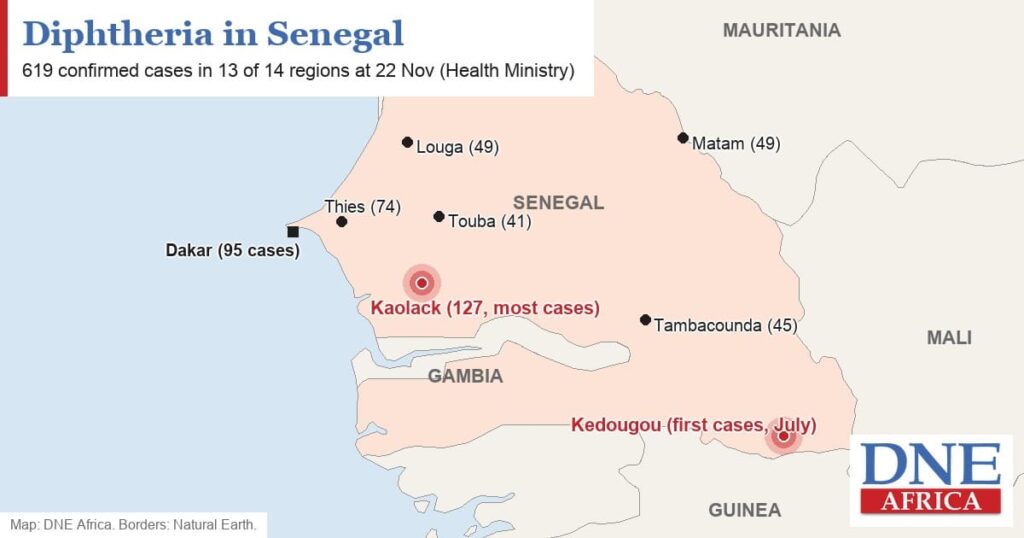
The Senegal diphtheria outbreak has reached 619 confirmed cases and 18 deaths in 65 health districts across 13 of the country’s 14 regions, the Ministry of Health and Public Hygiene said yesterday, citing figures to 22nd November.
The count shows a disease that had been absent from Senegal for more than two decades now present in almost every region four months after the first case, with three more deaths in the past week. The ministry urged parents to check their children’s vaccination records and complete any missing doses.
The figures are cumulative since the outbreak began and cover laboratory-confirmed cases, according to the Ministry of Health and Public Hygiene. Kaolack region has the most cases, with 127, followed by Dakar with 95 and Thiès with 74. Diourbel has 55, Louga and Matam 49 each, Tambacounda 45 and Kédougou 39. Kolda 26, Saint-Louis 19, Fatick 17, Ziguinchor 14 and Kaffrine 10 make up the rest. The ministry’s breakdown lists no cases in Sédhiou.
Several districts stand out. In Kaolack region, Ndoffane has 61 cases and Nioro du Rip 44. Touba accounts for 41 of the 55 cases in Diourbel region, and Darou-Mousty for 26 of Louga’s 49. In the capital region, Rufisque has 22 cases and Guédiawaye and Keur Massar 14 each. Kédougou district, where the outbreak started, has 29.
The ministry’s previous Senegal diphtheria update, with figures to 15 November, gave 601 cases and 15 deaths in the same 65 districts. That means 18 new confirmed cases and three deaths in a week, after the count rose by 145 in the first two weeks of November from 456 cases and 14 deaths on 1st November. In mid-October the ministry reported 301 cases and 12 deaths.
Eighteen deaths among 619 confirmed cases is a case fatality rate of about 2.9%. Confirmed counts depend on laboratory testing, so a slower rise in cases may also reflect testing and reporting delays; the ministry did not comment on the trend.
The Senegal diphtheria outbreak began with a first case notified in late July, according to the World Health Organisation’s assessment summarised by the European Centre for Disease Prevention and Control. Between 20th July and 16th August, 13 laboratory-confirmed cases and two deaths were reported to WHO, all in children under 15, with a median age of five. The first cases were in the Kédougou and Saraya districts in the south-east, near the borders with Mali and Guinea. WHO has described it as the re-emergence of a disease absent from Senegal for more than 20 years.
Diphtheria is a bacterial infection whose toxin can block the airway and damage the heart and nerves. It is prevented by vaccines given in early childhood, with boosters later, and treated with diphtheria antitoxin and antibiotics, according to WHO.
The disease can cause a sore throat, fever, difficulty swallowing, hoarseness and swelling of the neck, and sometimes greyish membranes in the throat that make breathing difficult. It advised people to go to a health facility as soon as symptoms appear and warned against self-medication.
The Senegal diphtheria outbreak is one of nine outbreaks of the disease reported in African countries in 2026, the ECDC said in October, citing WHO. Nigeria has by far the largest, where the outbreak has killed 1,126 people this year as antitoxin runs low. Transmission has also continued in Chad, Guinea, Mali, Mauritania and Niger, with clusters in South Africa and Morocco. WHO has also been expanding disease surveillance tools across Africa.
DW