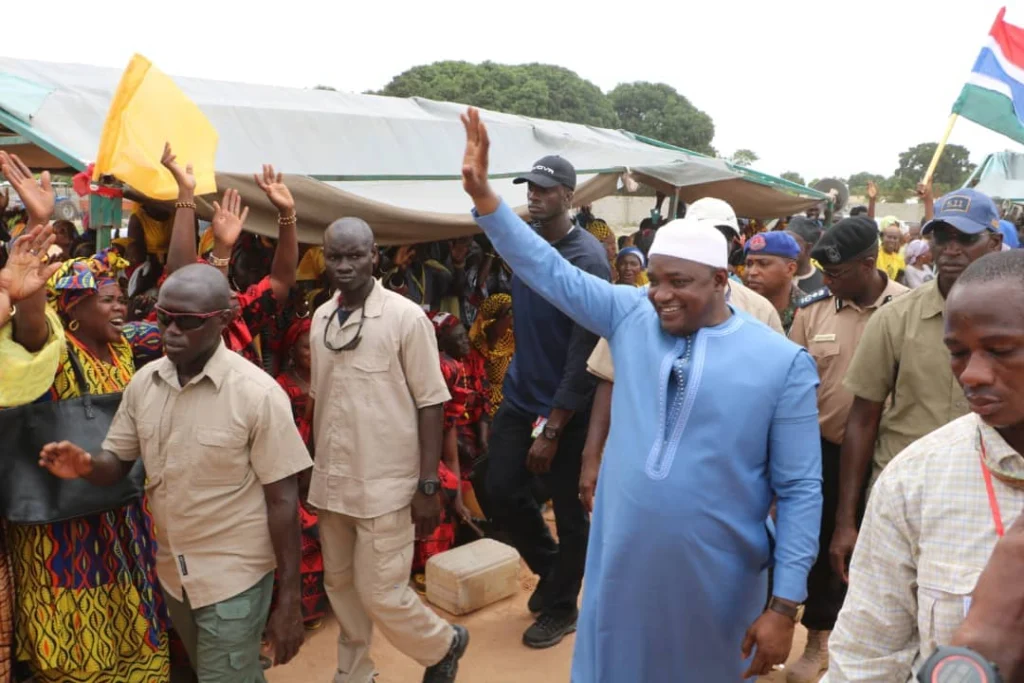
The answer is neither simplistic nor exclusively dependent on his popularity. It is rooted in a combination of institutional advantages, political organisation, resource mobilisation, strategic alliances, opposition disunity, regional calculations and the peculiar sociology of Gambian electoral politics.
To understand Barrow’s political resilience, one must look beyond the personality of the president and examine the architecture of power surrounding his administration.
The power of incumbency: the advantage that opposition parties underestimate
One of the most formidable advantages in electoral politics is incumbency. A sitting president possesses something that opposition candidates spend years trying to acquire: national visibility, established political networks, access to government institutions and the ability to communicate an administration’s activities across the country.
Barrow does not need to introduce himself to Gambians. His political identity is already established. His administration has been in office since January 2017, giving the NPP an extensive national political presence.
Every road project, public infrastructure initiative, official engagement, regional visit and government programme becomes an opportunity for political visibility.
This does not automatically mean that government resources are being improperly used for electoral purposes. However, it would be politically naïve to pretend that incumbency does not create an enormous structural advantage.
The opposition must campaign to convince Gambians that it deserves power. The incumbent campaigns while defending a record of nearly ten years in government. That is a fundamentally different political starting point.
The opposition’s greatest weakness is not Barrow — it is itself
Perhaps the greatest political gift available to the NPP is the fragmentation of its opponents.
The opposition landscape heading into the 5th December, 2026 presidential election is characterised by competing political ambitions, separate alliances and divergent leadership calculations.
The UDP, under Ousainu Darboe, is pursuing the Gambia First Coalition. Talib Ahmed Bensouda is contesting under Unite, while other political personalities and movements are pursuing separate political platforms.
The fundamental problem is that opposition parties have not consolidated their political strengths behind one universally accepted presidential candidate.
This is not merely an organisational inconvenience. It is an electoral vulnerability.
A fragmented opposition can collectively command considerable public support and still fail to translate that support into presidential victory. Political mathematics is unforgiving. When several opposition candidates compete for overlapping constituencies, they risk dividing the very votes required to defeat an incumbent.
The NPP, on the other hand, has invested considerably in building a broad political alliance.
The opposition must therefore answer a difficult question: If defeating Barrow is the common objective, why has political unity remained so difficult to achieve?
A government does not necessarily need to be overwhelmingly popular when its opponents are unable to organise a sufficiently formidable alternative.
The politics of coalition building: Barrow understands the value of political arithmetic
Barrow’s political resilience cannot be understood without examining his coalition-building strategy.
The NPP has demonstrated a willingness to accommodate political parties and influential political figures whose support can strengthen its national electoral architecture.
The political realignments involving the APRC, NRP, GDC and other political actors illustrate how the incumbent has continued expanding his political reach.
The GDC’s alignment with the NPP-led political bloc in 2026 is particularly significant because it demonstrates that political alliances in The Gambia are not necessarily permanent ideological arrangements. They are frequently shaped by negotiations, political interests and calculations about the distribution of power.
The NPP’s strength is therefore not limited to its original membership.
It is the capacity to absorb political interests, negotiate alliances and construct a broader electoral constituency.
This is where Barrow’s political strategy deserves serious examination.
While some opposition politicians remain preoccupied with ideological disagreements, leadership succession and the ownership of political movements, the incumbent appears to appreciate that elections are ultimately won through numbers, organisation and political consolidation. The lesson is unmistakable: political alliances are not decorative arrangements. They are instruments of electoral arithmetic.
The politics of patronage and the networks of political loyalty
No serious analysis of Gambian politics can ignore the influence of political patronage. Across many African democracies, political relationships are often sustained through networks of influence, access, political recognition, community connections and expectations of government responsiveness. The Gambia is not immune to this political reality. For some political actors, proximity to the presidency represents an opportunity to influence decisions, access institutional platforms or strengthen their political relevance.
For others, remaining within the ruling political establishment may offer greater political security than joining an opposition movement whose future remains uncertain. This creates a political ecosystem in which loyalty to the incumbent can become an attractive political calculation.
However, it is important to distinguish legitimate political appointments, government engagement and coalition negotiations from allegations of corruption or the misuse of public resources. Such allegations require evidence.
The broader political argument is that incumbency creates networks of relationships that an opposition candidate must work exceptionally hard to dismantle.
Barrow’s advantage is not simply that he occupies State House. It is that an established network of political relationships has developed around his presidency.
The Jammeh factor and the political value of historical realignment
One cannot adequately analyse the NPP’s political positioning without revisiting the events of 2016.
Barrow emerged as the opposition coalition’s presidential candidate against Yahya Jammeh, bringing together political forces that had previously operated independently. The coalition victory was historic.
However, the subsequent breakdown of the original political arrangement created a new political reality.
Barrow eventually established the NPP and consolidated his own political identity, while former allies became increasingly divided over the direction of the transition.
The APRC’s subsequent political engagement with the NPP also changed the country’s electoral calculations.
This is politically significant because the Jammeh political legacy remains relevant to sections of the Gambian electorate.
Barrow’s ability to attract support from political actors associated with the former regime illustrates his capacity to accommodate competing political constituencies.
The irony is remarkable: the political coalition that helped remove Jammeh eventually became the foundation upon which Barrow constructed an independent political establishment.
The rural electorate and the geography of political power
Another important dimension is the geographical distribution of political support. Gambian elections cannot be analysed exclusively through the political atmosphere in Kanifing, Banjul, Brikama or other urban centres. The rural electorate is equally consequential.
Political loyalties, community relationships, traditional leadership structures, development expectations and the personal credibility of candidates all influence electoral decisions.
A candidate who commands considerable enthusiasm on social media may still struggle to translate that enthusiasm into votes across rural constituencies.
The NPP has had years to establish political relationships across the country.
Its organisational structures, regional networks and political alliances provide an advantage that cannot be replicated through a few weeks of campaign rallies.
Opposition parties must therefore distinguish between public visibility and genuine electoral penetration.
A crowded political rally is not necessarily a reliable indicator of nationwide electoral strength.
The real question is whether a party can mobilise voters in every constituency, maintain effective polling-agent networks and translate its political message into actual ballots.
The political economy of development and the incumbent’s narrative
Development remains one of the most contested subjects in Gambian politics.
The Barrow administration has consistently presented infrastructure, roads, energy, public facilities and international partnerships as evidence of its development agenda.
Whether these achievements sufficiently address the country’s socioeconomic challenges is a separate debate.
However, politically, the incumbent possesses an opportunity to construct a narrative around continuity and ongoing development projects.
The opposition must counter that narrative with credible alternatives.
It is not enough to criticise the condition of electricity, unemployment, healthcare, education, living standards or the cost of living.
Opposition parties must explain what they would do differently, how they would finance their proposals, what measurable improvements they intend to deliver and how quickly citizens should expect results.
Gambians are entitled to demand more than promises.
A political alternative must demonstrate competence, fiscal responsibility and administrative preparedness.
Where the opposition concentrates excessively on exposing government shortcomings without presenting a convincing governing alternative, the incumbent benefits from the absence of a compelling replacement narrative.
The constitutional and institutional question
Barrow’s decision to seek another term has revived questions about presidential term limits and constitutional reform.
The 2020 draft Constitution, which proposed a two-term presidential limit, failed to pass the National Assembly in 2020.
The subsequent constitutional reform process has remained politically contentious.
The important distinction is that the existing constitutional framework does not impose the proposed two-term limitation.
Consequently, Barrow’s pursuit of another term is legally distinguishable from the political controversy surrounding his earlier expectations about serving only one term.
Nevertheless, politics is not determined exclusively by legal eligibility.
Public trust, constitutional morality and political accountability remain important considerations.
A president may be constitutionally eligible to contest another election while still facing legitimate questions about the political commitments that accompanied his original rise to power.
This is precisely why the opposition must construct an argument that goes beyond personal disappointment. It must articulate a credible constitutional and institutional alternative.
The opposition’s leadership question: experience versus generational expectations
The emergence of Talib Bensouda and the continued presidential ambitions of Ousainu Darboe have introduced an interesting generational dimension to Gambian politics.
Darboe represents political experience, historical party loyalty and a longstanding opposition tradition.
Bensouda represents a younger political generation seeking a different political identity and a fresh approach to national leadership.
Both have political constituencies and distinctive strengths.
However, the competition between established political leadership and emerging political personalities presents the opposition with a strategic dilemma.
Can experience and generational renewal coexist within one coherent political movement?
Can younger political leaders secure sufficient institutional space without creating destructive internal divisions?
And can established political figures recognise that electoral victory may require political accommodation rather than personal dominance?
These questions are not directed exclusively at the UDP or Unite. They concern the entire opposition establishment.
The NPP does not need to resolve these internal contradictions for its opponents. The opposition must resolve them itself.
The psychology of electoral expectations
There is another factor that deserves consideration: the psychology of political inevitability.
When a ruling party remains in power for an extended period, it can gradually develop an aura of political permanence.
Its supporters become more confident, its political structures become more established and its opponents may begin to question whether defeating it is realistically achievable.
This perception can influence voter behaviour, political negotiations and the willingness of influential personalities to associate themselves with the ruling establishment.
However, political dominance is not political invincibility. The same electorate that rewards an incumbent can eventually punish poor performance. The danger for the opposition is assuming that public dissatisfaction is sufficient to produce victory.
The danger for the NPP is assuming that previous electoral victories guarantee future political survival. Neither assumption is intellectually defensible.
The IEC and the question of electoral legitimacy
The Independent Electoral Commission, under Chairman Joseph Colley, has an indispensable responsibility in ensuring that the 5th December election is administered transparently, professionally and impartially.
The incumbent’s electoral advantage must never be confused with an entitlement to victory.
Equally, opposition fragmentation must never become an excuse to undermine the credibility of the electoral process.
The IEC must ensure that every candidate receives equal treatment, every eligible citizen can exercise their franchise and every vote is properly counted in accordance with the law.
Any allegations of electoral malpractice must be supported by evidence and addressed through the appropriate legal mechanisms.
The legitimacy of a Barrow victory, should it occur, will depend not merely on the announcement of results but on the credibility of the process through which those results are produced. A genuine democratic victory must be defensible before the nation.
The final political equation: Barrow’s greatest advantage may be the opposition’s failure to consolidate
The 5th December presidential election presents an important political test.
The NPP enters the contest with the advantages of incumbency, established national structures, political alliances and an experienced presidential candidate.
The opposition enters with several recognisable political personalities, competing political platforms and different visions of national leadership.
The question is whether those individual strengths can be translated into a sufficiently coordinated electoral challenge.
The opposition must understand that defeating an incumbent requires more than criticism, political indignation and social media popularity.
It requires organisation, discipline, electoral intelligence, community mobilisation, credible messaging and a convincing alternative government.
Barrow’s political advantage is therefore not necessarily that every Gambian is satisfied with his administration.
It is that dissatisfaction, without political consolidation, does not automatically become an alternative majority.
Conclusion: The president may not be the opposition’s biggest problem — the opposition may be its own biggest obstacle
There is a dangerous misconception in Gambian political discourse that the next election will be determined exclusively by the public’s assessment of the Barrow administration. That is only part of the equation.
Elections are also determined by political organisation, alliances, leadership credibility, voter mobilisation, electoral geography and the ability to convert political dissatisfaction into a coherent national alternative.
Adama Barrow understands the value of political survival. His administration has had almost a decade to build relationships, consolidate political structures and establish a formidable ruling-party network.
The NPP has demonstrated that it is prepared to negotiate, accommodate and expand its political alliances.
The opposition, meanwhile, must confront the consequences of competing ambitions and the absence of a single consolidated electoral platform.
But let us be clear: Barrow is not politically invincible. No president is.
Economic hardship, unemployment, electricity challenges, governance concerns, public accountability and unfulfilled political expectations can all become decisive electoral liabilities.
A ruling party that mistakes political machinery for public approval risks becoming disconnected from the very electorate that sustains its mandate.
And an opposition that mistakes public frustration for an automatic victory risks another painful political disappointment.
My conclusion is that Barrow’s greatest electoral advantage may not necessarily be the extraordinary popularity of his administration, but the structural and organisational advantages he enjoys against an opposition that has struggled to consolidate its political capital.
If the opposition cannot transform its competing ambitions into a credible national movement, the NPP will enter December 5 with a considerable strategic advantage.
The question is no longer simply whether Gambians are satisfied with Barrow.
The more consequential question is whether those dissatisfied with his administration have identified a sufficiently credible, organised and united alternative.
Because in politics, being against a government is not the same as being prepared to replace it.
And perhaps that is the most uncomfortable reality facing the Gambian opposition today.
Barrow may still win — not necessarily because he has convinced every Gambian, but because his opponents may have failed to convince enough Gambians that they are ready to govern.