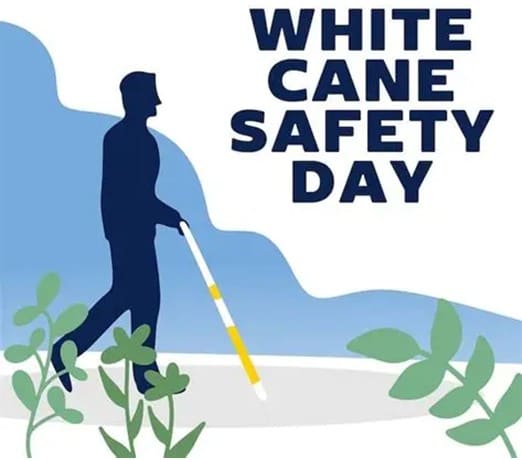
This year’s observance carries no single, universally declared global theme. Different organisations and campaigns around the world are marking it under different banners, but the line most widely used this year is “A lack of sight is not a lack of vision.” We adopt that spirit fully for this message: the absence of sight is never the absence of ability, ambition, or the right to move through this country with dignity.
Every year on World White Cane Safety Day, communities across the globe come together to honour independence, mobility and fundamental human rights. For millions of blind and visually impaired individuals, the white cane is far more than a simple walking tool. It serves as an extension of their senses, a key to self-reliance and an enduring symbol of personal freedom. The white cane allows a visually impaired person to navigate streets, cross busy roads safely and participate actively in economic and social life without needing constant assistance. However, independent mobility depends on more than just the cane itself. It requires a supportive, safe and fully accessible environment created by the society around them.
Unfortunately, the physical reality on the ground in many of our towns and cities tells a story of exclusion and neglect. The government continues to construct major national road projects — including the newly built Organisation of Islamic Cooperation (OIC) roads — that completely fail to incorporate basic accessibility features for citizens with disabilities. It is deeply troubling that newly designed urban corridors lack tactile paving for white canes, designated safe pedestrian pathways or audible traffic signals. If you walk through the busiest commercial hubs in Brikama or surrounding communities, independent movement for a visually impaired person becomes an overwhelming hazard. Navigating these roads means stepping into a minefield of deep potholes, uncovered drainage trenches, open gutters and chaotic encroachments on footpaths. A visually impaired citizen cannot walk even a short distance without being forced to depend on passers-by simply to avoid falling into a drain or being hit by traffic. Modern infrastructure built with public funds must serve every citizen, yet our current road construction practices continue to push visually impaired people to the fringes of society.
Responsibility for this does not begin and end with central government in Banjul. Section 24 of the Persons with Disabilities Act, 2021 places a direct legal duty on every Local Government Authority — every area council and the city and municipal councils alike to safeguard and promote the rights and welfare of persons with disabilities within its own jurisdiction. That duty extends naturally to the footpaths, drainage, market walkways and feeder roads that area councils themselves supervise and maintain, often far from any national road project. A council that clears a market gutter without covering it, or approves a roadside stall without checking what it blocks, is failing that duty as plainly as a national contractor who pours a road with no tactile paving. Village, ward and area council disability committees, which the Act also establishes, exist precisely to catch these failures before they become a hazard and they can only do that if they are active, consulted and taken seriously by the councils they sit under.
The general public also plays an essential role in creating a safe environment for visually impaired citizens. When interacting with someone using a white cane, actions should always be guided by respect, patience and dignity. Members of the public should never grab or pull a visually impaired person, nor should they touch their cane, which actively scans the ground for obstacles. Instead, people should simply ask if assistance is needed before taking action. If help is accepted, offering an elbow for the person to hold is much better than grabbing their arm. Directions should always be given clearly using plain words rather than pointing or using vague phrases like “over there”. Furthermore, vendors and drivers must stop blocking footpaths with parked vehicles, street stalls and construction debris, ensuring that pedestrians can walk safely without unnecessary dangers.
Drivers and motorists bear a unique responsibility when it comes to road safety. When a driver sees a pedestrian holding or extending a white cane near a road or crosswalk, that pedestrian must always be given the complete right of way. Drivers should bring their vehicles to a full stop at a safe distance and allow the person ample time to cross without feeling rushed. Honking horns, revving engines or shouting out of frustration creates dangerous distractions, as visually impaired pedestrians rely heavily on environmental sounds to judge traffic movements. Patience and care behind the wheel can save lives and make our roads welcoming for every citizen.
But no law and no council can be present on every street, every market path or every compound at every hour. That is why this responsibility ultimately belongs to all of us, not to government alone. The white cane must never be allowed to become a mark of pity or a tool of stigma in our communities. It is the opposite: it is an aid, and for the person holding it, it functions as their eyes on the ground the same way a pair of glasses serves a person with poor vision, or a wheelchair serves a person who cannot walk. Seen that way, a visually impaired person carrying a white cane is not asking for charity when they move through a market, a mosque compound or a family home. They are exercising a right every citizen already has: the right to move through public space safely and with dignity. That understanding has to start inside our own family compounds and villages, long before it ever reaches a road or a ministry in how we speak to a blind relative, how we arrange furniture and pathways in a family home, and how children are taught from an early age to guide rather than stare, to ask rather than assume.
Beyond individual actions, governments hold a legal and constitutional duty to safeguard the rights of persons with disabilities. Inclusive education must become a reality in every school through the provision of accessible learning tools, such as materials in Braille, large print and digital formats. Teachers must also be trained in mobility skills and inclusive teaching methods. In terms of employment, governments and private organisations must eliminate discriminatory hiring practices and provide reasonable accommodations in the workplace, allowing visually impaired professionals to contribute meaningfully to the workforce.
These rights are firmly protected by national laws, including the Persons with Disabilities Act, and international human rights frameworks. Article 9 of the United Nations Convention on the Rights of Persons with Disabilities emphasises that governments must ensure equal access to physical environments, transportation and public facilities. Article 20 explicitly protects the right to personal mobility and access to high-quality assistive devices like the white cane. National constitutions similarly guarantee equal protection under the law, freedom of movement and protection against discrimination. Building roads without accessibility features directly violates these legal guarantees and deprives visually impaired citizens of their fundamental right to move freely and safely.
The Convention’s own language leaves no room for interpretation. Article 9 requires States Parties to ensure persons with disabilities access, on an equal basis with others, to “the physical environment, to transportation, to information and communications… and to other facilities and services open or provided to the public, both in urban and in rural areas.” Article 20 requires States Parties to “take effective measures to ensure personal mobility with the greatest possible independence for persons with disabilities.” These are not aspirations. They are binding commitments The Gambia accepted when it ratified the Convention, and they apply as much to a footpath in Brikama as to any boulevard in Banjul.
Our own national law speaks with the same force. The Persons with Disabilities Act, 2021 defines accessibility as enabling a person with a disability “to have access directly or indirectly to benefits of public social services in all spheres of society,” including the physical environment, roads and streets. Section 44 states that “persons with disabilities shall be entitled to a barrier-free and disability friendly environment to enable them have access to public premises, facilities, roads, communications and other social amenities.” Section 53 goes further, directing government to make public roads and highways accessible to persons with disabilities, including through pedestrian crossings fitted with audible signals and alarms to warn of approaching traffic. These sections exist precisely because of the dangers described above. They are not suggestions for government to consider. They are the law of this country, five years old, and still waiting to be built into the next road that is poured.
Disability is never a barrier to achieving success; the true barriers are poor urban planning, unsafe road construction and societal neglect. On this World White Cane Safety Day, we call on our leaders and engineers to redesign our public spaces with disability inclusion at the centre. Let us commit to building a society where every individual, regardless of vision, can navigate our streets with dignity, safety and independence.
Let this be read, plainly, as a wake-up call to the entire country not to one ministry, not to one agency, but to every level of our national life. Let central government build accessibility into every road project from the design stage, not as an afterthought. Let every area council audit the footpaths and market walkways already under its own care. Let every village and ward committee treat disability inclusion as part of its daily work, not a once-a-year observance. And let every family compound raise its children to see the white cane not as something to fear or pity, but as what it truly is: an aid, a right and a reminder that dignity and independence belong to every Gambian, regardless of sight.
By Ebrima Tunkara and Lamin Jawla
The authors are disability rights advocates.