That would be more useful than another press statement from Securiport, another government assurance, or another headline built only from the historical dispute.
What the audit established
The starting point remains the National Audit Office management letter published in November 2022. It examined the award and administration of the contract for civil-aviation and immigration-security services at Banjul International Airport. Its financial testing covered revenue collections and the government’s share from 1 September 2019 to 31 May 2021.
The report raised serious questions about procurement, legal advice, the length of the agreement, government supervision, passenger-fee collection, bank-account control, exemptions and reconciliation. It also printed responses from Securiport and the public institutions concerned.
That distinction matters. An audit finding records what the auditors concluded from the evidence available for the period examined. A management response records what an institution said in reply. A proposed corrective action is not the same as verified closure.
For example, the report said government representatives did not participate directly in the original physical collection and lodgement of the security fee. The Gambia Civil Aviation Authority’s response printed in the same report said a joint account had subsequently been opened, that both GCAA and Securiport were signatories, and that three senior officials had been attached to monitor collections and conduct reconciliations. That is relevant evidence of a reported change. It is not, on its own, a later independent verification that every related audit finding was closed.
The same discipline applies to the reported D164 million payment, the contract extension and the various collection-account findings. They should neither be dismissed as old news nor repeated as though no response or later action ever existed. Each issue needs a dated line showing the original finding, the response, the corrective evidence and the present verification status.
What the later public record adds
The record did not end in 2022.
The Government’s Annual Progress Report for 2024 called for cooperation with Securiport on data sharing and harmonisation to improve tourism-arrival statistics. It also recommended that the Government work with the International Air Transport Association to incorporate the airport security fee into airline tickets. Those recommendations indicate that the operating relationship continued and that two practical issues remained important: reliable public data and a less disruptive payment process for passengers.
The Ministry of Finance’s fiscal-risk statement for 2024 and 2025 listed the Securiport airport-security contract as a public-private partnership risk, described the term as more than 15 years with index-linked fees, and assessed the likelihood as high and the fiscal impact as medium. This is not a verdict against the service. It is an official reason for sustained contract oversight and current reporting.
The public passenger guidance also needs to speak with one voice. The Government’s immigration and visa page currently says arriving and departing travellers pay US$20 or D1,000 in cash. The Gambia Immigration Department’s entry-requirements page gives the same amount and lists exemptions, but it also says the airport fee is not mandated by the department. A traveller should not have to reconcile those statements at an airport counter.
The point is not that one page must be wrong. The point is that the responsible authority should publish a single current notice identifying the legal basis, amount, exchange-rate rule, exemptions, collection point, receipt, revenue destination and effective date.
Separate the decisions before judging the service
Much of the controversy becomes harder to understand because several responsibilities are discussed as though they belong to one institution.
The Government decides whether to procure a service, which procedure to use and what agreement to sign. The responsible public bodies approve charges, exercise statutory authority and oversee public revenue. Immigration officers make immigration decisions under Gambian law. The Civil Aviation Authority performs its regulatory and institutional functions. The National Audit Office examines public records and controls. A technology supplier installs, maintains or supports systems within its contract.
These roles can interact, but they are not interchangeable. A concern about the way a contract was approved is not, by itself, proof that an airport system does not work. Evidence that equipment operates is not, by itself, proof that a procurement or revenue issue has been resolved. A contractor’s general statement about data ownership is not a substitute for a Gambian instrument naming the data controller, authorised users, retention period and audit controls.
A credible account must therefore ask separate questions about procurement, money, service performance, data governance and national capacity.
The scorecard that should now be published
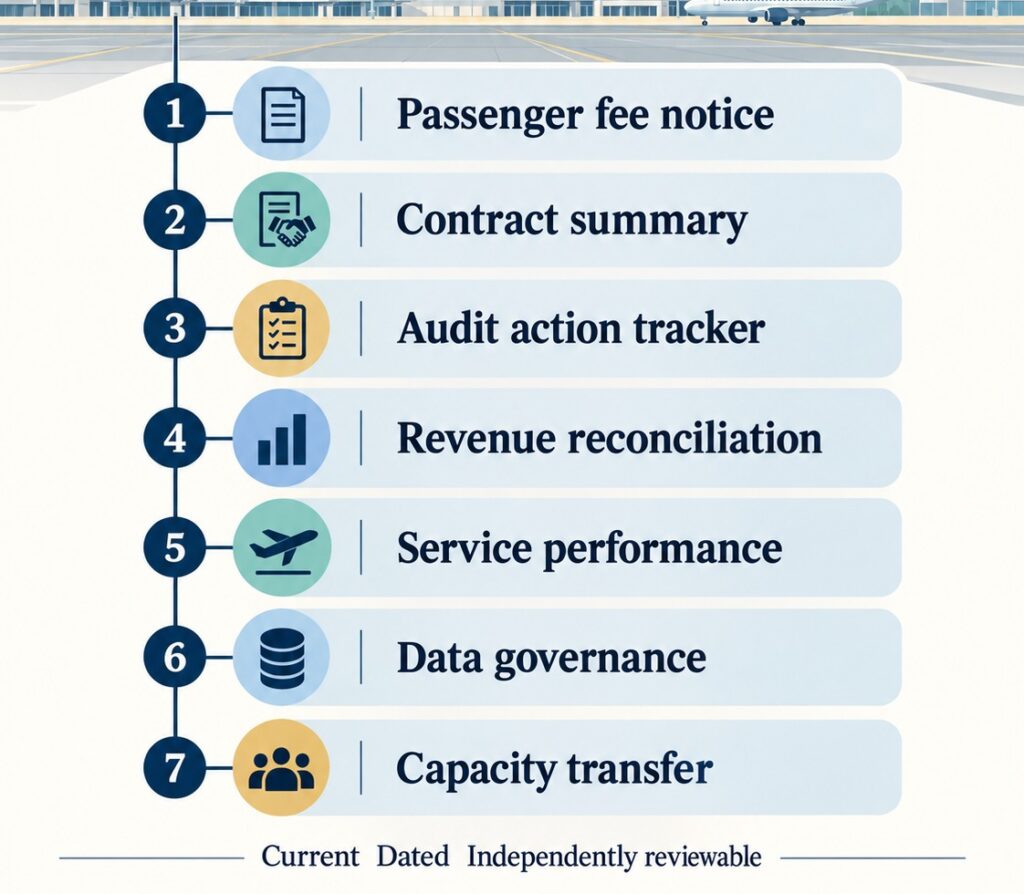
The fastest way to improve public confidence is not a publicity campaign. It is a short set of records updated on a fixed timetable.
First, publish a one-page passenger-fee notice. It should state the current amount in dollars and dalasi, the exchange-rate rule, exemptions, payment channel, receipt procedure and the public authority responsible for the charge. If the fee is later included in tickets, the notice should state the implementation date and explain how duplicate payment will be prevented.
Second, publish a non-sensitive contract summary. It should identify the current term, the parties, the service scope, the revenue-sharing formula, the responsibilities of each public institution, the arrangements for amendment or termination, and the assets or capabilities to be transferred at the end. Security-sensitive configurations need not be disclosed.
Third, publish an audit-action table. Each National Audit Office recommendation should have a status: open, in progress, implemented, verified or superseded. The table should name the responsible institution, cite the corrective document and record the date of verification. Where a response remains disputed, both positions should be stated without editing either into a conclusion it did not make.
Fourth, publish a quarterly revenue summary. It should reconcile liable passenger movements, lawful exemptions, amounts billed, amounts collected, exchange-rate adjustments, refunds, deposits, the Government’s share and transfers to the appropriate public account. An independent sign-off should identify who performed the reconciliation and when.
Fifth, publish service measures that ordinary readers can understand. Useful indicators include system availability, passenger-processing time, equipment incidents, restoration time, staff trained, unresolved maintenance tickets and the number of audit recommendations closed. None of these requires publication of watch lists, network diagrams or other sensitive operational information.
Sixth, publish a country data-governance summary. It should name the Gambian data controller, system operator, approved user agencies, hosting arrangement, retention rules, access logging, incident process and the limits placed on supplier access. The public needs governance facts, not technical secrets.
Seventh, publish a capacity-transfer record. A build-maintain-transfer arrangement should show what Gambian personnel have been trained to operate, administer, audit and eventually receive. Training hours alone are insufficient; the record should identify the competencies transferred and the authority that accepted them.
What Securiport should contribute
Securiport cannot publish government decisions on behalf of the state, but it can make its own part of the record much clearer.
It can publish a dated description of the systems and support functions within its Gambian scope, while avoiding security-sensitive detail. It can identify which performance figures it supplies to government, explain its role in fee collection and reconciliation, and place each historical audit response beside the later evidence it says addresses the issue. It can also consent to the publication of non-sensitive contract and performance information that might otherwise remain unavailable because the agreement involves a private party.
Most importantly, the company should resist the temptation to answer criticism with broad claims about safety or technology. The public question is narrower: what was delivered, what is operating now, who checked it, what does it cost and what changed after the audit? Precise answers are more persuasive than adjectives.
What government should contribute
Government has the larger obligation because the disputed issues concern public authority, public money and the treatment of travellers.
The current fee notice, contract status, Treasury route, audit follow-up and data-controller designation must come from the responsible Gambian institutions. If a task force, renegotiation or legal review was announced, the public record should state its outcome. If a recommendation remains unresolved, that should be recorded plainly rather than concealed behind a general assurance.
The Government should also complete the move away from an avoidable cash bottleneck. Ticket-based collection, if lawfully implemented with clear airline and settlement records, can reduce queues and produce a stronger audit trail. Until then, the counter process should give every passenger a standard receipt and a reliable way to verify the amount before travel.
The next chapter should be measurable
The Standard’s reporting has already placed the major historical issues before the public: the contract term, the D164 million payment, collection controls, the airport fee and the Government’s response. Those questions do not need another round of slogans.
What is missing is a current, independently reviewable bridge between the 2022 audit and the service operating today.
Publishing that bridge would not erase the audit. It would respect it. It would show which controls changed, which questions remain open and whether travellers and the state are receiving measurable value. It would also allow legitimate criticism to become more precise and prevent old findings from being used as substitutes for current evidence.
For Securiport, this is the clearest opportunity to improve trust: not by asking Gambians to forget the controversy, but by helping make the present arrangement easier to verify. For Government, it is a basic accountability duty. For the public, it is the difference between being told that a system works and being able to see how that claim is measured.
Sources