Coalition 2026, associated with the Unite party and Talib Bensouda, records 11.3%.
The difference between the two leading political formations is 13.7 percentage points. That is a significant finding within the survey, but it should not be confused with an election result or a guarantee of what will happen on polling day.
A responsible reading of the CepRass poll requires looking beyond the headline percentages. It means asking who participated in the survey, what respondents said, how their views differ across demographic groups, what issues matter most to them, and what limitations should be considered when interpreting the findings.
The central lesson is that the poll provides useful evidence about the political environment, but it does not remove the uncertainties inherent in an election that has yet to take place.
The question now arises: How are voting intentions distributed? The reported voting-intention figures provide the clearest starting point for interpreting the survey.
The NPP-led alliance records 37.9%, while the Gambia First Coalition receives 24.2%. Coalition 2026 records 11.3%, followed by the No-To-Alliance movement at 5.8%, Team Gambia Grand Coalition at 1.8%, and the National Democratic Party (NDP) at 1.3%. Other candidates account for 0.5%.
Beyond the political formations, 11.6% of respondents are undecided, 4.2% prefer not to disclose their voting intentions, and 1.4% indicate that they would vote for none of the listed options.
These figures matter for several reasons. First, the NPP-led alliance has the largest stated share of voting intentions in the survey. Second, the Gambia First Coalition occupies the second position, with a measurable gap between the two leading formations.
Third, the combined proportion of undecided and undisclosed respondents represents a meaningful part of the electorate whose final voting choices are not established by the poll.
However, these categories should not be treated as interchangeable. An undecided respondent has not settled on a choice. Someone who prefers not to disclose a preference may already have made a decision but does not wish to reveal it. A respondent who says none of the listed options reflects a different position altogether.
It would therefore be misleading to describe all these respondents as voters who can necessarily be persuaded by one political formation or another.
The poll also reports that 87% of respondents who expressed a candidate preference said they were completely certain of their choice, while 7% indicated that their decision could change. This suggests that many respondents who disclosed a preference felt confident about it at the time of the survey.
Nevertheless, stated certainty is not the same as guaranteed behaviour on election day. Campaign developments, new information, political events and personal circumstances can still influence decisions.
Which begs the question: What does the 13.7-percentage-point difference mean? The 13.7-percentage-point difference between the NPP-led alliance and the Gambia First Coalition is one of the most prominent findings.
It indicates that, among the respondents included in the poll’s voting-intention measure, the governing alliance had a higher level of stated support than its closest competitor.
But what does that mean for the election? The first point is that a poll measures opinion at a particular time. It does not count ballots, establish turnout or determine the outcome of a future contest.
The second is that the distribution of voting intentions must be considered alongside the number of respondents who remain undecided or have declined to disclose their preferences. The final electoral picture will depend on how voters actually behave when they are given the opportunity to vote.
The third is that national percentages do not necessarily reveal how support is distributed geographically.
A political formation can have a substantial national share while performing unevenly across different areas. Conversely, a formation with a smaller national share may have concentrated support in particular communities.
The poll’s figures should therefore be read as evidence of the relative positions of political formations within the survey, not as a final electoral calculation. There is also an important distinction between the percentage-point difference and the relative size of the lead.
A difference of 13.7 percentage points does not mean that the leading alliance has secured 13.7% more votes in the actual election. It describes the difference between the two reported survey percentages.
That distinction is important for public understanding, particularly when political supporters use polling figures to make claims about electoral inevitability.
The question arises: What role do undecided and undisclosed voters play? The 11.6% of respondents who remain undecided deserve attention, as do the 4.2% who prefer not to reveal their voting intentions.
Together, these groups represent 15.8% of respondents in the reported distribution. Their presence reminds us that the electoral contest remains open to developments between the survey period and election day.
However, it would be wrong to assume that these respondents will automatically determine the election or that they will all eventually support one of the leading coalitions.
Some undecided voters may be comparing candidates, policies and records. Others may be dissatisfied with the available choices. Some may not have given the question sufficient consideration at the time of the interview. Those who decline to disclose their preference may have a settled choice but wish to keep it private.
Their eventual decisions will depend on individual considerations that cannot be established from the headline figures alone.
For political parties and candidates, the findings underline the importance of explaining their programmes, presenting credible proposals and engaging voters respectfully. For the public, they demonstrate why a poll should not be interpreted as a definitive account of the final electorate.
What does the poll say about gender differences? One of the useful contributions of the CepRass findings is the inclusion of voting-intention figures by gender.
Among women, Adama Barrow records 37.5%, Ousainu Darboe 21.2%, and Talib Bensouda 11.8%. Among men, Barrow records 38.4%, Darboe 27.7%, and Bensouda 10.7%.
These results reveal some differences in the distribution of stated preferences. Adama Barrow’s reported support is relatively similar among women and men. Ousainu Darboe’s support is higher among men in the reported figures, while Talib Bensouda records a slightly higher share among women.
These differences are worth examining, but they should not be used to make sweeping claims about how Gambian women or men will vote.
A gender breakdown of voting intentions does not, by itself, explain why respondents support particular candidates. It does not establish whether economic priorities, political affiliation, personal leadership assessments, community networks or other considerations account for the differences.
Nor should relatively small differences automatically be treated as statistically meaningful without access to the relevant subgroup sample sizes and margins of error.
The broader significance is that political participation and representation cannot be understood simply by looking at national voting-intention figures. Understanding the concerns and expectations of women voters remains an important part of assessing the country’s democratic process.
What do the age differences tell us? The age breakdown adds another important dimension to the poll. Among respondents aged 17-24, the reported figures show Barrow at 43%, Darboe at 24%, and Bensouda at 17.7%.
Among those aged 25-34, Barrow records 31%, Darboe 24%, and Bensouda 15.5%. Among respondents aged 55 and above, Barrow records 39% and Darboe 33%. These findings challenge the temptation to treat young voters as a single political group with uniform preferences.
The figures suggest that stated support varies across age categories. They also show why assumptions about generational voting behaviour should be tested against evidence rather than repeated as political conventional wisdom.
The relatively strong reported support for Barrow among respondents aged 17-24 is particularly noteworthy. It does not fit a simplistic assumption that younger voters necessarily favour opposition political formations.
At the same time, the results do not establish that young Gambians are uniformly supportive of the incumbent. The 25-34 age group, for example, records a different distribution.
It is also important to recognise that the age-specific figures cited here cover the three candidates shown in the document, rather than providing a complete distribution of all voting-intention categories for every age group.
The age findings should therefore be treated as useful indicators of variation, not as a complete explanation of generational political behaviour.
For a country with a substantial youth population, the wider question remains how political formations respond to young people’s concerns about employment, education, economic opportunity, public services, representation and the future of the Gambia.
The poll provides a starting point for that discussion. It does not answer every question about what motivates younger voters.
Regional differences and the importance of electoral geography
National polling figures can sometimes conceal important geographical differences. The latest CepRass survey covers all eight local government areas, providing a basis for examining how political preferences vary across the country.
Some of the reported results are particularly striking. The NPP-led alliance records strong support in Kuntaur, Basse and Janjangbureh. In Brikama, the Gambia First Coalition records a slightly higher share than the NPP-led alliance. In Kerewan, the two leading formations are closely matched.
These findings illustrate why national support should not be interpreted as though it were distributed evenly across The Gambia.
The Gambia’s political landscape is shaped by different local histories, social relationships, economic circumstances and political networks.
Voters in different communities may assess candidates and political formations through different experiences and priorities.
However, care is needed when interpreting the geographical results. Local Government Area findings are not the same as a complete breakdown of voting intentions across all 53 constituencies. Nor should local government areas automatically be classified as either urban or rural.
The key-takeaways CepRass document does not provide a sufficiently detailed numerical urban-rural comparison to support firm conclusions on that question. It would therefore be premature to claim that the poll establishes a definitive urban-rural divide in the presidential contest.
A more detailed constituency-level publication would help researchers, political observers and citizens understand how support is distributed within the Gambia’s electoral geography.
Preference and expectation are not the same thing
Another revealing feature of the poll is the difference between respondents’ stated voting intentions and their expectations about who is most likely to win. While 37.9% express an intention to support the NPP-led alliance, 48% believe Adama Barrow is the candidate most likely to win.
By comparison, 23% believe Ousainu Darboe is most likely to win, while 8% identify Talib Bensouda.
This distinction is important. A person may intend to vote for one candidate while believing that another candidate is more likely to win. Voters can make assessments about political momentum, party organisation, alliances and electoral prospects without necessarily supporting the candidate they expect to emerge victorious.
The difference between preference and expectation therefore reveals two separate dimensions of public opinion.
Voting intention asks: Who would you choose? Expected winner asks: Who do you think is most likely to win?
They are not interchangeable questions, and their results should not be presented as though they measure the same thing.
The 48% expectation figure should consequently not be reported as though it represents Barrow’s voting-intention share. It measures respondents’ perceptions of electoral prospects, not their personal choices.
Which begs the question: What are Gambians saying about governance and public priorities? Perhaps one of the most important contributions of the CepRass poll is that it moves the discussion beyond the competition between political personalities.
It provides evidence about what respondents consider important in the Gambia’s national affairs. The economy and cost of living feature prominently.
Approximately 80% of respondents rate economic conditions as fairly bad or very bad. When asked to identify the most important national issue, 43% identify the cost of living, while 14% identify food prices.
These findings suggest that economic pressure is a major concern for many Gambians. Electricity is another important issue. The survey reports that 52% of respondents experience power outages daily or several times a week. Furthermore, 66% say electricity is very or somewhat important to their voting decisions.
These findings indicate that access to reliable electricity is not simply a technical matter of infrastructure. For many households and businesses, it is connected to livelihoods, education, household expenditure, productivity and the quality of everyday life.
The survey also provides information about public assessments of government performance, including the delivery of promises, democratic governance and the fight against corruption.
These indicators matter because voters do not necessarily evaluate political leadership through a single issue. They may consider economic conditions alongside public services, institutional performance, leadership qualities, integrity and confidence in the future.
The poll therefore offers a broader picture of the concerns that candidates will need to address as the campaign progresses.
It also reminds political parties that electoral competition should involve more than the mobilisation of supporters. It should include credible explanations of how their proposed policies would respond to the difficulties facing citizens.
What does the poll reveal about electoral confidence? The survey’s findings on electoral confidence deserve particular attention. The reported results indicate that 49% of respondents express some or a lot of confidence in the Independent Electoral Commission’s ability to conduct a free and fair election.
On the accuracy of the final voter register, 41% express confidence, while 48% express doubts. Only 27% report awareness of the Revising Court process.
These findings should be considered in the context of the importance of public confidence in the electoral process. An election is not judged only by the announcement of results. Its credibility also depends on whether citizens understand the rules, trust the institutions responsible for administering the process and believe that complaints can be addressed through lawful procedures.
The poll also reports that 69% identify greater IEC independence and transparency as the most important measure for improving electoral confidence. This is a significant public message.
It suggests that confidence-building measures should be treated as an essential part of election preparation.
Clear communication, accessible information, transparent procedures and timely responses to legitimate concerns can help strengthen public understanding.
These findings do not, by themselves, establish that the electoral process is compromised. They indicate that confidence is an area requiring attention.
The responsibility is shared. The IEC must communicate clearly and discharge its duties impartially. Political parties must use lawful channels to raise concerns. Citizens and public commentators must distinguish verified information from speculation.
Political competition, misinformation and the risks of the digital campaign
The survey also highlights concerns about misinformation and the growing influence of artificial intelligence-generated political content.
The reported findings indicate that 87% of respondents are concerned that misinformation could affect the fairness or peaceful conduct of the election. Some 71% are aware of AI-generated political content, while 88% express concern that AI-generated content and deep fakes could mislead voters.
These figures are important because political information increasingly travels through social media and digital communication networks.
A misleading video, fabricated statement or manipulated image can spread quickly, particularly when it appears to confirm an existing political belief.
The danger is not limited to false information about candidates. Misinformation can also undermine confidence in electoral institutions, create unnecessary tension between communities and distort public debate. The responsibility to address this problem should not be placed on one institution alone.
Political leaders should avoid sharing unverified material and should discourage supporters from circulating fabricated claims. Media organisations should verify information before publication. Digital platforms should respond appropriately to harmful manipulation, while citizens should develop the habit of checking the source and context of political information before sharing it.
The poll’s findings reinforce the importance of an informed electorate. A peaceful election requires not only the freedom to express political opinions but also access to reliable information.
The question now arises: What can the poll tell us about the final election outcome? Opinion polls can contribute to democratic debate, but they have limitations.
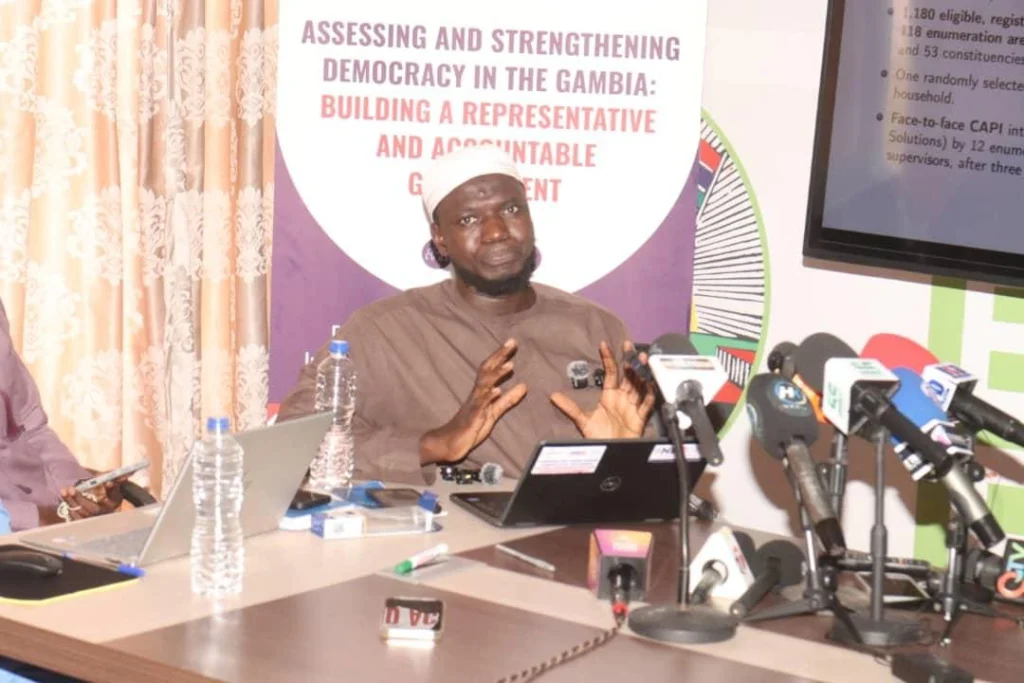
The CepRass survey interviewed 1,180 respondents across 118 enumeration areas, covering all eight Local Government Areas and the Gambia’s 53 constituencies. It used a multi-stage stratified sampling approach and weighted the data to account for the sampling design.
The fieldwork was conducted between 17th October and 1st November 2026. The report provides a nominal margin of error of approximately plus or minus three percentage points at the 95% confidence level.
However, the report also notes that the design-adjusted margin should be confirmed using the final sampling weights.
For me, this qualification matters. In a complex survey, the actual precision of estimates can be affected by clustering, weighting and the distribution of respondents across different groups. The nominal margin should not be treated as a guarantee that every reported percentage is accurate within exactly three percentage points.
There is also a methodological issue that deserves further explanation. The report indicates that household heads accounted for 77.4% of the responses to the voting-intention component, rather than the individual originally selected for interview.
This does not automatically invalidate the survey. However, it raises an important question about respondent selection and representation.
If the original sampling procedure selected one individual in a household, but another person subsequently provided the voting-intention response, readers need to understand why this occurred and how it was handled in the analysis.
The distinction matters because an individual’s voting preference cannot automatically be assumed to represent the preference of another household member.
CepRass should therefore provide a fuller explanation of this procedure in its technical documentation, including whether the household-head responses were part of the original design, how non-response was managed and what implications the approach may have for interpreting individual voting intentions.
There is another limitation worth emphasising: the poll measures stated intentions during the fieldwork period.
It does not establish who will turn out to vote, whether respondents will maintain their stated preferences or how events during the remaining campaign period may affect their decisions. A poll is not an election result. It is evidence about public opinion at a particular moment.
Which begs the question: What should Gambians take away from the findings? The latest CepRass poll provides several important messages.
First, the NPP-led alliance records the highest stated voting intention among the respondents surveyed. The Gambia First Coalition follows, with a 13.7-percentage-point difference between the two leading formations.
Second, the presence of undecided and undisclosed respondents means that a portion of the electorate’s final choices remains unknown.
Third, the gender and age breakdowns show that voting intentions are not identical across demographic groups. These differences deserve further investigation rather than simplistic political interpretation.
Fourth, the regional findings demonstrate the importance of examining the geographical distribution of support rather than relying exclusively on national percentages.
Fifth, the poll reveals that economic conditions, the cost of living, food prices and electricity remain important public concerns. It also identifies questions about governance, electoral confidence and the reliability of political information.
Finally, the survey’s methodology should be examined openly. Public trust in polling depends not only on the findings but also on the transparency of the methods used to produce them.
For political parties, the poll should be an invitation to engage with the electorate’s concerns. For the IEC, it highlights the continuing importance of transparency and public communication. For journalists and researchers like me, it provides material for further examination. For citizens, it offers an opportunity to assess the political debate with evidence rather than assumptions.
In conclusion, opinion polls measure voter sentiment at a specific point in time rather than guaranteeing an outcome. Turnout levels, late campaign mobilisation, and potential pre-election withdrawals before the 27th November 2026 deadline can still shift the final result.
In short, poll interpretations reflect voter sentiment at the time the survey was conducted and depend heavily on whether opposition alliances shift or voter turnout changes before election day.
Nonetheless, the latest CepRass national opinion poll is an important contribution to public understanding of the Gambia’s 2026 presidential election.
It provides a picture of stated voting intentions, reveals differences across demographic groups, identifies public priorities and raises questions about electoral confidence and political communication. But its significance should not be exaggerated.
The 37.9% recorded by the NPP-led alliance is not an election result. The 24.2% recorded by the Gambia First Coalition does not establish its final electoral position. The undecided and undisclosed respondents cannot simply be allocated to any political formation. Nor can expectations about the likely winner be treated as personal voting preferences.
The survey tells us where public opinion stood during the period in which the interviews were conducted. It does not tell us with certainty where every voter will stand on 5th December 2026.
The most valuable contribution of an opinion poll is not to declare a winner before citizens have voted. It is to encourage informed discussion, expose the issues that matter to the public and provide a basis for examining the claims made by political leaders.
As the campaign enters its final phase, Gambians should look beyond the headlines and consider the evidence carefully. Political parties should respond to the concerns reflected in the findings, while the media, researchers and citizens should continue to distinguish between measured public opinion, political interpretation and electoral fact. Ultimately, the authority to choose the next President of The Gambia belongs to the voters, not to a poll, a political prediction or a campaign declaration.
Author’s note: The analysis above was undertaken using the shorter summary report, The Electorate at Crossroads: Key Takeaways, which was sent to me early Monday morning. At the time of writing this article, the full technical report accompanying the latest CepRass national opinion poll had not yet been made available to me.
By Dr Ebrima Ceesay
Dr Ebrima Ceesay is a Gambian academic based in the UK