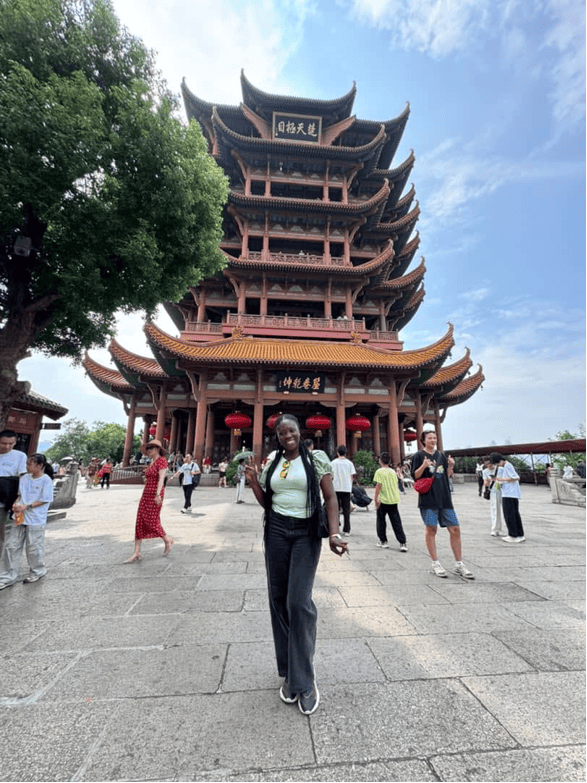
China’s iconic yellow crane tower draws 5 million visitors with legend of immortal and crane
By Amadou Jadama just from Beijing
Perched on Snake Mountain above the Yangte River, the Yellow Crane Tower has stood for nearly 1,800 years as one of China’s most beloved landmarks. More than a building, it is a story of myth, poetry and resilience that draws millions to Wuhan each year.
Officials describe the tower as a famous historical site and landmark of Wuhan, standing on the peak of Snake Mountain on the bank of the Yangtse. Due to its unique geography and cultural weight, it has become a cultural icon integrating nature and culture.
It is regarded as “one of the three most famous towers in south China together with Yueyang Tower in Hunan and Tengwang Pavilion in Jiangxi” and enjoys the reputation of “China’s No.1 Tower.” Last year alone, it drew over 5 million tourists from home and abroad.
But its fame is not only from its view. It comes from a legend of kindness and reward locals still tell.
In an interview with The Standard, tour guide and Wuhan native Hannah Hu recounted the tale that gave the tower its name:
“Long ago, there was a woman surnamed Xin who sold wine on Yellow Crane Mountain. One day, a ragged old Taoist priest came by, asking for wine. Seeing him in such a pitiful state, Xin readily agreed.”
The priest came daily. For a whole year, Xin gave him free wine.
“One day, the old Taoist came to bid farewell, saying, ‘I owe you a lot for the wine, I have no way to repay you. However, I can lend you a crane.’ With that, he picked up an orange peel from the ground and drew a crane on the wall. Because the orange peel was yellow, the crane was also yellow. Then he said, ‘Just clap your hands, this yellow crane will come down and dance to entertain your guests.’ After that, the old Taoist disappeared,” Hu said.
Xin clapped, and the yellow crane leapt down and danced.
“The news spread, attracting visitors from far and wide. From then on, business at Xin’s inn flourished, and she became wealthy,” Hu added.
Ten years later, the Taoist returned.
“’I wonder if the money you earned in these ten years is enough to repay my wine debt?’ Xin hurriedly thanked him and said, ‘It’s enough to make me rich.’ After hearing this, the old Taoist took out a flute, played a tune facing the yellow crane on the wall, and the crane flew to him, carrying him away.”
“It was only then that Xin realised she had encountered an immortal and a celestial crane. To commemorate the immortal and the crane, she used all her wealth to build a tall building here, naming it the Yellow Crane Tower,” Hu said.
“The first tower was built during the Three Kingdoms period (AD 223) by Sun Quan, ruler of the Wu Kingdom. It was originally a military tower for observing enemy movements along the Yangtse River,” Hu stated.
Over centuries, it was destroyed and rebuilt more than 20 times due to wars, lightning and fires. The old towers were mostly wooden and smaller. Today’s tower, rebuilt in 1981 and opened in 1985, is larger and reinforced with concrete and steel, but designed in Qing Dynasty style. Ancient builders used mortise-and-tenon joints, rammed earth foundations, and bamboo scaffolding.
Each level tells part of China’s cultural history.
The 1st floor has a ceramic mural of the immortal and crane. The 2nd shows reconstructions through dynasties. The 3rd honours Tang and Song poets like Cui Hao and Li Bai. The 4th displays modern calligraphy. The 5th offers a panoramic mural of the Yangtse and Wuhan.
“Yellow symbolises the earth and immortality. Red represents good fortune and vitality,” Hu said.
Today, the Yellow Crane Tower remains a bridge between legend and modern China — where 5 million visitors each year come not just to see a tower, but to hear a story that still flies.
Enjoyed this story?
Applaud it for the newsroom — one clap per reader, per story.