EFSCRJ Position Paper On The 5th December 2026 Presidential Election And Candidates
Introduction The 5th December 2026 presidential election comes at a defining moment in the political history of The Gambia. It takes place ten years after the electoral defeat of a brutal 22-year dictatorship, against the backdrop of an unfinished democratic transition and persistent challenges of corruption, weak institutions, poverty, injustice, and poor governance.
The Edward Francis Small Centre for Rights and Justice therefore considers this election highly consequential for the future of the Republic. It presents Gambians with an opportunity to consolidate democracy, advance constitutionalism, strengthen accountability and secure a better future for the country. Alternatively, it could entrench the status quo and weaken democracy, accountability, and good governance.
As a stakeholder in national governance and development, EFSCRJ has consistently worked to protect the sovereign will of the people and ensure that elections serve as instruments for advancing democracy, protecting human rights, and safeguarding the public interest.
Our role in elections encompasses monitoring and observing electoral stakeholders and processes, including political parties, candidates, campaigns, and voting, to ensure adherence to the rule of law, respect for human rights and the protection of electoral integrity.
EFSCRJ maintains that civil society organisations, like citizens, the media, and other stakeholders, have a legitimate right and responsibility to advocate and take principled positions on matters affecting the Republic. Independence does not mean indifference to authoritarianism, injustice, corruption, or threats to democracy.
While fully recognising and respecting the right of every voter to freely determine their electoral choice, EFSCRJ considers it necessary to highlight fundamental issues that should inform public debate and electoral decision-making.
Against this background, EFSCRJ hereby presents its position on the presidential election and the following candidates.
Adama Barrow EFSCRJ notes that President Adama Barrow is seeking a third presidential term after serving two consecutive terms.
Our position is that President Barrow should withdraw his candidature in fulfilment of his previous commitments to constitutional reform, presidential term limits, and democratic renewal.
In 2016, Barrow promised to serve a three-year transitional presidency, introduce a new constitution, and undertake comprehensive legal and institutional reforms to usher in the Third Republic. Following his election, he established the Constitutional Review Commission, whose work culminated in the 2020 Draft Constitution containing a two-term presidential limit. On several occasions, including media interviews, Barrow publicly expressed his support for presidential term limits.
Indeed, his 2016 manifesto promised reforms that would put an end to the “culture of impunity and self-perpetuating rule.”
Having failed to honour his three-year transitional commitment, President Barrow should, at the very least, respect his subsequent commitment to two presidential terms.
The Gambia’s political history demonstrates that prolonged occupation of presidential office has contributed significantly to the erosion of democratic institutions, abuse of power, corruption, impunity, and underdevelopment.
While the existing Constitution does not prohibit a third presidential term, the absence of a legal restriction does not absolve President Barrow of his political and moral commitments to the Gambian people.
EFSCRJ therefore opposes a third term for President Adama Barrow as a matter of democratic principle, political accountability, and national interest. For that matter, EFSCRJ calls on the electorates to use their votes to institute term limits by rejecting third term bid of Mr Barrow at the polls.
Almameh Gibba EFSCRJ expresses grave concern over the candidature of Almameh Gibba, the independent presidential candidate representing the APRC No-To- Alliance Movement and singlehandedly handpicked by former dictator Yahya Jammeh.
Our concern arises not merely from his political affiliation but fundamentally from his continued allegiance to Yahya Jammeh and his failure to publicly repudiate the authoritarianism, corruption and gross human rights violations that characterised the AFPRC and APRC regimes.
While his campaign seeks to restore several policies associated with the former regime, EFSCRJ has yet to see a clear and unequivocal commitment from him to acknowledge the atrocities of that regime, uphold the findings and recommendations of both the Truth, Reconciliation and Reparations Commission (TRRC) and the Janneh Commission, and advance justice and accountability for victims.
Almameh Gibba’s efforts to amend the Women’s Act and his subsequent legal challenge before the Supreme Court to overturn the ban on female genital mutilation (FGM) demonstrate a troubling disregard for women’s and girls’ rights. His position seeks to dismantle hard-won legal protections, perpetuate harmful traditional practices and further entrench patriarchal structures that sustain gender inequality and discrimination. It raises fundamental questions about his commitment to human dignity, bodily autonomy, equality, justice, and the protection of human rights. Such a position represents a serious threat to the gains made in advancing women’s rights and gender equality in The Gambia.
The Gambia cannot consolidate democracy by romanticicing dictatorship, condoning violence against women and girls, denying documented atrocities, or subordinating the national interest to the political interests of a former ruler.
EFSCRJ considers his continued political allegiance to Yahya Jammeh, without a clear repudiation of the former regime’s abuses, to be a serious concern for democratic consolidation, national reconciliation, and transitional justice. His presidency, under these circumstances, risks reopening national wounds, retraumatising victims, deepening divisions and reversing democratic gains.
EFSCRJ therefore considers the political orientation represented by Almameh Gibba’s candidature incompatible with the country’s democratic and transitional justice imperatives. EFSCRJ therefore urges voters to reject the candidacy of Almameh Gibba so long as he remains loyal to a former dictator and denying the regimes corruption and human rights violations.
Dr Isatou Touray EFSCRJ welcomes the historic candidature of Dr Isatou Touray as the first Gambian woman to appear on a presidential election ballot. Her candidature represents a significant milestone in the longstanding struggle for gender equality, political inclusion, and women’s leadership.
Campaigning under the message “Progress, Not Promises,” Dr Touray prioritises constitutional reform, good governance, accountability, and socioeconomic development.
Her key commitments include introducing a new constitution to usher in the Third Republic, combating corruption, strengthening democratic institutions, promoting transparency in public financial management and ensuring merit-based public appointments.
She also pledges to address the rising cost of living, create employment opportunities for young people, improve electricity supply, strengthen healthcare and education, modernise agriculture, and enhance food security.
Her agenda further emphasises women’s empowerment, security sector reform, justice and reconciliation, and diaspora participation, including voting rights. She has specifically proposed establishing a National Cost of Living Taskforce within her first 100 days in office.
EFSCRJ considers these commitments relevant to the country’s democratic and development needs. Her historic candidature notwithstanding, her leadership record, policy proposals, integrity, and capacity to deliver remain important considerations for voters in assessing her suitability for the presidency.
Lamin J Darboe Lamin J Darboe, backed by Team Gambia Grand Coalition 2026, is campaigning under the motto “Sovereignty, Social Justice and Prosperity,” with a vision of returning power to the people and giving the country a new start.
The Coalition proposes a single-term transitional administration centred on constitutional reform, national sovereignty, participatory democracy, social justice, and economic self- reliance.
Its principal commitments include delivering a new constitution within 18 months, establishing presidential term limits, restoring the absolute majority electoral system, eradicating poverty within five years, protecting sovereign national assets and transforming the economy through productive investments.
The manifesto also prioritises universal access to social services, youth employment, women’s political representation, workers’ rights, diaspora participation, and decentralization.
EFSCRJ recognises the relevance of these commitments to national democratic and socioeconomic transformation. Their feasibility, financing, implementation mechanisms, and the candidate’s leadership capacity are important matters for voters to decide and public scrutiny.
Ebrima Tabora Manneh Ebrima Tabora Manneh, presidential candidate of the People’s Alliance Party (PAP), prioritises national unity, economic transformation, employment creation, and citizen empowerment.
He promises to promote Gambian ownership of businesses and industrial fishing trawlers, establish agricultural and fish-processing facilities, provide farmers with modern equipment and inputs, and address poverty and the rising cost of living.
His agenda also includes rehabilitating roads and hospitals, addressing shortages of essential medicines, combating tribalism, and promoting honest, inclusive, and accountable governance.
EFSCRJ recognises the importance of these priorities, particularly the emphasis on Gambian economic empowerment and national cohesion. Greater clarity on constitutional reform, institutional strengthening, implementation timelines, and financing would enhance public understanding of his proposed administration.
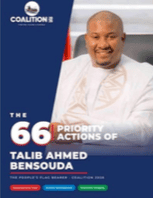
Talib Ahmed Bensouda Talib Ahmed Bensouda, presidential candidate of Coalition 2026, presents 66 priority actions focusing on accountable governance, human development, and economic transformation.
He promises to introduce presidential term limits, repeal the Public Order Act, enforce asset declarations, strengthen independent accountability institutions, settle outstanding verified victims’ reparations claims and end reliance on Ecomig forces.
His socioeconomic agenda includes reducing the cost of living, introducing minimum wages, establishing a National Development Bank, reforming Nawec, suspending foreign industrial fishing trawlers and promoting Gambian-owned enterprises.
He also pledges to allocate 15 per cent of the national budget to healthcare, facilitate the provision of 10,000 affordable homes, guarantee universal access to safe drinking water, introduce student loans, achieve 40 per cent women’s representation on public boards and commissions, and operationalise diaspora voting.
EFSCRJ recognises the significance of these commitments, particularly the inclusion of measurable targets and implementation deadlines that facilitate public accountability.
However, EFSCRJ has serious human rights concerns regarding his commitment to apply the death penalty. This proposal warrants particular scrutiny in light of the right to life, the irreversible consequences of wrongful convictions and The Gambia’s international obligations.
The feasibility, financing and human rights implications of his proposed policies remain important considerations in assessing his candidature.
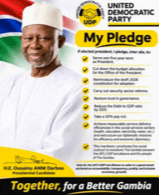
ANM Ousainu DARBOE ANM Ousainu Darboe, presidential candidate of the Gambia First Coalition/UDP-led Alliance, pledges to serve one five-year term, take a 20 per cent presidential salary cut, reduce presidential expenditure, and reintroduce the 2020 Draft Constitution within his first 100 days in office.
His manifesto prioritises constitutional and institutional reforms, presidential term limits, anti-corruption, decentralisation, security sector reform, and a professional and politically neutral civil service.
His socioeconomic agenda focuses on reducing inflation, public debt, and the cost of living, modernising agriculture, achieving food self- sufficiency, operationalising health insurance, expanding educational opportunities,
empowering women and youth, improving electricity supply and reducing Internet costs.
He also promises to establish a Sovereign Wealth Fund from future petroleum revenues, guarantee diaspora voting rights and strengthen public sector accountability through performance contracts.
EFSCRJ recognises the relevance of these commitments, particularly the single-term pledge, the proposed timeline for reintroducing the 2020 Draft Constitution and the emphasis on institutional reform and fiscal discipline.
The implementation, financing, and sustainability of these commitments, alongside his political and professional track record, remain important subjects for voters and public scrutiny.
Conclusion EFSCRJ’s position is anchored in the principles of constitutionalism, human rights, democratic accountability, transitional justice, and the protection of the public interest.
The establishment of presidential term limits remains a fundamental democratic imperative for The Gambia. A two-term presidential limit is not a panacea for all
the country’s problems, nor does it automatically guarantee good governance. It nevertheless constitutes an important institutional safeguard against the concentration and personalization of power, authoritarianism, corruption, and impunity.
Presidential term limits promote leadership renewal, peaceful transfers of power, political competition, popular participation, and accountable leadership. They reinforce the fundamental democratic principle that no individual is indispensable to the governance and development of a nation.
Equally fundamental is the need to safeguard The Gambia against authoritarian regression. The country must not abandon its commitment to truth, justice, reparations, accountability and guarantees of non-recurrence. Political leadership must demonstrate an unequivocal commitment to these principles and to the dignity of victims of human rights violations.
EFSCRJ welcomes the historic candidature of Dr Isatou Touray and recognises that the policy proposals presented by her, Lamin J Darboe, Ebrima Tabora Manneh, Talib Ahmed Bensouda and ANM Ousainu Darboe address several of the
country’s pressing democratic and socioeconomic needs. This recognition does not constitute an endorsement of their respective manifestos or candidatures.
We urge citizens to critically scrutinize the candidatures of Adama Barrow and Almameh Gibba in light of their respective positions: Barrow’s pursuit of a third presidential term despite his previous commitments to term limits, and Gibba’s continued allegiance to a former authoritarian ruler and efforts to overturn the ban on female genital mutilation (FGM). Both positions raise fundamental concerns about democratic consolidation, human rights, gender equality, and the future of the republic.
Campaign promises must not be accepted at face value. Candidates must be assessed on their integrity, competence, professional and political track records, respect for human rights, commitment to democratic principles, and capacity to translate promises into measurable results.
The presidency is a public trust, not a personal entitlement. Elections must be about the Republic and its people, not the ambitions of individuals or the interests of political parties.
EFSCRJ encourages all eligible citizens to exercise their right to vote freely and peacefully on 5th December, without intimidation, inducement, prejudice, or coercion.
We further urge all candidates, political parties and citizens to respect electoral laws, honour the Presidential Election Peace Pact, await the official declaration of results by the Independent Electoral Commission, and pursue any electoral grievances through lawful and peaceful mechanisms.
Above all, the sovereign will of the Gambian people must prevail.
Issued this 25th day of November 2026.
Enjoyed this story?
Applaud it for the newsroom — one clap per reader, per story.