This is an important development for electoral transparency.
It gives political parties, journalists, civil society organisations, researchers and the public a more detailed picture of how the electorate is distributed across The Gambia.
However, the publication also raises further questions.
While we now know considerably more about where voters are registered, we still do not have a complete public picture of who those voters are by age and gender at constituency level, how many are first-time voters, or how the electorate has changed within each constituency since the December 2021 Presidential Election.
The new figures are therefore an important step forward, but they should also be the starting point for a wider discussion about access to electoral information.
The national picture: 1,146,474 registered voters
The final register contains 184,317 more registered voters than the 962,157 recorded for the 2021 presidential election.
This represents an increase of approximately 19.2 per cent over five years.
The increase is substantial, but it is important to distinguish between the net increase in the final register and the number of people recorded during the 2026 supplementary registration exercise.
The 2026 supplementary exercise recorded 212,095 registrations. That figure should not be treated as the net addition to the final electorate.
The final 2026 register combines the previous master register with the 2026 supplementary registration data after the relevant administrative processes, including verification and corrections.
The difference between the 2021 and 2026 final totals is 184,317.
The new constituency and polling-station data now make it possible to examine how the 1.146 million registered voters are distributed across the Gambia in considerably greater detail.
Brikama has the largest registered electorate
The most striking feature of the new figures is the concentration of registered voters in the Brikama administrative area.
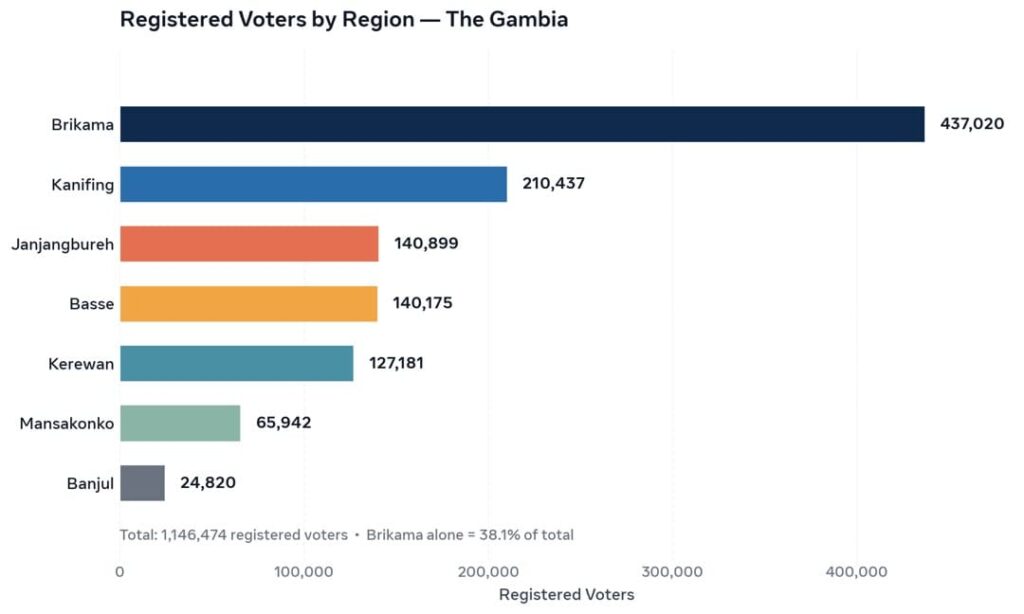
Brikama administrative area has 437,020 registered voters, representing approximately 38.1 per cent of the national electorate.
It is followed by Kanifing, with 210,437 voters, or approximately 18.4 per cent.
Together, Brikama and Kanifing account for 647,457 registered voters, approximately 56.5 per cent of the entire national register.
The remaining administrative areas are distributed as follows:
Banjul: 24,820 registered voters.
Basse: 140,175 registered voters.
Brikama: 437,020 registered voters.
Janjangbureh: 140,899 registered voters.
Kanifing: 210,437 registered voters.
Kerewan: 127,181 registered voters.
Mansakonko: 65,942 registered voters.
These figures demonstrate the considerable geographical concentration of the registered electorate in Brikama and Kanifing.
However, a larger registered electorate does not automatically mean that an administrative area will determine the election.
Electoral outcomes depend on turnout, the distribution of votes among candidates, the number of constituencies and the geographical spread of support.
Registration figures tell us where voters are registered; they do not tell us how those voters will vote.
It is also important to remember that the IEC’s administrative area called Brikama should not be confused with Brikama town alone.
The Brikama administrative area includes 12 constituencies with very different population and settlement characteristics.
The 53 constituencies: where are the largest electorates?
The newly published constituency figures provide a more useful basis for understanding the geographical distribution of voters.
The largest registered electorate is in Kombo South, with 77,307 voters. It is followed by:
Busumbala: 65,339.
Sanementereng: 63,456.
Old Yundum: 62,494.
Serekunda West: 51,522.
Brikama North: 45,807.
Brikama South: 44,722.
Latrikunda Sabiji: 42,274.
These eight constituencies illustrate the considerable size of several electorates in the Brikama and Kanifing administrative areas.
Kombo South alone accounts for approximately 6.7 per cent of all registered voters nationally.
The five largest constituencies together account for about 320,118 voters, or approximately 27.9 per cent of the national register.
At the other end of the distribution, Janjangbureh constituency has 1,851 registered voters, the smallest figure in the published constituency dataset.
The difference between the largest and smallest constituencies is substantial.
Kombo South has more than 41 times the number of registered voters recorded in Janjangbureh constituency.
This raises an important question about the geographical distribution of the electorate and the practical organisation of elections.
Constituencies with very different numbers of registered voters may require different levels of logistical preparation, staffing and voter-management arrangements.
However, these figures should not be interpreted as evidence of unequal representation or electoral advantage without considering the legal framework governing constituency boundaries and representation.
The number of registered voters is an important measure, but it is not the only consideration in assessing electoral arrangements.
Brikama’s 12 constituencies: significant differences within one administrative area
The constituency-level figures also show why it is misleading to treat an entire administrative area as if it had one uniform electoral profile.
The Brikama administrative area has 12 constituencies, but their registered electorates vary considerably.
Kombo South has 77,307 registered voters, while Foñi Bondali has 5,735
Busumbala has 65,339, Old Yundum 62,494 and Sanementereng 63,456.
By contrast, Foñi Jarrol has 6,184 registered voters, while Foñi Brefet has 10,887.
These differences matter when examining electoral participation and planning voter education.
A national or administrative-area average can conceal substantial variations between constituencies.
For example, the fact that Brikama accounts for 38.1 per cent of registered voters does not mean that each of its 12 constituencies has a similar number of voters.
Nor does it mean that political preferences, turnout patterns or demographic characteristics are the same across those constituencies.
The newly released figures allow researchers to begin examining these differences more carefully.
They also provide a more reliable geographical framework for future analysis of voter participation, campaign activity and election-day administration.
Polling centres and polling stations: why the distinction matters
One of the most useful aspects of the IEC’s publication is the additional information about polling arrangements.
The national figures identify 730 polling centres and 1,773 polling stations. These are not interchangeable terms.
A polling centre is a physical location where voting takes place. A polling centre may contain more than one polling station.
The polling-station dataset also identifies individual streams, with registered-voter figures attached to the relevant entries.
This distinction is important because the number of polling centres is not the same as the number of polling stations or the number of registered voters assigned to each individual voting stream.
The administrative-area distribution of polling stations is particularly revealing.
Brikama administrative area has 632 polling stations, the largest number nationally.
Kanifing has 306 polling stations, followed by Janjangbureh with 239, Basse with 227, Kerewan with 215, Mansakonko with 116 and Banjul with 38.
Brikama and Kanifing together account for 938 of The Gambia’s 1,773 polling stations.
The constituency and polling-station documents also provide the names and locations of individual polling stations, together with their stream codes and registered-voter figures.
This information can help election observers, political parties and civil society organisations identify where polling facilities are located and examine the distribution of registered voters across individual voting locations.
It may also support more focused planning for election-day observation, voter information and logistical arrangements.
Nevertheless, the publication of registered-voter figures does not, by itself, establish whether a polling station is adequately staffed, accessible or sufficiently equipped.
Those questions require additional information about facilities, staffing, materials, accessibility and operational readiness.
What do the polling-station figures tell us about election-day preparation?
The distribution of voters across polling stations deserves particular attention.
A polling location with several streams may have a different administrative and logistical profile from one with fewer streams.
The number of registered voters assigned to each stream can also help the IEC assess the distribution of election materials and personnel.
The newly published dataset makes it possible to examine these allocations rather than relying only on national totals.
However, the figures should be interpreted carefully. The number of registered voters assigned to a stream does not tell us how many will actually turn out to vote.
Nor does it establish how long voters may have to wait, whether facilities are accessible to people with disabilities, or whether the number of staff and materials will be sufficient.
The IEC should therefore ensure that the published registration figures are matched by clear information about operational preparations.
In particular, the public would benefit from information on polling-station staffing, the availability of election materials, accessibility arrangements and procedures for managing queues and resolving administrative problems on election day.
The objective should be to ensure that every registered voter, irrespective of location, can exercise their right to vote in an orderly and accessible environment.
What do we now know about women in the electorate?
An important development is that the IEC’s registration statistics page also provides gender percentages for the seven administrative areas.
The figures show that women constitute a larger proportion of registered voters in each of the seven areas.
The published percentages are:
Banjul: 52.53 per cent female and 47.47 per cent male.
Basse: 60.72 per cent female and 39.28 per cent male.
Brikama: 55.74 per cent female and 44.26 per cent male.
Janjangbureh: 57.67 per cent female and 42.33 per cent male.
Kanifing: 54.19 per cent female and 45.81 per cent male.
Kerewan: 56.54 per cent female and 43.46 per cent male.
Mansakonko: 54.05 per cent female and 45.95 per cent male.
Basse has the highest reported proportion of female registered voters, at 60.72 per cent, while Banjul has the lowest, at 52.53 per cent.
This is useful information. It provides evidence that women make up a majority of registered voters in every administrative area.
However, percentages alone do not provide the complete picture.
The IEC should also publish the actual numbers of registered women and men, nationally and across individual constituencies.
A constituency-level breakdown would allow researchers to examine whether the gender distribution varies significantly between different parts of The Gambia.
It would also help organisations working on women’s political participation, voter education and democratic representation to develop programmes based on reliable local evidence.
It is important, however, not to assume that a majority of women on the register automatically translates into greater political representation or a particular voting preference.
Registration, turnout, candidate selection and political representation are different questions and require separate evidence.
What is still missing? The age profile of the electorate
Despite the progress made through the publication of constituency and polling-station figures, one important information gap remains: the public still needs a clear age breakdown of the registered electorate.
How many registered voters are aged between 18 and 25? How many are between 26 and 35? What proportion of the electorate is below 35? How many are older citizens?
These questions matter because The Gambia has a relatively young population, and younger citizens are an important part of the Gambia’s democratic future.
The national total of 1,146,474 does not tell us how many young people are registered.
Nor does the constituency dataset provide the age distribution of voters in individual constituencies.
The IEC should clarify whether age information is available in its registration records and, if so, whether it can publish aggregated statistics without compromising individual voter privacy.
Such information would be valuable to political parties, researchers, youth organisations and civil society groups.
It would also help establish whether voter education and participation programmes are reaching younger citizens effectively.
Without this information, public discussion about the size and influence of the youth electorate risks relying on general population statistics rather than evidence from the actual voter register.
First-time voters are not necessarily the same as newly registered voters
Another important distinction concerns first-time voters.
The 2026 supplementary registration exercise recorded 212,095 registrations.
However, it would be incorrect to assume that everyone registered during that exercise is voting for the first time.
Some people may have recently attained the legal voting age. Others may have been eligible for several years but had not previously registered.
These are different categories. A first-time eligible voter is not necessarily the same as a person who has newly registered.
The distinction matters when assessing the number of young people entering the electorate and the number of previously eligible citizens who have joined the register.
The IEC should therefore clarify whether its records allow it to identify first-time eligible voters separately from other newly registered voters.
If this information can be reliably established, an aggregated breakdown would provide a useful addition to the constituency and polling-station data.
It would also help youth organisations and civil society institutions plan voter education initiatives for citizens participating in a presidential election for the first time.
What further information should the IEC publish?
The latest IEC release is a positive step towards greater electoral transparency. But a more complete public understanding of the electorate requires additional information.
From my perspective, the following would be particularly useful:
First, age statistics. The IEC should publish the number of registered voters by clearly defined age groups, nationally and, where possible, across all 53 constituencies.
Second, constituency-level gender statistics. The existing administrative-area percentages are helpful, but actual numbers of registered women and men in each constituency would provide a more detailed picture.
Third, first-time voter information. Where the records permit, the IEC should distinguish between people who have recently become eligible to vote and those who have newly registered despite having been eligible previously.
Fourth, comparable constituency-level historical data. A breakdown showing how the register has changed between 2021 and 2026 in each constituency would help researchers understand where the electorate has grown most significantly.
Fifth, accessible data formats. The information should be made available in downloadable and machine-readable formats, such as spreadsheets or CSV files, so that researchers, journalists and civil society organisations can analyse it independently.
Sixth, clear explanations of the data. The IEC should explain the definitions used, the distinction between polling centres, polling stations and streams, and how transfers, corrections, duplicate entries and court-ordered removals were handled in compiling the final register.
These requests are not intended to question the validity of the final register. They are constructive proposals aimed at strengthening public understanding and confidence through the publication of reliable information.
Where certain data are not collected or cannot be reliably produced, the IEC should simply explain that position.
Why does the new data matter beyond the December presidential election?
The value of the newly released information extends beyond the immediate presidential election.
A detailed and accessible voter register can support future research into population movement, electoral participation, constituency representation and the changing geographical distribution of the electorate.
It can also help civil society organisations identify areas where voter education may be particularly important.
For example, constituencies with large numbers of registered voters may require different logistical arrangements from those with smaller electorates.
Areas experiencing significant registration growth may also require closer attention to polling facilities and voter information.
Researchers can use the new figures as a baseline for examining future changes in the electorate.
But this work will be more meaningful if the IEC continues to publish comparable data in subsequent electoral cycles.
Electoral statistics should not be treated as information required only during election campaigns.
They are part of the country’s wider democratic infrastructure and should be available for public scrutiny and informed debate throughout the electoral cycle.
In conclusion, the publication of the IEC final voter register is a welcome step, but transparency must continue*.
Indeed, the IEC’s publication of the constituency and polling-station data is a welcome development.
For the first time in this electoral cycle, the public can examine the distribution of all 1,146,474 registered voters across the 53 constituencies and access detailed information about the 730 polling centres and 1,773 polling stations.
The figures reveal the considerable concentration of registered voters in Brikama and Kanifing, the wide differences in electorate size between constituencies, and the scale of the logistical arrangements required for the December 2026 presidential election.
The administrative-area gender percentages also provide useful information about women’s participation in the registered electorate.
However, important questions remain unanswered.
The public still needs a clearer age profile, more detailed constituency-level gender statistics, and reliable information about first-time voters and the changes in registration within individual constituencies.
The IEC has made progress. The next step should be to build on that progress through consistent, accessible and sufficiently detailed publication of electoral information.
The objective is not simply to know how many people are registered.
It is to understand the composition of the electorate, where voters are registered, and what the changing figures reveal about democratic participation in The Gambia.
A transparent electoral process is strengthened when citizens can examine the information on which public discussion and electoral planning are based
Words of Wisdom: A voter register is more than a list of names and numbers. It is a record of citizens exercising their democratic right. Publishing the figures is an important first step; making them understandable, accessible and open to scrutiny is what turns electoral data into public confidence.
By Dr Ebrima Ceesay
Dr Ebrima Ceesay is a distinguished Gambian academic based in the UK