Bangladesh: songs of subversion
“The US government has observed the power of hip hop culture as a vehicle for expression, protest, and a political voice for young people,” Professor Sujatha Fernandes, a sociologist at the University of Sydney and the author of the book, Close to the Edge: In Search of the Global Hip Hop Generation, told MintPress News.
“Groups like the National Endowment for Democracy (NED) and USAID earlier consistently chose Black cultural expressions from jazz to hip hop as a way of infiltrating those societies and trying to promote regime change,” she added.
One of those countries is Bangladesh. In 2024, longstanding prime minister Sheikh Hasina was toppled in a US-supported revolution. Hasina’s relationship with Washington had seriously deteriorated over her friendliness towards China and her refusal to cede control of the strategically located Saint Martin’s Island in the Bay of Bengal so the US could build a military base there.
Just days after meeting with Assistant Secretary of State for South and Central Asia Donald Lu, Hasina publicly warned that a “white skin country” had threatened there would be trouble for her if she did not grant it permission to build a base in Bangladeshi territory. Nevertheless, she remained obstinate; “I do not want to come to power by leasing out parts of the country or handing it over to someone else,” she said.
Three weeks later, nationwide protests erupted across the country. Specifically targeted at a controversial quota system that reserved 30% of government jobs for the families of those that fought for the country’s independence in 1971, the movement quickly expanded to include people from a wide swath of society. It also turned extremely violent: over 1,400 people were killed before the military stepped in, forcing Hasina to ignominiously flee to India by helicopter.
Hasina was replaced by Muhammad Yunus, a longtime associate, mentor, and close friend of Bill and Hillary Clinton. One month after the affair, Yunus traveled to New York to meet with President Biden, who offered “continued U.S. support as Bangladesh implements its new reform agenda.” Yunus also spoke at the Clinton Global Initiative, where he revealed that the protests were not a spontaneous uprising, but an operation “meticulously designed” by young Bangladeshi leaders.
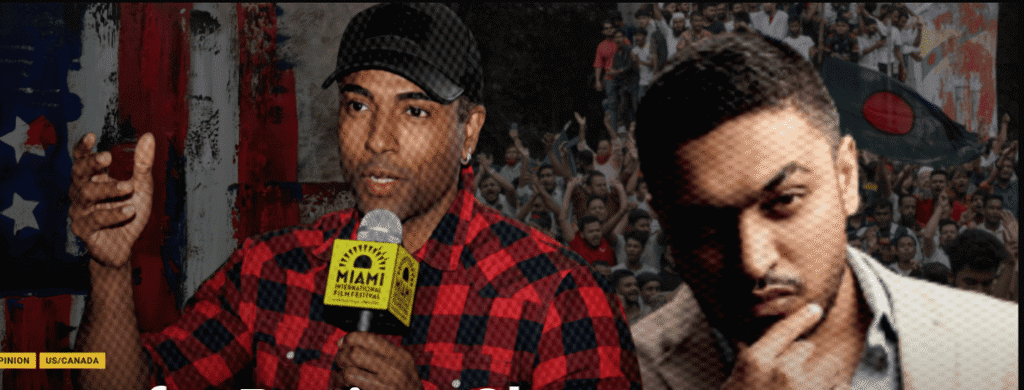
One of the leaders of the demonstrations was rapper and barrister Towfique Ahmed, who shot to prominence after he offered to provide free legal support to anyone arrested by Hasina’s forces.
Yet Ahmed had for years been on the US government payroll, explicitly as an agent of change, the International Republican Institute (IRI) – a CIA front group – funding and promoting his music career far and wide.
A leaked IRI document published by The Grayzone shows that the organization’s expressly stated goal was to “destabilize Bangladesh’s politics.” To that end, they spent millions funding all manner of opposition groups and figures, including musicians like Ahmed, whom, the document notes, “are neither solely an artist nor solely an activist; instead, they are functioning as a hybrid agent of change.”
“If the public is more aware of current issues of government oppression, discrimination and shrinking space for political participation, then the Bangladeshi people will be more active to drive [a] power shift through social and political reforms,” it concludes.
As it was never intended to see the light of day, the report is unusually frank about the US government’s explicit goals of regime change, and does not mask it with vague language alluding to democracy promotion.
The IRI produced a number of music videos for Ahmed, and helped spread his music far and wide. His song, “Tui parish” (You Can Do It) is a thinly veiled call for regime change. As the IRI notes, “Tui Parish” “targets youth with a message of perseverance in difficult times and encourages those who are committed to strengthen democracy in Bangladesh in every possible way including protests and street movements.”
Another song, “E Daay Kaar” (Demand It!) the IRI states, was specifically “designed to reveal social issues in Bangladesh and build up disappointment and even dissent to government so as to call for social and political reforms.”
Ahmed’s music became an anthem of the protests, thanks in part to the IRI consistently promoting it, including on its own televised cultural program, that, it boasted, “reached over 79,000 households in Bangladesh.” In total, the IRI spent millions supporting a wide range of artists, musicians, dancers and actors, all with the goal of removing Hasina from power.
Today, Bangladesh and the United States are in the final stages of agreeing a new strategic military partnership that will grant the US the rights to use a plethora of Bangladeshi ports and airbases for military purposes.
Senegal: the revolution will be organized
If Bangladesh was the perfect insurrection, Senegal was the blueprint. Western media called it the “Rap Revolution.” In 2012, enormous protests against President Abdoulaye Wade broke out. The 85-year-old leader was seeking a controversial third term in office, and was attempting to bring his son, Karim, into high office – a move many critics saw as Wade trying to establish a family dynasty.
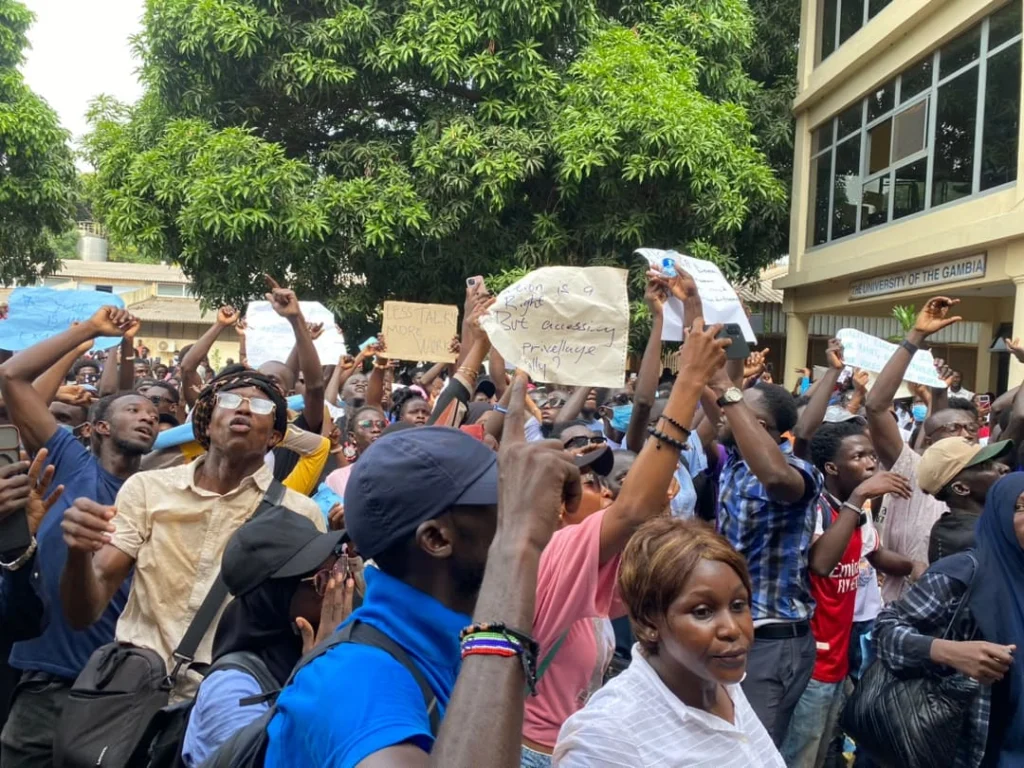
The demonstrations were led by a rap collective called “Y’En a Marre” (Enough is Enough). Y’En a Marre capitalized on public discontent over corruption, blackouts, and economic stagnation, inflaming tensions and encouraged people out on the streets.
One rapper in particular had been sowing the seeds for action for quite some time. In 2010, Cheikh Oumar Touré, known by his stage name, Thiat, released the song with his group, the Keurgui Crew called “Coup 2 Guele” (Diatribe), in which he and his partner, Kilifeu, excoriated Wade and called for a revolution.
“Old man, your seven year presidential reign has been expensive,” “You cheated during the last elections,” “This lusty regime has wasted all our money,” he raps. “Let’s fight this buffoon who is stealing all our money” he tells his countrymen, while concluding that the people of Senegal must “act on our words in the same way we resisted Hitler and De Gaulle.”
Surprisingly, the Kergui Crew immediately released an English version of the song, suggesting their intended audience was not purely Senegalese. Thiat was elevated to stardom in the West, where he received a great deal of positive press, long before the protests even began.
Coup 2 Guele became the soundtrack to the struggle, and Wade was decisively beaten at the ballot box, as Western media applauded this innovative form of activism. Thiat and Y’En a Marre became known worldwide as “the rappers who took down a dictator.”
Many expected Thiat to formally enter electoral politics. Instead, however, one of his first major post-revolution moves was to announce that he had been appointed a Reagan-Fascell Democracy Fellow at the National Endowment for Democracy (NED).
The NED was explicitly set up as a front group of the Central Intelligence Agency.
In the wake of a series of public scandals that seriously hurt the agency’s credibility, the Reagan administration established the NED in 1983. It proceeded to act as a front group for the CIA, carrying out many of its most controversial regime change operations abroad, in an effort to give the US some level of plausible deniability. The endowment interfered in the 1996 Russian elections to ensure US puppet Boris Yeltsin remained in power. Six years later, it bankrolled a briefly successful coup against Venezuelan president Hugo Chávez. It has also funded and supported insurrections in Ukraine, Hong Kong, and Belarus, among other countries.
Although it is funded and staffed by the US government and its officials, the NED is technically a private entity, meaning it is not subject to the same transparency laws and public scrutiny as a body like the CIA.
In their more candid moments, NED leaders are unequivocal about the organization’s role. “It would be terrible for democratic groups around the world to be seen as subsidized by the CIA,” Carl Gershman, NED president from 1984 to 2021, said, explaining why his organization was set up. NED co-founder Allen Weinstein agreed: “A lot of what we do today was done covertly 25 years ago by the CIA,” he told The Washington Post.
USAID – an official government body – has functioned in much the same way, acting as a CIA front group, spying on both enemy and friendly countries, and organizing countless coups around the world. When the Trump administration cut funding to USAID last year, it inadvertently exposed a global network of over 6,000 journalists and nearly 1,000 “independent” media outlets that suddenly faced immediate bankruptcy. In 2025, USAID and its activities were formally subsumed into the State Department.
It was this context that explains why so many were shocked when Thiat made his announcement, and led some to wonder how much the United States was involved in the seemingly spontaneous, grassroots uprising.
Certainly, the NED had been agitating in Senegal for years. In 2006, it funded a project whose public goal was to “strengthen understanding and advocacy for democracy among the urban middle class and youth in Senegal.” The NED’s local partners, it stated, would “lead a civic education campaign on democracy consisting of a series of published investigative reports on Senegal’s democratic development and training seminars for young people, civic organisations, and political parties.
By Alan MacLeod
Source: Orinogo Tribune