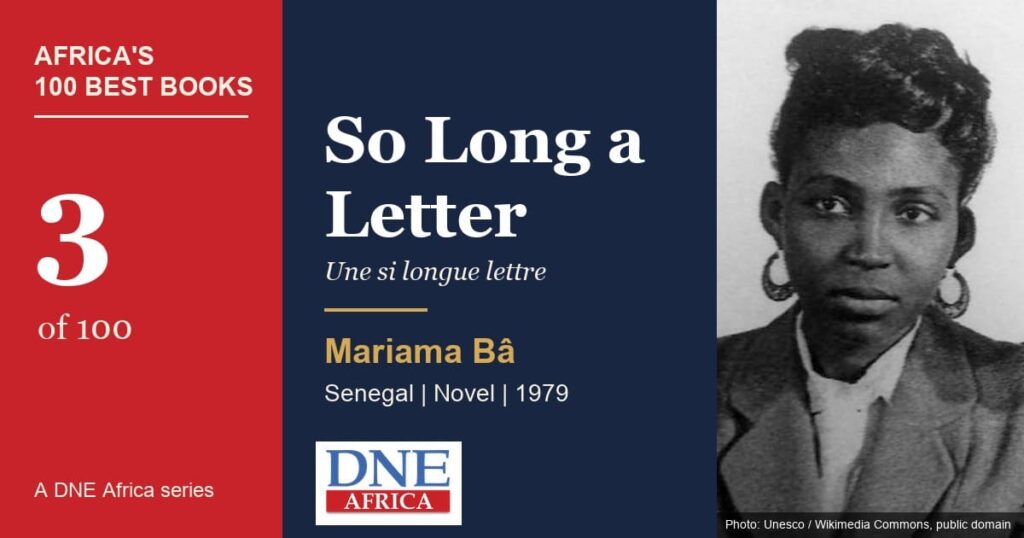
So Long a Letter, the 1979 novel by Senegal’s Mariama Bâ, had a sequel in manuscript among the papers in her bedside drawers when she died in 1981, according to her daughter and biographer.
That unfinished second half matters because So Long a Letter is itself a book about a woman who has not yet decided what comes next. Forty-seven years on, it is taught in Senegal’s schools, its film adaptation topped the box office in Dakar in 2025, and Senegalese writers say its questions about marriage are sharper now than when Bâ wrote them.
The standard account is well known: Une si longue lettre, published by Nouvelles Éditions Africaines in Dakar, won the first Noma Award for Publishing in Africa in 1980, and the jury that chose Africa’s 100 best books in 2002 placed it in its top 12, according to the African Studies Centre Leiden. The English translation by Modupé Bodé-Thomas appeared in Heinemann’s African Writers Series in 1981, according to the African Union library.
What is So Long a Letter about?
So Long a Letter is written by Ramatoulaye Fall, a schoolteacher in Dakar, to her oldest friend Aïssatou, who lives in the United States. Ramatoulaye begins writing after the sudden death of her husband, Modou Fall, and keeps going through the mourning period that custom imposes on a widow. The letter is her account of marriage, friendship and work since her youth, written from inside a house full of relatives and mourners.
Two marriages run through the book. Aïssatou married Mawdo Bâ, a doctor from a noble family; his mother, Aunty Nabou, raised a young niece to become his second wife, and Aïssatou left him rather than share him. Ramatoulaye stayed when Modou, after 25 years of marriage, secretly married Binetou, a schoolfriend of their daughter. The widow’s letter weighs both choices without declaring a winner.
That is the strength of So Long a Letter. Ramatoulaye is not a heroine of escape: she is a teacher, a mother and a believer who must still decide what to do with her life when suitors appear during her mourning. Bâ gives her intelligence and anger, and lets her be inconsistent. Readers who want a manifesto will be frustrated; readers who want a mind at work will not.
What did Mariama Bâ leave unfinished?
Mame Coumba Ndiaye, Bâ’s daughter and the author of the biography Mariama Bâ ou les allées d’un destin, described the papers her mother left in a 2024 interview in French with the scholar Tobias Warner, published by PMLA, the journal of the Modern Language Association. In the drawers of her bedside table, Ndiaye said, were the manuscript of Bâ’s second novel, Un chant écarlate, and that of a third novel, which she called “the sequel to Une si longue lettre” (our translation).
The sequel has never been published, and Ndiaye did not describe it. But its existence changes how the open ending of So Long a Letter reads: Bâ apparently saw Ramatoulaye’s story as unfinished, not a closed parable. Ndiaye also agreed that Bâ’s early writing for L’Ouest Africain, the newspaper run by her husband Obèye Diop, served as a first workshop for So Long a Letter; one such text, on the 1977 Festac festival in Lagos, was recovered by Warner and published in PMLA in 2024.
Ndiaye said she wrote her biography partly to separate her mother from her heroine. Students sent to her by the publisher, she said, “literally confused” Bâ with the narrator, and the press had spread the idea that the book was autobiographical. Bâ herself denied that her heroine was her double, Le Soleil, Dakar’s daily, noted on the 45th anniversary of her death in August 2026, although Gale’s encyclopaedia notes that her own marriage, which ended in divorce, provided inspiration for the novel.
What do Senegalese critics say about So Long a Letter?
The sharpest Senegalese readings now concern how little has changed. Ndèye Fatou Kane, a novelist and feminist activist, told RFI in August 2026 that polygamy “no longer repels educated women” in Senegal, and that reading So Long a Letter today, one might think it was written about “the Senegal of 2026”. According to Adama Pouye, a librarian and feminist who also spoke to the broadcaster, there is something of Mariama Bâ in every Senegalese woman writer, though she argued that women authors are still rarely seen on television or at conferences.
Ndiaye offers a different emphasis. In her account, Bâ’s modernism never meant rejecting her culture, family values or Islam: she defended what Ndiaye calls a “peaceful feminism”, not at war with men, and opposed cultural domination from any side. Her reading matters because the question of whether Ramatoulaye’s decision to stay married is a defeat has divided readers since 1979. For Ndiaye, the aim of committed writing such as her mother’s is to reach towards a better world, even when the best one is out of reach.
Mamadou Oumar Kamara, reviewing the 2025 film for Le Soleil, called the novel a “radioscopy” of Senegalese society of 50 years ago that had kept its freshness. Beside these voices, the standard English-language view of So Long a Letter as chiefly a protest against polygamy looks narrow: in these Senegalese readings it is about education, friendship between women and the cost of choices.
How is So Long a Letter read in Senegal today?
So Long a Letter is on the syllabus in Senegalese secondary schools and universities, according to AFP and Le Soleil, and has been translated into about 20 languages, Le Soleil said. Its widest new audience for So Long a Letter came through the cinema. The Senegalese director Angèle Diabang worked on her adaptation from 2012; it premiered at Fespaco in 2025 and opened at the Pathé cinema in Dakar in July 2025, with Amélie Mbaye as Ramatoulaye, according to Le Soleil and Au Sénégal.
The film stayed at the top of the box office at Pathé Dakar through July and August 2025, ahead of Hollywood releases including Jurassic World: Rebirth and Superman, AFP reported, and was later shown in 16 cinemas across French-speaking Africa. It was not the novel’s first screen life: Le Soleil recalled a television film made in the 1980s by the Daraay Kocc troupe and produced by the national broadcaster RTS.
A girls’ school on Gorée island, the Maison d’éducation Mariama Bâ, carries her name, Le Soleil noted: a fitting memorial for a writer who held that education was the first condition of women’s emancipation.
Who was Mariama Bâ?
Mariama Bâ was born in Dakar on 17th April 1929 into a Lebou Muslim family and was raised by her grandparents after her mother’s death, according to Le Soleil. Her father, Amadou Bâ, later became health minister in Senegal’s first government in 1957. She qualified as a teacher at the École normale in Rufisque in 1947 and married the politician Obèye Diop, with whom she had nine children; they later divorced.
She was active in women’s associations and spoke and wrote on education, maternity protection and polygamy before So Long a Letter, her first novel. She died in Dakar on 17th August 1981, aged 52, after a long illness; Un chant écarlate, about a mixed marriage between a Senegalese man and a Frenchwoman, appeared after her death, Le Soleil said.
On style, the letter form does much of the work. It lets Bâ move freely between the funeral, memories of the 1950s and the politics of independence, and it gives a private voice the authority of testimony. Because Aïssatou knows much of the story already, the letter can also argue with her, remind her and ask her to judge. The book is short: Heinemann’s English edition runs to under 100 pages, which helps explain its place on reading lists worldwide.