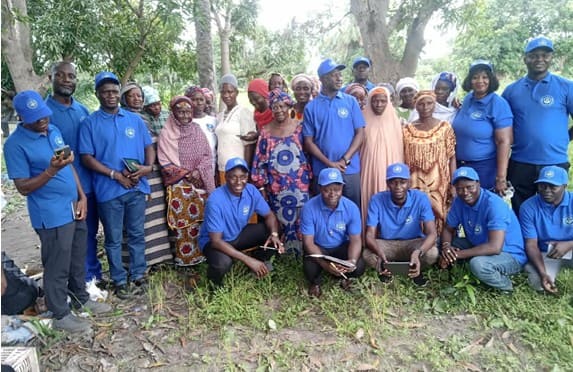
The Social Security and Housing Finance Corporation (SSHFC) has formally commenced registration for its Informal Sector Social Security Scheme, with 1,800 beneficiaries already registered in the pilot targeting women gardeners.
The scheme was launched yesterday at Lamin Wayorto women gardens.
Managing Director Saloum Malang said the Corporation has delivered on its three-year promise to include informal workers in the national social protection system.
“The season has started and details will follow,” Malang declared.
He said SSHFC spent three years conceptualising the scheme and conducting a nationwide mapping exercise using its own staff to ensure authentic data.
“In Africa, one of the problems is data integrity. Data I am keeping like my life, because it is so important,” he said.
Malang said analysis of the data confirmed the viability of the concept, paving the way for digitisation and formal rollout.
He said the pilot deliberately targets women gardeners because of their economic potential, vulnerability and organisation.
“When I was going to school in Bakau, I saw women gardeners. They are liquid, they go into gardening, they sell their produce to the hotels,” he recalled.
“If I want to start with 100 percent of everybody, it will be difficult. My women became my target because I know they get money, but management is their problem.”
He said targeting women also aligns with global priorities on gender equality and protection of vulnerable groups.
Describing himself as “Chief Servant of Social Security,” Malang announced: “Formally, I can say today, the informal sector has kick-started.”
He warned that 85.8percent of Gambian workers are not covered by any social security, according to GBoS.
“If 85 percent of the workforce are not covered, then Social Security as an institution has failed in its social protection mandate. We cannot sit back and fold our hands.”
Malang said expansion to the informal sector is critical for SSHFC’s sustainability, with potential to generate more revenue than the formal sector.
“Social protection is all about three things: coverage, adequacy, and sustainability.”
He cited Ghana, where informal sector revenue now surpasses the formal sector.
“This scheme is the best thing that can happen to Social Security. There is a direct correlation between social protection and economic prosperity.”
He said covering women gardeners will boost household incomes, cut hotel dependence on imports and improve the trade balance.
“Hotels will buy from them cheaper than importation. Government will make savings on imports and can even export excess. When that happens, our balance of trade will be positive.”
He said the Corporation will intensify nationwide sensitisation to ensure full coverage of informal workers.