The distinction could determine the future of the republic.
1. Barrow has changed the political battlefield
Adama Barrow entered national politics as the candidate who could unite Gambians against the entrenched political order of Yahya Jammeh. The coalition that brought him to power in 2016 was built upon a common objective: ending the old regime and opening a new democratic chapter.
Yet political coalitions formed to defeat a common adversary are not necessarily designed to survive the distribution of power. Once the common enemy disappears, differences over leadership, appointments, policy and the future direction of government inevitably emerge.
Barrow experienced that reality and subsequently established the NPP. Today, the same president who once depended on a coalition to defeat a dominant incumbent is seeking another mandate with an enlarged political alliance of his own.
That is a remarkable political reversal.
The NPP’s official messaging emphasises “Peace, Progress and Unity.” Its current nine point development plan also places good governance, justice, education, healthcare, agriculture, infrastructure, youth empowerment, digital transformation and environmental protection among its stated priorities.
These are compelling national aspirations. Nobody should oppose them merely because they are articulated by the governing party. But neither should the Gambian electorate confuse a manifesto with a completed achievement.
A promise is a political undertaking. A budgetary allocation is an administrative commitment. A completed project is evidence of implementation. A measurable improvement in the lives of ordinary citizens is the ultimate test of delivery.
On 5 December, voters must judge the distance between those four stages.
1. The defections are politically significant, but they are not electoral miracles
The entry of former opposition figures into the Grand Alliance is an undeniable political advantage for Barrow. It potentially expands his network of political organisers, strengthens his access to communities previously associated with rival parties and complicates the opposition’s attempt to construct a unified alternative.
Nevertheless, there is a dangerous assumption circulating in Gambian politics: that when a party leader changes political allegiance, the electorate follows automatically.
That assumption is profoundly mistaken.
Political leaders can change parties overnight. Voters do not necessarily change their convictions at the same speed. A supporter who has spent years criticising a government may not immediately embrace that government simply because the supporter’s preferred political figure has negotiated a new arrangement.
The question is whether the former opposition leaders can transfer their political credibility to Barrow, or whether their supporters will interpret their decisions as evidence that political principle has become negotiable.
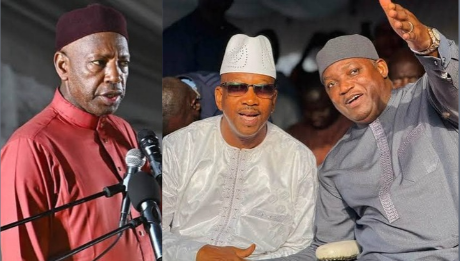
For Mamma Kandeh, Essa Faal and other political figures joining the alliance, the test is particularly demanding. They must explain not merely why they have joined, but what their participation will achieve for the people who previously trusted them to offer an alternative.
For Barrow, the calculation is equally consequential. He is gaining political allies, but he is also accepting responsibility for the expectations, grievances and constituencies those allies bring into his administration.
Every defection strengthens the coalition numerically while creating a new obligation politically.
The president may have enlarged his tent, but the bigger the tent becomes, the more difficult it is to satisfy everyone seated inside it.
1. The opposition’s greatest enemy may be its own arithmetic
The opposition must confront an uncomfortable reality. A ruling party does not need to command the affection of every Gambian to win a presidential election. It needs to mobilise enough voters across the country while its opponents divide the electorate among competing candidacies.
This is where the opposition’s fragmentation becomes potentially decisive.
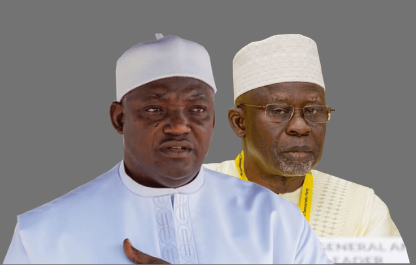
The United Democratic Party, led by Ousainu Darboe, retains an established political identity and a substantial electoral history. Talib Ahmed Bensouda and the Unite movement represent another significant political force, particularly in the urban political landscape. Other candidates and parties also possess constituencies, ambitions and legitimate claims to participate in the democratic process.
Yet a collection of opposition parties is not the same thing as a united opposition.
If competing candidates divide voters who would otherwise prefer a change of government, Barrow could benefit even without securing an absolute majority of all eligible voters. The applicable constitutional and electoral framework must be distinguished from political rhetoric: under the existing constitutional arrangements, the presidency is not governed by the two term limit contained in the rejected 2020 draft Constitution.
The consequence is clear. The opposition cannot simply rely on dissatisfaction with the incumbent. It must translate that dissatisfaction into a viable electoral strategy.
If its leaders spend more energy competing for ownership of the opposition than developing a credible pathway to government, they may inadvertently become the most effective campaigners for Barrow’s continued presidency.
There is no constitutional entitlement to defeat an incumbent merely because one opposes him. Victory must be secured through votes.
1. The Constitution permits political competition, not political entitlement
The Constitution of The Gambia is the supreme law of the republic. Article 61 establishes the presidency and requires the president to uphold and defend the Constitution. Article 62 sets out the qualifications for presidential election, while Article 63 provides for a presidential term of five years, subject to its specified provisions.
The existing Constitution does not impose the two term presidential limit that appeared in the 2020 draft Constitution, which failed to secure the required legislative support in 2020. A proposed constitutional reform must not be confused with the constitutional text currently in force.
Accordingly, the question of Barrow seeking a third term must be analysed through the existing law, not merely through the political expectations created during the 2016 transition.
But legality and political legitimacy are not identical concepts.
A candidate may satisfy the applicable constitutional requirements and still face serious questions about whether his political conduct honours the democratic expectations under which he originally acquired public support.
Barrow’s critics are entitled to interrogate his record, his promises and his interpretation of democratic renewal. His supporters are equally entitled to defend his record and argue for continuity. Neither side should claim that constitutional disagreement alone makes its opponents enemies of the nation.
The Constitution does not belong to the NPP, the UDP, Unite or any individual political leader. It belongs to the republic.
The electoral contest must therefore be settled by the lawful process, with the Independent Electoral Commission exercising its responsibilities and citizens retaining the freedom to choose their preferred candidate.
The most dangerous political argument is the one that treats victory as proof that everything a winner has done is right, or defeat as proof that an election was illegitimate without credible evidence.
1. Barrow’s manifesto is now a contract with an increasingly demanding electorate
The NPP’s stated priorities include good governance and public service delivery, national security and the rule of law, education and human capital development, healthcare and social protection, agriculture and food security, energy and infrastructure, youth and women’s empowerment, digital transformation, and environmental protection.
These priorities cover the principal areas in which citizens expect the state to perform.
However, their breadth creates an equally broad accountability obligation. The government cannot claim credit for the language of development while treating persistent public dissatisfaction as nothing more than opposition propaganda.
Young Gambians want more than ceremonial declarations of empowerment. They need credible employment opportunities, practical skills, access to finance and a business environment in which talent does not become a passport to emigration.
Farmers require productive infrastructure, reliable access to markets, agricultural financing and policies that improve food security. Businesses need dependable electricity, predictable regulation and a climate in which investment can create employment rather than merely generate announcements.
Families want public services that function. Citizens expect institutions that treat them fairly, irrespective of their political affiliations.
These expectations are not anti government. They are the legitimate demands of citizenship.
The president’s campaign must therefore do more than catalogue roads, buildings, official visits and political endorsements. It must demonstrate how public investment translates into household welfare, sustainable employment, stronger institutions and measurable improvements in living standards.
If the government can substantiate those achievements, it will have a serious argument for continuity. If it cannot, its expanding coalition may simply give more citizens an opportunity to ask why so many political leaders have joined the government while so many everyday problems remain unresolved.
1. The most explosive contradiction inside the Grand Alliance
Here lies the central political paradox.
Barrow’s coalition may become broader than any rival political organisation, yet its very breadth could make it harder to govern politically. Different parties enter alliances with different histories, supporters, expectations and calculations about their future.
Some may be motivated by development priorities. Others may believe cooperation offers a better route to national influence. Still others may conclude that remaining outside the governing camp carries greater electoral risk.
Those motives cannot responsibly be assumed in every individual case. Political agreements must be judged on their actual terms and subsequent conduct.
Nevertheless, a fundamental question remains: what happens when the interests of coalition partners diverge?
Will the alliance preserve meaningful internal debate, or will it demand unquestioning loyalty? Will new entrants influence policy, or will they merely strengthen the incumbent’s electoral machinery? Will political inclusion produce better government, or will it create competing expectations over appointments, influence and resources?
These are not allegations of wrongdoing. They are the unavoidable questions confronting any coalition that expands rapidly before an election.
Barrow’s greatest challenge may not be bringing former rivals into his camp. It may be persuading their supporters that the arrangement represents something more enduring than an electoral transaction.
A coalition can win an election through numbers. It can survive a governing term only through credible leadership, a coherent programme and the management of competing interests.
1. What is most likely to happen on 5 December?
My assessment is that Barrow enters this election with a formidable structural advantage. He possesses the advantages of incumbency, a recognised national political organisation, an enlarged alliance and a campaign narrative centred on continuity, stability and development.
The opposition, meanwhile, faces a more complicated strategic environment. Its candidates must distinguish themselves from one another while convincing voters that their competing ambitions will not collectively preserve the incumbent’s advantage.
The August 2026 pre election poll reported by The Point placed Barrow at 32 per cent, Darboe at 25 per cent and Bensouda at 19 per cent, with 17 per cent undecided. Those figures are a snapshot of reported opinion, not a forecast of the final result, and their interpretation has been contested by political actors. They nevertheless illustrate how a divided field could shape the contest.
My prediction is not that Barrow is guaranteed victory. It is that he is well positioned to benefit if the opposition remains fragmented, if the Grand Alliance successfully mobilises its expanded constituencies and if the governing party can persuade undecided voters that continuity offers a credible prospect of improvement.
Conversely, a coherent opposition strategy, persuasive policy alternatives, effective voter mobilisation and a credible explanation of how a change of government would improve citizens’ lives could substantially alter the contest.
The election is therefore likely to be decided by three interrelated factors: whether Barrow converts political defections into actual votes, whether opposition leaders can consolidate their support without alienating their respective constituencies, and whether undecided citizens prioritise continuity or change.
The most dangerous mistake for the opposition would be to assume that the electorate will punish Barrow automatically. The most dangerous mistake for the NPP would be to assume that political endorsements have already settled the election.
Neither assumption is intellectually defensible.
1. The verdict belongs to the Gambian people
The December election is not a contest to determine which politician can assemble the largest collection of former rivals. It is a contest over the exercise of public power and the direction of the republic.
Barrow must answer for his record. His opponents must demonstrate that they offer more than criticism. Those who have joined the Grand Alliance must explain what their participation means for the people who entrusted them with political representation.
The electorate must demand evidence, not theatre; measurable commitments, not extravagant promises; and constitutional fidelity, not selective appeals to legality.
Above all, Gambians must resist the temptation to transform political disagreement into permanent national hostility. A supporter of the NPP is not automatically an enemy of democracy. A supporter of the UDP, Unite or another opposition party is not automatically an enemy of development. The ballot must remain an instrument of peaceful choice, not a licence for intimidation, contempt or collective punishment.
My final prediction
Adama Barrow has a credible pathway to victory, and the expanding Grand Alliance could prove decisive. But an electoral advantage is not an electoral verdict, and political consolidation is not the same as national reconciliation.
If the opposition remains divided, Barrow’s position could strengthen considerably. If his new allies deliver their constituencies and his administration demonstrates tangible results, the case for continuity becomes harder to dismiss. If those allies fail to transfer support, if internal contradictions become public disputes, or if citizens conclude that political realignment has not improved their lives, the coalition’s apparent strength could prove less formidable than it looks.
The decisive question is not how many politicians have joined Barrow. It is how many voters will follow them, how many citizens will trust his record, and how many undecided Gambians will believe that the next five years offer a better prospect than the last five.
On 5 December 2026, the country will not be choosing a coalition photograph. It will be choosing a president.
And when the votes are counted, the greatest political embarrassment will belong to whichever side mistakes its own applause for the voice of the nation.
By Mohammed Jallow