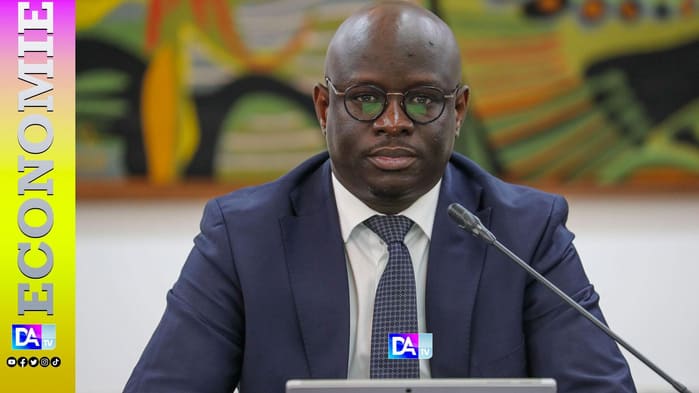
The Minister of Economy, Finance, and Planning, Cheikh Diba, yesterday told the Finance and Budgetary Control Committee that the government has reached a technical agreement with the IMF but that “you cannot build a sovereign Senegal on fragile public finances… a country that controls its debt controls its own destiny.”
The minister advocated for transparency regarding the figures, even at the risk of becoming unpopular. Faced with a projected growth rate of 1.5% for 2027—following 2.7% in 2026 — he rejected the notion that this signalled failure. “I want to be clear, this figure is not an act of resignation; it is the deliberate price of recovery.” He stated that he had “chosen the truth of the numbers over flattering assumptions that reality would have easily disproven”.
He urged the members of parliament to “face the facts,” noting that while growth is projected at 6.75% for 2025, driven by the Sangomar and Grand Tortue Ahmeyim projects, it would fall to 2.2% if the hydrocarbons sector were excluded. He applied the same caution to revenue projections: “We have learned lessons from 2026. We refuse to include in the budget any revenue that we are not certain we can actually collect.”
His philosophy of public policy, he explained, centres on the concept of trade-offs. “Governing means making difficult choices. In a context of limited resources, every franc allocated to a priority reflects a specific choice, and necessitates giving something else up,” he stated. According to him, this approach translates into prioritising healthcare, water and sanitation, education, mobility, and the protection of the most vulnerable. He pointed to the doubling of “family security grants”, from 70 billion to 140 billion CFA francs, as “one of the most significant choices in this budget,” alongside the 480 billion CFA francs earmarked to settle arrears owed to the private sector. “Paying what the state owes means injecting cash back into the real economy,” he said, pledging that no new arrears would be allowed to accumulate.
It was regarding the reform of energy subsidies that the minister took his firmest stance, promising to speak “frankly”. “Currently, a large portion of energy subsidies benefits the wealthiest households. This is neither fair nor sustainable,” he asserted. He did, however, outline several safeguards: maintaining subsidies for domestic butane gas (specifically for smaller canisters), implementing a social tariff for electricity for low-consumption users, and ensuring that protective measures are put in place “before or at the same time as any adjustment, never after.” The savings generated are intended to fund social safety nets. The goal remains to bring the cost of subsidies down to 1% of GDP by 2029.
Cheikh Diba also advocated for a rigorous approach to the use of public funds, particularly regarding struggling state-owned or parastatal enterprises. “Public money must yield results, not cover losses,” he declared, while announcing the restructuring of SONACOS, SODEFITEX, SAED, SODAGRI, and Air Sénégal. Regarding debt, he pledged that “every franc borrowed will be recorded, tracked, and justified,” as no loan or grant will be permitted to be executed outside the formal budgetary process. Cheikh Diba presented transparency as a deliberate choice: “It is not a constraint imposed upon us; it is a commitment we make to you, to our partners, and, above all, to the people of Senegal.”
Dakaractu