The National Environment Management Bill, 2026 has passed.
Now comes the work of making it breathe.
Last week, the National Assembly unanimously passed the National Environment Management Bill, 2026 at its third and final reading. Once the President assents, it will replace the National Environment Management Act of 1994, the law that has guided this country for three decades. The Ministry of Environment, Climate Change and Natural Resources (MECCNA) deserves credit for drafting the broadest environmental legislation this country has seen in a generation, and for doing it in the open, with the text on the National Assembly bill tracker for every Gambian to read. The National Assembly Members who saw it through deserve credit too. I offer observations as a physician who spends his working life treating the lungs this law is meant to protect.
What the law does
The Act opens with a right. Every person in The Gambia has a right to a clean, safe and healthy environment. Any person, group or association can go to the High Court when that right is threatened.
It establishes a National Environment Management Council, chaired by the President, with the Vice-President and the ministers of finance, environment, health, energy, agriculture, fisheries, trade and local government. The Council is the final decision-making body for environmental policy, regulations and standards. For the first time, environmental protection sits at the very top of government.
It creates an Environmental Quality Standards and Regulations Committee, chaired by the Deputy Executive Director of the National Environment Agency (NEA), with seats for the University of The Gambia, the Gambia Standards Bureau, the Gambia Bureau of Statistics and public health. Its mandate on air is clear: prescribe how air quality is measured, set ambient and occupational air quality standards, set emission standards by source, and issue guidelines for controlling pollution from vehicles, factories and other sources. The Council approves the standards, and the Agency publishes them in the Gazette. Environmental inspectors can enter premises, take samples, install monitoring equipment and, with the Executive Director’s approval, close polluting operations. The Agency can designate reference laboratories, and a certificate from an accredited laboratory will stand as evidence in court.
The Act puts real consequences on air pollution. A person who discharges fumes or other pollutants in breach of the Act faces a fine of D150,000 to D500,000 (roughly 2,100 to 7,100 US dollars), up to five years in prison, or both. A company faces a fine of not less than two million dalasi (roughly 28,500 US dollars), and directors who knew of the offence and did nothing can be held liable as well. In either case the court can order the polluter to pay the full cost of cleanup and compensate those harmed.
Why this matters for health
Air pollution is not an abstract concern in The Gambia. It is a daily reality. Air quality here is highly seasonal and is worst in the dry season, when Harmattan winds carry Saharan dust across the country. Beyond that natural cycle, there is a large human contribution from open burning of household and municipal waste, traffic pollution from an ageing vehicle fleet, and emissions from industry, including fish smoking along coastal fishing communities including Tanji, Gunjur, and Kartong. These are the sources a national law can do something about.
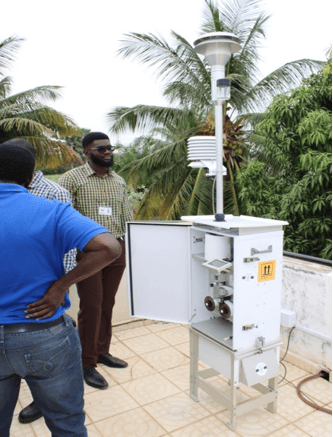
Through the Clean Air Initiative, the NEA, under the leadership of its Executive Director Dr. Dawda Badgie, has built a national ambient air quality network with the Permian Health Lung Institute. The network has more than 28 monitoring points covering all seven regions and combines low-cost sensors with the country’s only reference-grade monitor. It measures fine particulate matter, particles smaller than 2.5 microns (PM2.5). These particles pass from the lungs into the bloodstream and rank among the most potent environmental toxins known. Many people do not appreciate how poor air quality in The Gambia can be, or how heavily certain occupations are exposed.
The NEA has gone further than measurement. This year it hosted the country’s first Air Quality Awareness Week and carried a national awareness campaign to every region. It then completed the first National Household Survey on Air Quality and Waste Management with the Ministry of Health, the Gambia Bureau of Statistics and our institute. The survey covered 300 households in 30 enumeration areas from Banjul to Basse. It was designed to gauge public understanding of air pollution, learn how families cook and dispose of waste, and find where the gaps lie in reducing exposure. Analysis is under way. This work has been recognized internationally with an Air Quality Milestone Award from the University of Chicago’s Energy Policy Institute. A country cannot set standards or measure progress without knowing where it stands.
From law to clean air
Passing the bill was the first step. Whether the law works will now depend on its regulations, on the Standards Committee’s first agenda and on the national budget. The Act lets the Minister make regulations on the Agency’s recommendation and leaves most of the technical detail to the Standards Committee. That is where the following matters can still be settled.
Put a clock on air quality standards. The Act gives the ban on importing vehicles older than ten years a three-year runway. The air quality standards have no deadline at all. This matters more than it may seem, because the Act defines the general offence of pollution as polluting in excess of the standards and guidelines set under it. Until ambient standards for the major pollutants are gazetted, that offence has very little to measure against. The Standards Committee and the Council must each meet at least once every six months. Gazetting ambient air standards for fine particulate matter and the other major pollutants should be first on both agendas, with a public target date.
Write the monitoring network into regulations. The Act requires the Agency to monitor the environment and makes it the principal source of environmental data, but it does not say what that monitoring must consist of. Standards without measurement cannot be enforced. Regulations should set out a national ambient monitoring network with reference-grade instruments in each region. That would anchor the whole air chapter and secure the work the NEA has already begun.
Open the data. Under the Act, environmental information is released on application and payment of a fee, and the full state of the environment report comes every five years. Air quality changes by the hour. A public air quality index and an annual air quality report would cost little and build enormous trust. The Agency does not need a new law to do this.
Bring household air into scope. The Act defines ambient air to exclude the air inside any structure, and its air standards cover only ambient and occupational air. Yet for most Gambian families the heaviest exposure comes from the cooking fire and the burning of household waste. Emerging data from the household survey picture is sobering. By our preliminary count, well over 90 percent of households still cook with firewood and charcoal drawn from a forest estate that is shrinking by thousands of hectares a year. With the population growing at around 2.5 percent a year, a simple projection suggests the country could lose most of its remaining forest cover within a generation. Household energy is a forestry, climate and food security question as much as an air quality one. The Standards Committee already has a mandate on materials used for domestic purposes and on regulations for forest management and protection of the atmosphere. Household energy should be named explicitly on that agenda.
Pair enforcement with support for small operators. The penalties were written with factories in mind, but the minimum fine for an individual is the same D150,000 whether the polluter runs a plant or a fish-smoking oven. Courts must weigh the size of a business when setting a fine, but they cannot go below that floor. Artisanal fish smoking is the main way fish is preserved after harvest in The Gambia. The work is led overwhelmingly by women and sustains thousands of families in Tanji, Gunjur and Kartong. These communities cannot simply be told to stop. They need modern processing technology and occupational health protection over a realistic timeline. The same applies to roadside waste burning and small workshops. The Act lets the Minister of Finance, on the Agency’s recommendation, propose customs waivers and tax rebates for cleaner equipment. That section is the place to build a transition pathway, and enforcement guidelines should make clear that for small operators, improvement notices and support come before prosecution.
Set standards for laboratories and inspectors. Because a laboratory certificate will be evidence in court, the methods behind it must be beyond challenge. The Act refers to accredited laboratories but does not say who accredits them or against what standard. It requires only that inspectors be “duly qualified.” Regulations should name an accreditation standard and quality assurance requirements for designated laboratories, and set minimum training for inspectors. Given the capacity gaps in the country, accrediting private laboratories under NEA oversight would let existing capacity be used rather than built from scratch.
A case for investment
The Act creates the institutions and gives the Agency new sources of revenue: a share of taxes on imported second-hand vehicles, a share of the environmental tax on petroleum products, and seventy-five percent of environmental fines paid in court. A National Environment Trust Fund can receive grants for research and capacity building. None of this money is set aside for the monitoring network, the laboratories or the trained people who make them work.
Our experience with monitoring technology in The Gambia has taught us something important. The NEA’s low-cost sensor network is a real achievement and exactly the right tool for initial assessment, public awareness and tracking trends. But low-cost sensors were never designed to carry the weight of law. In our preliminary calibration work with the NEA, we compared the sensors against a reference-grade beta attenuation monitor. The two track each other closely, but the reference monitor records fine particulate levels about two and a half times higher than the sensors report. Those findings are still being finalized, but the direction is clear. A standard enforced in court must rest on an instrument that the law, the courts and the regulated community can all trust.
The Gambia currently has one such instrument. It was donated to the NEA, is maintained by the Permian Health Lung Institute, and is already proving its worth in the Greater Banjul Area. But one monitor cannot speak for a whole country. Air quality in the interior, where dust, agricultural burning and household fuel use combine differently, is not the same as along the coast. What the NEA needs now is capital investment to buy, install and maintain reference-grade monitors in every region, along with sustained support for capacity development and for recruiting and keeping talented staff. A fixed share of the vehicle and fuel levies, which come from the very sources being measured, would be a fair place to start. This is the natural next step for a program that has already earned international recognition, and the return can be measured in hospital beds not filled and lives extended.
The Ministry has given the country a strong foundation, the National Assembly has made it law, and the NEA has shown it can build on it. The task now, for the Ministry, the Council and all who care about this country’s air, health and environment, is to make sure the regulations and the budget secure the data, the laboratories and the people that will turn good law into clean air.
The author is a Pulmonologist and Critical Care doctor, and co-founder of the Permian Health Lung Institute. The views expressed are his own.