And it speaks through the ballot.
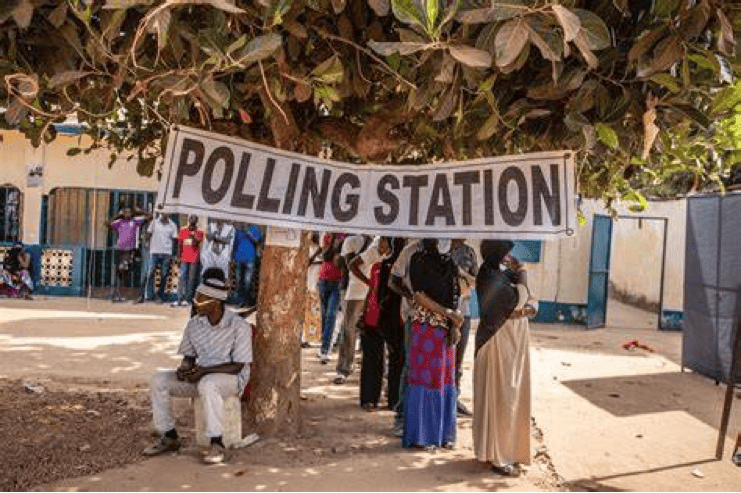
Yet, in every election, there are citizens who choose silence.
Some stay away because the queues are too long. Some because they have lost confidence in politics or politicians. Some believe that one vote cannot possibly make a difference. Others say they do not sufficiently trust any candidate to justify voting. Young people may feel disconnected from political institutions, while some elderly citizens may find the physical demands of voting difficult. For others, December is a season of holidays, celebrations and family gatherings, and voting becomes something to fit around everything else.
But democracy cannot survive indefinitely on the participation of only those for whom voting is convenient.
The right to vote becomes meaningful only when citizens are willing to exercise it.
I write these words as a Gambian living in the diaspora.
Like many Gambians abroad, I have responsibilities in my country of residence. Travelling home merely to cast a ballot involves time, expense and inconvenience. Yet I have made it a priority, In sha Allah, to return home to The Gambia to vote and thereafter return to my country of residence.
Why?
Because my vote is my voice.
Because voting is not, for me, a ceremonial exercise performed once every electoral cycle. It is the constitutional means by which I participate in determining the direction of the country to which I belong.
I do not regard voting as a favour granted to me by government.
It is a constitutional right, not a privilege.
History teaches us why that distinction matters.
Perhaps one of the most powerful lessons comes from South Africa.
For generations under apartheid, millions of Black South Africans were denied the fundamental democratic right to participate equally in choosing the government that exercised authority over their lives.
Then came 27th April 1994.
The images from South Africa’s first democratic election remain among the most moving images in modern political history because of the extraordinary queues of citizens stretching across fields, streets and communities as people waited patiently for the opportunity to cast a ballot in a fully democratic national election.
Many waited for hours.
The elderly came.
The young came.
Mother’s carrying their babies on their backs waited.
Fathers carrying their children in their arms waited.
People who had spent most of their lives denied an equal political voice came.
They did not look at the queue and say, “It is too long, I will vote another time.”
For many, there had never been another time.
Some had waited not merely hours to vote.
They had waited a lifetime.
Nelson Mandela himself, then seventy-five (75) years old, cast his first vote in a national election in 1994.
Think about that.
A man who had spent twenty-seven years imprisoned in the struggle against apartheid reached the age of seventy-five before he could exercise a democratic right that many of us possess from early adulthood.
That history should force us to ask an uncomfortable question:
What value do we place upon a right for which others sacrificed generations when we surrender it merely because exercising it may inconvenience us for several hours?
A long queue can be frustrating.
A lost constitutional opportunity is far more consequential.
Another powerful lesson comes from Australia, one of the world’s most enduring constitutional democracies. Unlike The Gambia, voting in Australian federal elections is compulsory by law. Section 245(1) of the Commonwealth Electoral Act 1918 provides in simple but powerful language:
“It shall be the duty of every elector to vote at each election.”
An elector who fails to vote without a valid and sufficient reason may receive a penalty notice and be required to explain the failure or pay the prescribed penalty.
Australia did not adopt compulsory voting because its people lacked democratic values. Quite the contrary. It was introduced federally in 1924 to encourage broad civic participation, strengthen the legitimacy of elected governments and ensure that elections reflected the will of the community rather than only those motivated enough to vote. Since its introduction, voter turnout at Australian federal elections has consistently exceeded 90 per cent of enrolled voters.
Reflect for a moment on what that means.
In a nation of more than twenty-seven million people, millions of Australians wake before dawn on election day, travel to polling stations and patiently wait in queues to fulfil what the law regards as a civic duty. They do not vote because it is always convenient. They vote because participation in choosing their government is considered an essential responsibility of citizenship.
The Gambia, by comparison, has a little over one million registered voters. No law compels us to cast our ballots. Our Constitution gives us that freedom and leaves the decision to our own conscience.
That freedom should inspire participation, not indifference.
If millions of citizens in Australia willingly comply with a legal duty to vote because they recognise its importance to democratic governance, surely, we, as Gambians who enjoy the freedom to choose whether or not to vote, should feel an even greater moral responsibility to honour that right voluntarily.
Democracy is strongest not when citizens are compelled to participate, but when they understand why participation matters.
The true measure of citizenship is not merely possessing the right to vote, it is recognising the privilege and responsibility that accompany that right and choosing to exercise it for the good of the country.
History teaches us two enduring lessons. In South Africa, people waited a lifetime for the right to vote. In Australia, the law requires citizens to vote. In The Gambia, we possess that right freely. The question, therefore, is not whether we can vote, but whether we value that right enough to use it.
We must therefore speak particularly to the young people of The Gambia.
The youth are not merely “the leaders of tomorrow,” as we so often tell them. They are citizens of today.
The decisions made by governments now will determine the quality of the education they receive, whether jobs exist when they graduate, whether entrepreneurship is encouraged, whether they can afford housing, whether they see migration as their only path to opportunity, and whether the country they inherit offers them hope.
If young people withdraw from elections, they do not withdraw from the consequences of elections.
You may choose not to participate in choosing a government, but you cannot choose not to live under the decisions that government makes.
The cost of disengagement does not disappear because one refuses to vote.
It appears in classrooms.
It appears in hospitals.
It appears in the price of food.
It appears in employment opportunities.
It appears in electricity and water.
It appears in roads and public transport.
It appears in national debt and taxation.
It appears in policing and national security.
It appears in the independence and strength of public institutions.
It appears in whether young Gambians believe they can build successful lives at home or must risk everything in search of opportunity elsewhere.
That is why voting must never be reduced to personalities.
An election should not be a beauty contest.
We should not vote for someone merely because we like him.
We should not reject someone merely because we dislike him.
We should not vote because a candidate comes from our family, village, region, tribe, social circle or community.
We should not surrender our independent judgment because of rumours, WhatsApp messages, political slogans or what somebody told us about a candidate.
Nor should politics become football, where allegiance to a team survives regardless of performance.
The question before a voter should be much more serious:
Who, in my considered judgment, is best equipped to advance the national interest of The Gambia?
That question requires us to examine substance.
What is the candidate’s vision for the country?
What has the candidate actually achieved where he or she has previously held responsibility?
Does the candidate demonstrate integrity?
Does the candidate respect the Constitution, the rule of law and the independence of institutions?
What are the candidate’s plans for education?
Healthcare?
Employment?
Agriculture and food security?
Infrastructure?
Security?
Energy?
Housing?
Investment?
Youth development?
Women’s economic empowerment?
Technology?
The environment?
What is the candidate’s approach to corruption and public accountability?
Does the candidate understand the economy?
Can the promises being made realistically be financed?
Does the candidate have the competence and team necessary to transform promises into policy and policy into results?
Does the candidate seek to unite Gambians or divide them?
Does the candidate regard political opponents as enemies or as fellow citizens with different views?
And perhaps most importantly:
Will this person leave The Gambia stronger than he or she found it?
These are reasons to vote.
There is also another category of political behaviour that deserves reflection and they are those I have previously described, metaphorically, in an earlier article as “The Mafia.” They often remain conspicuously absent from the democratic process itself. They watch, they wait and they calculate. Rather than openly exercising their constitutional right and making a considered choice while the outcome remains uncertain, they wait to see who wins and once power has found its new or renewed address, they suddenly emerge, gravitating towards the victor, rediscovering relationships and positioning themselves for access, influence, relevance or opportunity.
There is something fundamentally troubling about seeking to enjoy the fruits of an electoral outcome while avoiding the civic responsibility of participating in the process that produced it. Democracy should not become a system in which ordinary citizens patiently stand in queues to determine the future of their country while others remain comfortably on the sidelines, waiting to discover whom they should embrace after the votes have been counted.
A healthy democracy requires something more principled. If you believe in a candidate, exercise your constitutional right according to that considered belief. If you believe another candidate offers a better future, vote accordingly. If you are undecided, examine the records, interrogate the policies, assess the character and make the best judgment your conscience permits. But do not treat democracy like a horse race in which you wait until the winner crosses the finishing line before rushing into the winner’s enclosure and presenting yourself as though you had been part of the journey all along.
That culture substitutes proximity to power for commitment to principle. Presidents change. Governments change. Political fortunes change. But our convictions about what is right for The Gambia should not conveniently change merely because the occupant of political power has changed.
Indeed, a citizen who conscientiously votes for a candidate who ultimately loses has participated more meaningfully in the democratic process than one who refuses to make any choice but appears beside the winner the morning after victory proclaiming loyalty.
By Omar F M’Bai