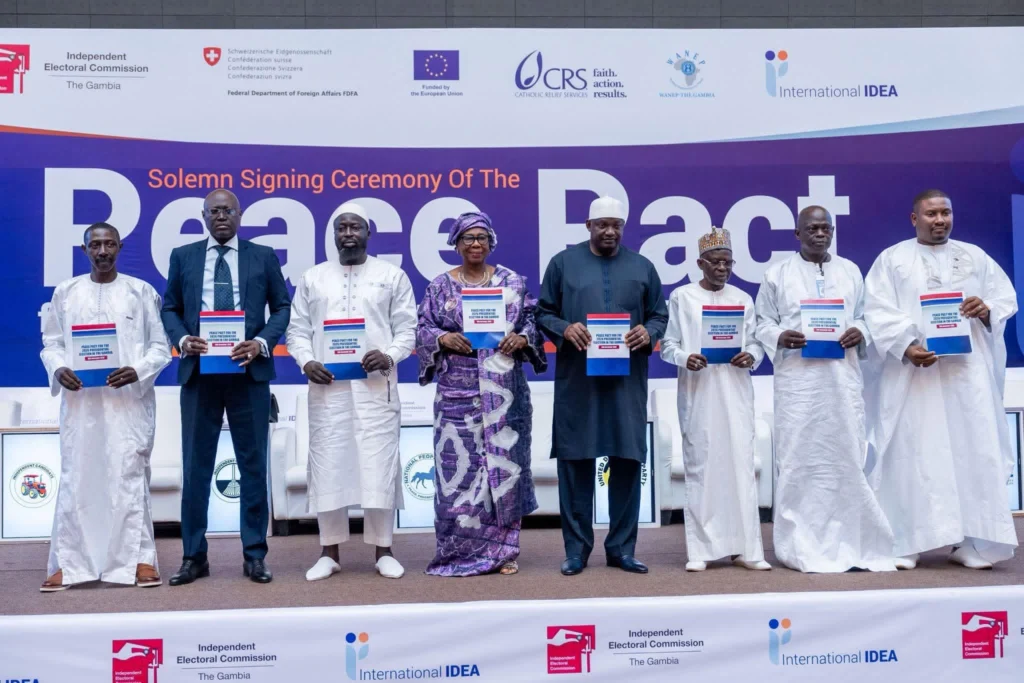
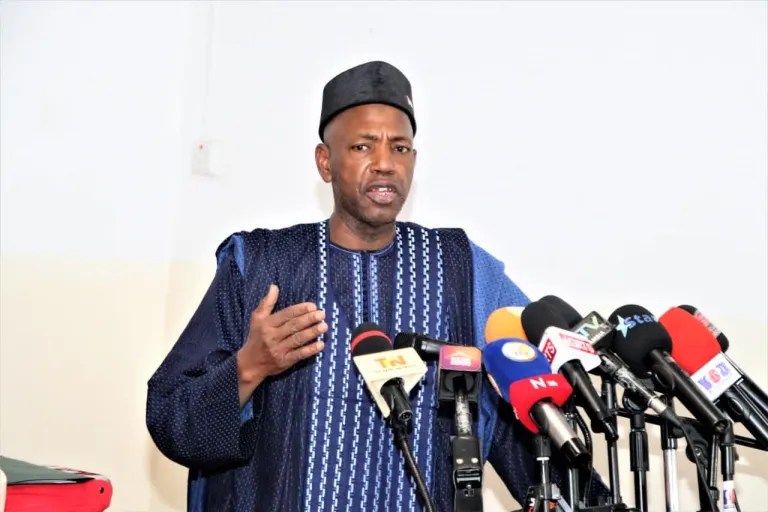
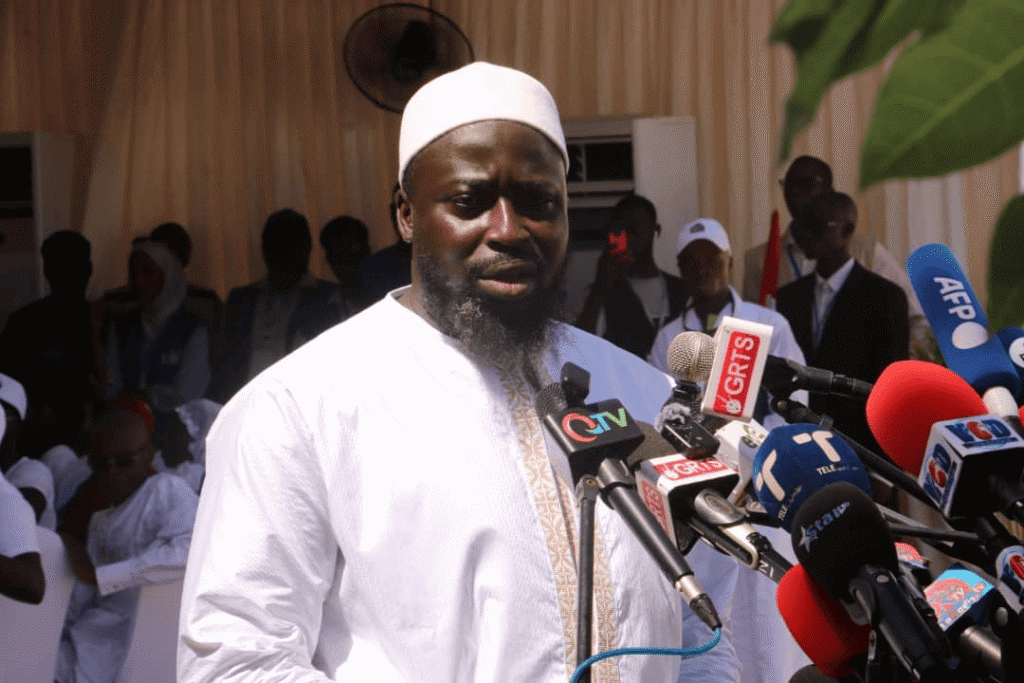
Opposition (UDP) leader ANM Ousainu Darboe is contesting under the Gambia First Coalition, while Talib Bensouda leads the Coalition 2026 platform associated with Unite. The Gunjur-born lawyer, Lamin J Darbo, has been nominated as the flag-bearer of the Team Gambia Coalition. Other candidates are also seeking the presidency.
The available evidence gives us a basis for assessing their relative positions. It does not, however, justify declaring the winner before Gambians cast their ballots.
A responsible assessment must distinguish between three things: who currently has the strongest polling position, who has the most favourable electoral conditions, and who is ultimately capable of securing the highest number of valid votes.
These are related questions, but they are not identical.
Two November polls, two different pictures
The most important new evidence comes from the CepRass national opinion poll, released on 16 November 2026, and the November 2026 third-round Gambia Participates survey, whose findings became public on 18 November 2026.
The Gambia Participates survey reported the following voting intentions:
Adama Barrow: 28%
Ousainu Darboe: 25%
Talib Bensouda: 24%
Undecided: 19%
Other candidates collectively: 4%
On these figures, Adama Barrow leads Ousainu Darboe by three percentage points and Talib Bensouda by four. The difference between Darboe and Bensouda is just one percentage point.
This is a closely grouped contest among the three leading candidates in the latest Gambia Participates survey. The survey does not establish a comfortable lead for any of them.
CepRass reported a different picture. Its voting-intention findings were presented by political formation:
Adama Barrow’s NPP-led coalition: 37.9%
Ousainu Darboe’s Gambia First Coalition: 24.2%
Talib Bensouda’s Coalition 2026: 11.3%
Almameh Gibba’s No to Alliance: 5.8%
Lamin J Darboe’s Team Gambia Grand Coalition: approximately 1.8%
NDP: 1.3%
Other candidates: 0.5%
None: 1.4%
Undecided: 11.6%
Prefer not to say: 4.2%
The NPP-led coalition was ahead of Gambia First Coalition by 13.7 percentage points. Coalition 2026 was in third position.
At first glance, the CepRass figures suggest a more substantial advantage for the incumbent’s political formation than the Gambia Participates figures suggest for Barrow personally.
But the two surveys are not measuring precisely the same thing. Gambia Participates reported support for individual candidates, while CepRass presented its principal voting-intention figures by political formation or alliance. The figures should therefore not be placed side by side as though they were identical measurements.
Nor should the difference between them be treated as proof that one survey is right and the other wrong. Both provide information about public opinion at particular moments. Their differences make methodological transparency and careful interpretation even more important.
The question now arises: How do incumbency, alliance support, and the burden of performance shape Adama Barrow’s political prospects?
President Adama Barrow enters the December 2026 presidential election with an important political advantage: incumbency.
He has occupied the presidency since 2017 and is seeking another term with the backing of the NPP-led alliance. Incumbency can provide advantages in visibility, national political organisation and the ability to present a record of government performance to voters.
The November 2026 CepRass poll gives the NPP-led coalition a leading position at 37.9%. The Gambia Participates survey also places Adama Barrow first in individual voting intention, with 28%.
There is another potentially important finding from Gambia Participates. The Gambia Participates survey reported that 37% of respondents believed Adama Barrow had the best chance of winning, compared with 24% for Ousainu Darboe and 22% for Talib Bensouda.
This is not the same as saying that 37% intend to vote for Adama Barrow. It measures perceived likelihood of victory rather than personal voting preference.
Nevertheless, the distinction is politically interesting. More respondents appear to expect Adama Barrow to win than say they personally intend to vote for him. That gap may reflect perceptions of incumbency, political organisation, the strength of his alliance or other considerations. The poll alone cannot establish which explanation is responsible.
However, Barrow also faces a significant challenge: the public’s assessment of his government’s performance. CepRass found widespread dissatisfaction with economic conditions.
Approximately 80% of respondents rated the economic situation as fairly bad or very bad. The cost of living was identified as the most important election issue by 43%, while food prices accounted for another 14%. These findings suggest that economic conditions will be central to the campaign.
The question for Adama Barrow is whether his administration can persuade enough voters that its record, policies and future plans deserve another mandate.
Barrow’s incumbency and alliance support are important assets, but they do not remove the need to answer public concerns about living costs, employment, electricity, governance and public services. A leading position in an opinion poll is not immunity from electoral accountability.
This brings me to another question: How does Ousainu Darboe’s established political base shape his position and influence within the opposition, ahead of the presidential election?
Ousainu Darboe remains a central figure in the opposition contest. The Gambia Participates survey places Ousainu Darboe at 25%, just three percentage points behind Adama Barrow and one percentage point ahead of Talib Bensouda.
The November 2026 CepRass survey places Darboe’s Gambia First Coalition at 24.2%, making it the second-largest political formation in its voting-intention results. These findings suggest that Ousainu Darboe retains a substantial base of support.
Darboe’s challenge is to convert that support into a sufficiently broad national coalition of voters. The presence of several opposition candidates makes this more complicated.
It would be tempting to add the support of all opposition formations together and conclude that the opposition collectively has more votes than the ruling alliance. Such arithmetic is not a reliable prediction of an election result.
Voters do not automatically transfer their support from one candidate to another simply because those candidates oppose the incumbent. Political loyalties, personal preferences, policy differences, local considerations and perceptions of leadership can all influence individual decisions.
The central question for Ousainu Darboe is therefore not simply how much opposition support exists in total. It is how much of that support he can personally attract and whether he can expand beyond his established political base.
The available polls show that Ousainu Darboe remains a serious contender. They do not establish that opposition voters will consolidate behind him.
Another key question arises: How does Talib Bensouda’s political presence influence the dynamics of a three-way electoral contest?
Talib Bensouda and Coalition 2026 introduce another important dimension to the election. The November 2026 Gambia Participates survey places Talib Bensouda at 24%, only one percentage point behind Ousainu Darboe and four behind Adama Barrow. That is a substantial position in a contest involving eight candidates.
According to an official public notice issued by the Gambia’s Independent Electoral Commission on 19th November 2026, Ansu Sanneh of the National Builders Party (NBP) withdrew from the 5th December 2026 presidential election after formally qualifying, thereby reducing the final field from nine candidates to eight.
Now, coming back to Talib Bensouda’s chances, CepRass, however, places Bensouda’s Coalition 2026 at 11.3%, considerably below the NPP-led and the Gambia First political formations (alliances).
This difference deserves attention, but it must be interpreted in light of the different questions and categories used by the surveys. Candidate-level support and alliance-level support are not necessarily interchangeable.
Talib Bensouda’s position also raises a broader question about the relationship between established political loyalties and support for alternative political leadership.
Can a candidate build a national coalition that extends beyond an existing party base? Can organisational strength at local level translate into support across different parts of the country? And can a campaign maintain its momentum beyond areas where the candidate is already well known?
The November 2026 Gambia Participates figures suggest that Talib Bensouda is firmly part of the leading group in that survey. Whether that support is sufficiently broad and durable to produce an electoral breakthrough remains to be established.
The question now arises: How does geographical distribution influence voting patterns and electoral outcomes?
The forthcoming presidential election in the Gambia cannot be understood through national percentages alone. The IEC’s final register records 1,146,474 registered voters across 53 constituencies, 730 polling centres and 1,773 polling stations.
The geographical distribution is particularly important. Brikama administrative area accounts for 437,020 registered voters, approximately 38.1% of the national register. Kanifing has 210,437, approximately 18.4%. Together, these two administrative areas account for approximately 56.5% of registered voters.
This concentration makes Brikama and Kanifing important areas for understanding the national electoral contest. However, their size should not be confused with a guaranteed political advantage for any presidential candidate.
The November 2026 CepRass poll provides some useful local-government-area figures. In Brikama, the Gambia First recorded 29.6%, compared with 27.8% for the NPP-led alliance. Talib Bensouda’s Coalition 2026 recorded 11.5%, while 17% were undecided.
The difference between Gambia First Coalition and the NPP-led alliance was only 1.8 percentage points. In Kerewan, the NPP-led alliance recorded 37.6%, compared with 36.7% for the Gambia First Coalition, a difference of just 0.9 percentage points. These are narrow differences.
Without the relevant subgroup sample sizes and design-adjusted margins of error, they should not be described as statistically established leads. The Kanifing figures also deserve attention.
CepRass reported 31.7% for the NPP-led alliance, 19.5% for Gambia First Coalition and 12.9% for Coalition 2026, with 22% undecided.
These findings demonstrate why a national poll should not be treated as a complete picture of the electoral map. A candidate may lead nationally while facing a much closer contest in particular areas. Another may have concentrated support in selected locations without yet demonstrating the national reach required to win.
The new constituency-level register data can help researchers understand where voters are registered and how the electorate is distributed. But registration numbers do not tell us how those voters intend to vote. The distinction between the size of an electorate and its political preferences must remain clear.
To what extent could the undecided electorate influence the outcome of the presidential election?
One of the most important features of both November 2026 surveys is the number of respondents who have not settled on a candidate. The November 2026 Gambia Participates reported 19% undecided. CepRass reported 11.6% undecided and another 4.2% who preferred not to disclose their choice.
These categories should not be combined indiscriminately. An undecided voter is not necessarily someone who refuses to disclose a preference. A person who declines to answer may already have made a decision.
Nevertheless, both surveys indicate that a meaningful proportion of the electorate has not publicly committed to a candidate or has not disclosed its preference. The final campaign period may therefore be important.
Candidates will need to explain their programmes, demonstrate their credibility and persuade voters that their proposed leadership offers a convincing response to the Gambia’s challenges. However, it would be misleading to assume that undecided voters will move towards the candidate who campaigns most aggressively or makes the most attractive promises.
Their eventual decisions may be influenced by economic considerations, political identity, local relationships, candidate credibility, campaign developments and the broader national environment. The direction of their movement remains unknown.
To what extent could economic conditions influence voter preferences and determine the outcome of the presidential election?
The economic question is central to the 2026 presidential election. The November 2026 CepRass found that approximately 80% of respondents viewed economic conditions negatively. The cost of living was the leading election issue, followed by security and food prices.
When asked what mattered most in choosing a presidential candidate, respondents identified competence (39%), policies and manifestos (22%), and integrity (16%).
These findings suggest that voters are not necessarily evaluating candidates only through party affiliation or political alliances.
They are also considering whether candidates possess the competence, policies and personal integrity needed to govern.
For the incumbent leader, the economy represents an opportunity and a risk. The Barrow government can present its achievements, explain its policies and make the case for continuity.
The opposition candidates can challenge the Barrow government’s record and propose alternatives.
But public dissatisfaction does not automatically mean that voters will reject the incumbent. Equally, incumbency does not guarantee that voters will reward the government. The electoral question is how voters translate their economic experiences into political decisions.
The campaign should therefore be judged not only by the number of rallies held or promises announced, but by the seriousness and credibility of the solutions presented.
What are the limitations of the available polling evidence in assessing electoral trends and voter preferences?
A credible election assessment must examine the quality of the evidence as well as the headline figures.
The November 2026 CepRass survey reported a sample of 1,180 respondents, covering 118 enumeration areas across all eight Local Government Areas and 53 constituencies. Its fieldwork took place between 17th October and 1st November 2026.
The CepRass survey used face-to-face household interviews and a multi-stage stratified sampling approach. It reported a nominal margin of error of approximately three percentage points at the 95% confidence level.
However, its summary findings also indicate that 77.4% of respondents who answered the voting-intention component were household heads rather than the individuals originally selected for interview.
That is an important methodological issue. The full technical report is needed to understand how respondent substitution was handled, how the data were weighted and what implications this may have for the reliability of the voting-intention estimates.
The November 2026 Gambia Participates survey reported interviewing 1,861 adults with valid voter cards between 20th October and 4th November 2026. Its survey covered all eight Local Government Areas, 53 constituencies and 120 wards.
However, the full technical report for its November 2026 round is also needed to assess the sampling procedures, respondent selection, weighting, question wording and design-adjusted uncertainty.
The two surveys therefore provide useful evidence, but their technical limitations and differences must be acknowledged.
A larger sample does not automatically guarantee a more accurate poll. Nor does a published margin of error remove the effects of sampling design, weighting, non-response or respondent selection. Until the full technical documentation is available, strong claims about which survey is more reliable would be premature.
What would change the electoral picture before 5th December 2026? Several developments deserve close attention during the remaining campaign period.
First, the consolidation of political support. The extent to which the leading candidates can mobilise their existing supporters and attract additional voters will matter.
Second, the geographical distribution of support. Developments in Brikama, Kanifing and other areas with significant registered electorates could influence the national outcome.
Third, the economy and public services. Voters’ assessment of the Barrow government’s record and the credibility of opposition proposals may influence undecided voters.
Fourth, campaign organisation and turnout. Stated voting intention is not the same as actual participation. A candidate’s ability to translate support into votes on election day is crucial.
Fifth, campaign conduct and public confidence. The IEC’s preparations, the candidates’ Peace Pact commitments and the work of domestic and international observers will all contribute to the credibility of the process.
The final weeks may produce new information that changes the relative positions of the candidates. Any assessment published now must remain open to revision as further evidence becomes available.
So, who is best positioned to win the presidential election? The evidence from the surveys supports a cautious but meaningful conclusion.
President Adama Barrow currently has the strongest overall polling position across the two November 2026 surveys, although the nature of that lead differs.
Gambia Participates places Adama Barrow first as an individual candidate, with 28%, ahead of Darboe at 25% and Bensouda at 24%.
The November 2026 Gambia Participates survey also reports that more respondents believe Barrow has the best chance of winning.
The November 2026 CepRass survey places the NPP-led alliance first with 37.9%, ahead of Gambia First Coalition at 24.2% and Coalition 2026 at 11.3%.
Taken together, these findings suggest that Adama Barrow is currently the candidate best positioned on the available national polling evidence.
That is a reasonable assessment of the evidence, not a prediction that the election is already decided.
Ousainu Darboe remains a serious challenger, with support close to Adama Barrow in the November 2026 Gambia Participates survey and a substantial political base represented in the November 2026 CepRass figures.
Talib Bensouda is also an important contender. Bensouda’s 24% in the November 2026 Gambia Participates survey places him close to Ousainu Darboe and within four percentage points of the incumbent.
The evidence does not establish that either opposition candidate can automatically inherit the support of the other. Nor does it establish that Barrow’s polling advantage will necessarily survive the final campaign period.
There is also no sound basis for treating the combined opposition vote as a single transferable bloc. The distinction is important: being best positioned at this stage is not the same as being certain to win.
In conclusion, the ballot, not the poll, will decide the outcome of the forthcoming presidential election, as the ultimate verdict rests with voters when they cast their votes on election day, not with projections, predictions or opinion surveys.
The 2026 presidential election is approaching with a clearer candidate field, a substantial registered electorate and two national surveys offering different but useful perspectives on voter preferences.
The available evidence gives President Adama Barrow the strongest overall polling position. But the contest remains open enough to warrant serious attention to Darboe, Bensouda, undecided voters, geographical variations and the capacity of each campaign to mobilise support.
For CepRass, the responsibility is not to manufacture certainty or declare a winner prematurely. It is to examine the evidence, identify what it establishes, acknowledge what remains unknown and explain why the distinction matters.
An election is ultimately determined by valid votes cast, not by the expectations of respondents interviewed weeks before polling day. On 5th December 2026, Gambians will make the decision. Until then, every assessment must remain evidence-based, measured and open to new information.
Words of wisdom: An election is not won in an opinion poll, nor is it decided by the arithmetic of political alliances. Polls reveal possibilities; voters determine outcomes. The responsibility of serious political analysis is to interpret the evidence without pretending to know what only the ballot can decide.
By Dr Ebrima Ceesay
Dr Ebrima Ceesay, is a distinguished Gambain academic based in the UK.