

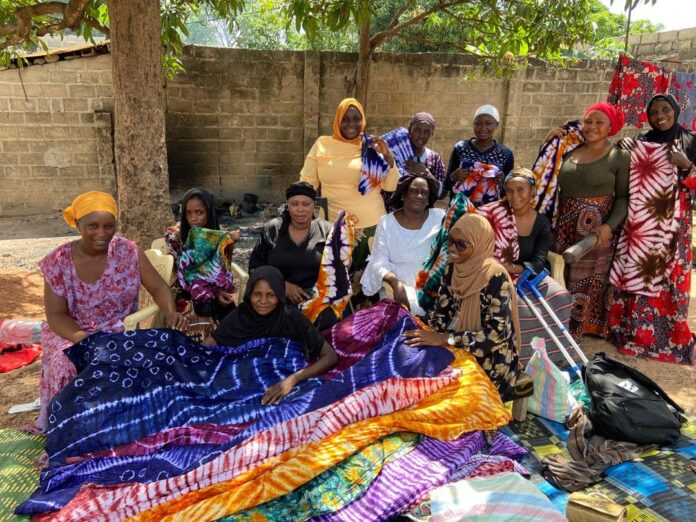

By Olimatou Coker
STAND-Gambia, in partnership with the European Union (EU), has trained 10 women amputees in tie-dye production as part of a three-day skills development and entrepreneurship training under its Ladies Empowerment for Growth and Success (LEGS) initiative.
The training, which ended yesterday at Sututa Nema, was designed to equip the participants with practical skills to create income-generating opportunities and enhance their economic independence.
The initiative forms part of a three-year STAND-Gambia project aimed at supporting persons with limb differences to regain independence, improve their livelihoods and strengthen their capacity to provide for their families and contribute meaningfully to their communities.
Through skills development and entrepreneurship support, the programme seeks to promote the economic empowerment of women with limb differences by providing them with practical skills that can be turned into sustainable sources of income.
Nyima Ceesay, Administrator of LEGS, said the programme is the second phase of their skills-development initiative, following an earlier training in bead making and key-holder production.
She said the tie-and-dye products produced by the participants will be sold, with the proceeds kept in the association’s account to support and sustain the initiative.
Ceesay added that LEGS plans to extend the training to other regions, but appealed to the government, stakeholders and donors to support the initiative.
“We cannot do it alone,” she said, urging partners to help empower women with disabilities to become self-reliant.
The training is being conducted in collaboration with Stand We Walk Together, an NGO supported by the European Union in The Gambia.
Ceesay also thanked The Standard newspaper for its continuous coverage of the initiative and called on other media houses to help highlight the achievements and activities of persons living with disabilities.
By the end of the three-day training, participants produced 31 tie-and-dye pieces ready for sale.
She encouraged the participants to remain determined, saying: “If they push, they can do it. Let them believe in themselves.”
Ebrima Bah, Coordinator of the EU STAND Project, said the project – Enhancing Rehabilitation and Empowering Amputee Associations in The Gambia, is a joint initiative co-funded by the European Union and STAND Gambia. Launched in 2025, the project will run until November 2027.
According to Bah, the project aims to improve rehabilitation services and empower amputee communities across The Gambia through skills development, training, community sensitisation and microfinance support.
The project currently works with amputee organisations, including Ladies Empowered for Growth and Success (LEGS) and the Gambia Amputee Football Association (GAFA).
Bah said 10 women are benefiting from the training, which is designed to equip them with practical skills for self-employment and income generation.
“We want to train them to competency so that they can use these skills to develop themselves and generate income,” Bah said, noting that skills development can help address the challenge of unemployment.
He added that the project is also exploring ways to support the sustainability of the associations beyond the project period. This includes plans to establish a shop where beneficiaries can sell tie-and-dye and bead-making products and generate income to support their associations.
“Our aim is to ensure that they are empowered and able to sustain their associations even after the project ends,” Bah said.
Mama Mboge, the Vice President of Ladies Empowerment for Growth and Success (LEGS), expressed delight in being part of such training.
She added that the knowledge gained will help them and their families.
She also thanked their partners for always standing beside them, saying they have been helping them a lot which they are grateful of always.
“We are being left behind in the inclusiveness they claim. If 99 percent are included and only 1 percent of us are included, that is not fair.”
Tida Fofana, trainer, urged the participants to make best use of the knowledge gained.
Mariama Njie, a beneficiary from the Ladies Empowerment for Growth and Success (LEGS), said she is very happy to be part of the training.
She added that the knowledge she gained will be impactful and useful to her.
The training will also enable beneficiaries to apply their newly acquired tie-dye production skills to establish or expand small businesses, thereby improving their livelihoods and contributing to the economic well-being of their families.

