


By Olimatou Coker
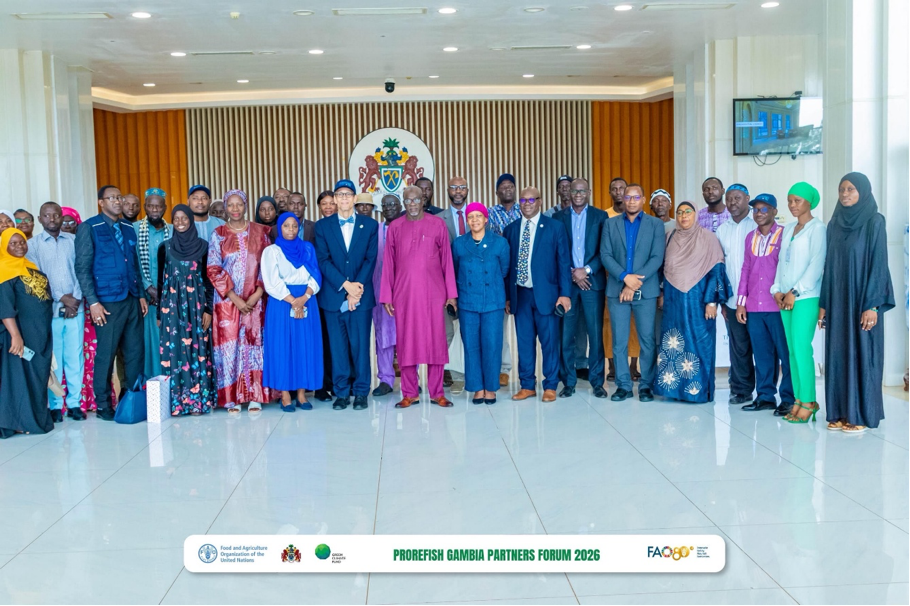
The Food and Agriculture Organisation of the United Nations (FAO), in partnership with the Government of The Gambia, recently convened the PROREFISH Gambia Partners’ Forum 2026 at the Sir Dawda Kairaba Jawara International Conference Centre in Bijilo under the theme “Resilient Fisheries and Ecosystems: Progress and Partnerships.”
PROREFISH Gambia is a six‑year climate adaptation initiative financed by the Green Climate Fund (GCF) and implemented by FAO in collaboration with the Ministry of Fisheries, Water Resources and National Assembly Matters. The Partners’ Forum brought together government bodies, development partners, civil society organizations and other stakeholders to review achievements, share institutional updates, and identify opportunities for deeper collaboration to advance climate‑resilient fisheries and sustainable ecosystem management.
Musa S Drammeh of the Ministry of Fisheries, Water Resources and National Assembly Matters said the forum provides a timely opportunity to evaluate progress and agree concrete actions that will deliver sustainable results for communities that depend on fisheries and aquatic resources.
“The Government of The Gambia values its partnership with FAO,” Drammeh said. “Through PROREFISH, we are building a fisheries sector that is productive, resilient and environmentally sustainable, and that creates decent livelihoods—particularly for women and young people.”
He noted the fisheries sector remains a pillar of the national economy, contributing substantially to food and nutrition security, employment, export earnings and household incomes. “Thousands of Gambians depend directly or indirectly on fisheries, with women playing a central role in processing, marketing and value addition,” he said.
Drammeh highlighted PROREFISH investments in mangrove restoration, which rebuild breeding and nursery habitats for fish and other aquatic species, strengthen coastal resilience, protect biodiversity and secure the natural resources fishing communities rely on. He also praised the project’s focus on women, saying efforts to build literacy, technical skills and business capacity are enabling stronger participation in the value chain and improving household incomes.
Ms Moshibudi Rampedi, FAO Representative in The Gambia, said PROREFISH strengthens adaptation and reduces climate risks in the fisheries sector by reducing vulnerability of artisanal fisheries infrastructure and equipment; expanding aquaculture to offset climate‑driven declines in capture fisheries; and restoring degraded mangroves that serve as key breeding and nursery grounds.
“This Forum has three clear purposes: take stock of progress across the project’s components—habitat restoration and community management, aquaculture expansion, and improved climate adaptive capacities; identify persistent challenges; and align PROREFISH with broader national priorities, including mangrove restoration, climate‑proofing landing sites and livelihood strengthening,” Rampedi said. “We must move from project implementation to programme building, from reporting to strategic reflection, and from partnership to renewed collective commitment.”
Karl Frederick Paul, UN Country Coordinator in The Gambia, said PROREFISH aligns with United Nations priorities and The Gambia’s Green Recovery‑Focused National Development Plan. He noted the United Nations Sustainable Development Cooperation Framework (UNSDCF, 2024–2028) supports green growth and the Sustainable Development Goals.
“PROREFISH is a fisheries initiative with far‑reaching impact,” Paul said. “When a woman dries her catch with less spoilage, her household eats better and earns more. When a cooperative keeps proper records, it becomes a stronger partner for lenders.”
He also referenced the recent State of World Fisheries and Aquaculture report, which recorded a global production high of 235 million tonnes while noting continued pressure on marine stocks and unequal access to aquatic food.
PROREFISH Gambia aims to reduce climate risk and improve livelihoods by decreasing exposure and vulnerability, promoting aquaculture, and restoring mangrove ecosystems. The project will advance aquaculture technologies, strengthen the enabling environment for fisheries, and engage the private sector for long‑term sustainability across its three components.