


By Aminata Kuyateh
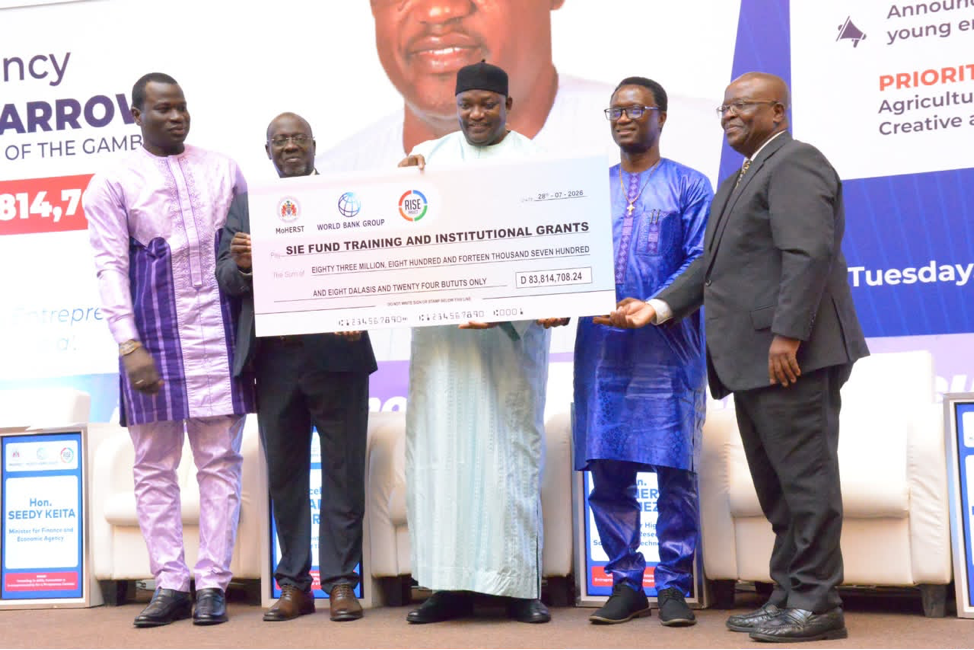
President Adama Barrow on Tuesday awarded D83,814,708.24 in grants to Technical and Vocational Education and Training (TVET) institutions under the Skills, Innovation and Entrepreneurship (SIE) Fund at the International Conference Centre. The funding, provided through the World Bank-funded Resilient Inclusive Skills and Employment (RISE) Project and administered by the Ministry of Higher Education, Research, Science and Technology (MoHERST), aims to expand market-relevant skills and boost youth employment and entrepreneurship.
The awards include scholarships and stipends for 1,318 TVET students and institutional improvement grants to 25 TVET providers. The SIE Fund disbursed support through two windows: Window One awarded D33.9 million to 25 institutions to upgrade infrastructure, equipment, governance, and training quality; Window Two allocated D49.9 million to 18 institutions to deliver labour-market driven training for young people and women.
President Barrow said the grants target priority sectors—agriculture, engineering, tourism, business, and the creative and performing arts—and stressed that the investment is a strategic effort to reduce youth unemployment, foster enterprise development, and drive economic growth. “This D83.8 million investment will intensify skills delivery and expand opportunities for our young people,” he said. He added that training must be linked to enterprise creation, innovation and access to markets.
Barrow announced a new call for proposals under Window Three to support the establishment of 75 startups annually, including targeted funding for young agri-entrepreneurs.
World Bank representative Franklin Mutahakana said the SIE Fund under the Gambia RISE Project is increasing access to market-relevant TVET and supporting pathways from training to jobs and entrepreneurship. He highlighted demographic pressures—63.7% of Gambians are under 25, and 37% of youths aged 15–24 are not in education, training, or employment—underscoring the need for stronger links between training providers and employers.
Mutahakana urged greater inclusion of women, persons with disabilities, and youths outside the Greater Banjul Area, and emphasised the need for sustained partnerships among government, training institutions, and industry to scale impact.