Saikou ML Ceesay
6th year medical student
How often have you heard on the news recently, or on Whats On Gambia, of people committing suicide because of one problem or another? Unfortunately, what I have to say next is the worst possible follow-up to that. Many people are actually contemplating it, and one of the many possible reasons stopping them is that their religion forbids it. This hits home more when it is colleagues and friends in school and at work places going through it.
I initially wanted to write about how people usually misconstrue depression with sadness but what changed my mind was a message I received about someone I am beginning to get fond of saying they want to disappear.
That took my mind to an incident of when I went to a pharmacy, and saw a young lady being sold antidepressant medications. I am guessing anyone reading have at least once heard a friend say they were depressed before. We have also heard about the stigma attached to it: “yow dor niteh” “kee dafa bori problem” “bopam b sedut” “dafa doff” and the list goes on.
But what is depression and what causes it?
Before defining it, there are some terms you have to be familiar with. One of those terms is called neurotransmitters; these are chemicals that allow cells in your brain called neurons, to send each other signals and to control our moods and behaviour. The most important neurotransmitters (or let’s call them “brain chemicals” from now on) are serotonin, dopamine and norepinephrine, as these hormones when present, improve your mood.
Another word is genetic, which means traits transferred from your parents to you.
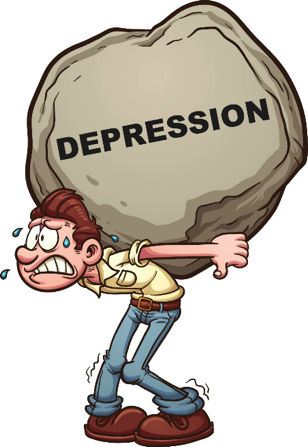
Now, depression in the simplest of terms I can explain is that depression is feeling deeply sad for a long time, even when there’s nothing specific making you sad. It can feel like a big gray cloud that blocks out the sun, even on a nice day. It makes it hard to feel happy or do the things you usually enjoy. However, on the outside, it’s often hard to tell when someone is having these feelings because people are good at masking it and acting as if nothing is going on. One of the reasons is that they do not want to be looked at differently, seen as “weird,” “mad,” or in the case of boys, not being “masculine enough” to handle whatever life throws at you. These reasons alone are problems we, as a society need to solve, but that is a topic for another day.
The main cause of depression is actually unknown; however, there are factors that increase the chances of a person developing depression. One of these is genetics. So if your family has a history of depression, those genes could have been passed on to you, making you susceptible. That is called heritable depression.
Nevertheless, genetics alone cannot cause depression. Another factor is biology, which relates to the brain chemicals we mentioned earlier. These chemicals, serotonin, norepinephrine and dopamine, when in the right balance, help you maintain a good mood, emotional stability, healthy sleep, motivation and energy. However, if there is an imbalance and these chemicals are in low amounts, the person will be in a bad mood, emotionally unstable, lack good sleep, be less energetic and demotivated, all of which, as mentioned earlier, are signs of depression.
Furthermore, another factor is psychology. This could stem from a person grieving the death of a loved one, going through physical abuse, psychological abuse or childhood trauma. All of these can alter your brain and increase its vulnerability to depression.
Recent studies from 2020, according to the WHO rental Health Atlas for The Gambia, showed that about 2,000 people per 100,000 are depressed, and 10 in every 100,000-commit suicide. The report also indicated that no research or publications have been made on mental health, and government expenditure on it remains unknown. Additionally, there are only four psychiatrists and two psychologists in the country.
However, at the end of the day, what we want is a solution to this silent epidemic, but the solution is not one-size-fits-all. So, we have a non-pharmacological approach, meaning treatment that does not involve medication. This includes regular physical exercises, because this increases the release of the chemicals which elevate your mood, so hitting the gym or running on the beach will be a great place to start. Another approach is having a healthy eating habit and eating nutritious food, keep a social network of friends and family to talk to or go and “campeh.”
You can also see a trained psychologist or psychotherapist. All these approaches help elevate your mood and help detect negative patterns on time and change them.
Now, the pharmacological approach is taking medications called antidepressants, prescribed by a professional to balance the imbalanced brain chemicals which improve your mood.
Lastly, as a society, we need to work together to help tackle this and the best place to start is being more knowledgeable about depression, not stigmatising depressed people, being more empathetic and seeing it as something that could happen to anyone.