

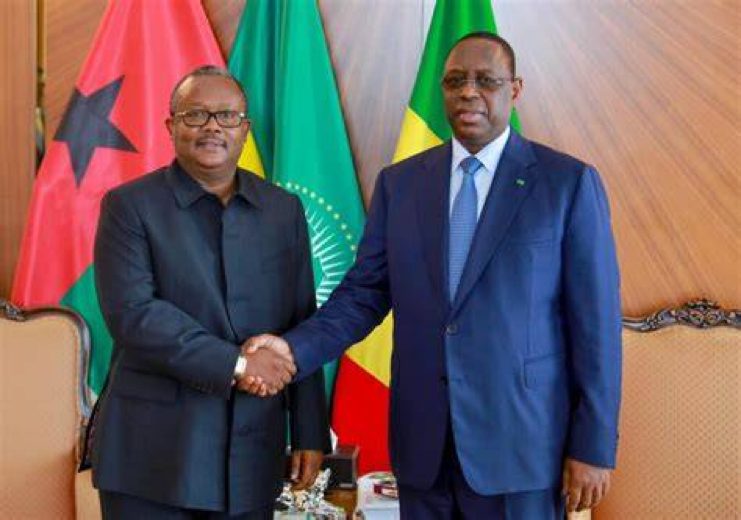
By Sheriff Bojang Jnr
The former president of Guinea-Bissau has become the constant companion on Macky Sall’s bid for the UN’s top job, turning a decades-old mentor-protégé relationship into one of West Africa’s most striking displays of political loyalty.
When Macky Sall arrived at the presidential palace in Mogadishu this week for talks with Somali President Hassan Sheikh Mohamud, the focus was naturally on the former Senegalese president’s campaign to become the next United Nations secretary-general.
But there was another familiar figure quietly following every step of the visit. Walking beside Sall, greeting officials and joining the high-level audience was former Guinea-Bissau president Umaro Sissoco Embaló.
Since losing power, the 54-year-old has relentlessly tried to reinvent himself – without obvious success. Ousted in November 2025 in a disputed coup that opposition figures say was staged to prevent an electoral defeat – a claim that also drew scepticism from former Nigerian president and ECOWAS election observer Goodluck Jonathan – Embaló has become a constant companion on Sall’s campaign trail.
From the Umrah pilgrimage in Mecca to lobbying visits in Mogadishu, he has rarely been far from the former Senegalese president’s side. On Monday, he made his loyalty explicit.
“I reaffirm my total and constant support for the candidacy of President Macky Sall, a convinced pan-Africanist whose experience and vision will honour Africa at the head of the United Nations,” he wrote on Facebook.
Sall’s diplomatic campaign is also gathering pace. On Tuesday, he announced he would travel to Senegal on Friday for talks with President Bassirou Diomaye Faye as part of consultations linked to his UN bid. Embaló is widely reported to have helped broker a rapprochement between the former president and his successor, easing the way for their meeting after months of strained relations.
To date, Faye has held the line, refusing to endorse Sall’s candidacy. That is key to Sall’s prospects: contenders who cannot secure the backing of their own country stand little chance of winning over many of the UN’s other 193 member states. But that position could shift after the two men meet in Dakar on Friday.
So what explains Embaló’s extraordinary loyalty to Sall, even after both men have left office?
Brothers before presidents
The relationship between the two men stretches back decades, long before either occupied a presidential palace. According to Guinea-Bissau investigative journalist Allen Yero Embalo, former president Embaló spent several years living in Sall’s home in Dakar before Sall entered frontline politics.
“He was eating, sleeping and washing his clothes in Macky’s house,” Allen tells The Africa Report. “That is what built the very strong relationship they have.”
Allen says Embaló was already close to Sall when the future Senegalese president was still a senior official in Senegal’s state oil sector. When Sall later fell out with then-president Abdoulaye Wade and decided to establish the Alliance for the Republic (APR), Embaló remained at his side.
“He contributed a lot to finding the first funds to set up the party,” Allen says. “He considers himself one of the founders of APR even though he is not Senegalese.”
The friendship endured as both men rose to power and survived after they left office. Sall settled in Marrakech while Embaló made Casablanca his base, but the two remained in frequent contact.
“They share a lot of things,” Allen says. “Now they are moving around the world together [as Sall campaigns for the UN top job].”
Senegalese political analyst and media manager Hamadou Tidiane Sy says the relationship was never a conventional political alliance but something closer to an elder-younger brother bond.
“Embaló worked with Sall more like someone working with an elder brother, the African way,” Sy tells The Africa Report. “It was something informal, but they were very, very close and had special personal ties.”
The relationship has never been one-sided. Seydi Gassama, executive director of Amnesty International Senegal, says Sall also played an important role in Embaló’s own rise to power in Bissau.
According to him, after the first round of Guinea-Bissau’s 2019 presidential election, Sall hosted a political conclave in Dakar where defeated candidates, including outgoing president José Mário Vaz and third-placed Nuno Gomes Nabiam, agreed to unite behind Embaló against first-round winner Domingos Simões Pereira of the African Party for the Independence of Guinea and Cape Verde (PAIGC).
“That rallying of the other candidates, secured in Dakar, was decisive in his victory on 29 December 2019,” Gassama says.
The mutual political debt, analysts say, helps explain why Embaló has invested so visibly in Sall’s international ambitions.
A role unlike any other
Embaló’s support extends beyond public endorsements. In recent months, he has accompanied Sall across the Middle East, Asia, Europe and Africa as the former Senegalese president lobbies for the UN’s top job. Their travels have taken them from the Umrah pilgrimage in Saudi Arabia to meetings with leaders in China, South Korea and Pakistan, an audience with French President Emmanuel Macron at the Élysée Palace, and this week’s visit to Somalia.
The two men have arrived together at official meetings and greeted leaders side by side, making Embaló the most visible supporter of Sall’s international campaign.
Allen says the former Guinea-Bissau president is putting his own diplomatic network at Sall’s disposal.
“He knows many heads of state and government,” he says. “He wants to use those relationships to give Sall every possible chance of becoming secretary-general.”
Unlike domestic elections, the race to succeed Antonio Guterres will be decided through months of quiet diplomacy, personal relationships and painstaking lobbying before it reaches the United Nations Security Council and General Assembly.
“Embaló certainly doesn’t have the votes to propel Sall to victory, but he has the connections and the political doggedness to get leaders to warm up to him and perhaps put in a good word when the UN makes its decision,” a former senior official at Guinea-Bissau’s foreign ministry, who requested anonymity because of the sensitivity of the issue, tells The Africa Report.
“Embaló’s political strength lies in his cunning and persistence. He gets what he wants, even if it means walking over people or hurting them. But he’s also extremely charming and convincing.”
Sy agrees that Embaló’s value lies less in Guinea-Bissau’s diplomatic weight than in the signal sent by another former African president visibly championing Sall’s candidacy.
“The mere fact that another former head of state is almost playing the protocol role for Sall is important,” Sy says. “He may not have many votes to offer, but he can open doors in certain circles.”
An alliance under scrutiny
The partnership has also attracted fierce criticism from human rights campaigners.
Gassama argues that Sall and Embaló share not only a close personal bond but also similar approaches to power and governance.
According to Gassama, the two men’s political relationship should raise questions for UN member states assessing Sall’s candidacy.
“Sall’s candidacy would never have been credible if human rights and good economic and financial governance still mattered to UN member states,” he says.
Gassama adds that more than 65 Senegalese, including children and teenagers, were killed during Sall’s presidency and accuses the former government of leaving behind about $7bn in hidden public debt that has worsened the country’s economic crisis.
Will Embaló be an asset or liability for Sall?
Gassama is equally critical of Embaló, accusing him of presiding over democratic backsliding in Guinea-Bissau.
“The fact that he associates with Embaló, whose track record on democracy and human rights is equally disastrous, and makes him his main lobbyist, is an affront to the founding values of the United Nations, namely peace and security, economic and social development, and human rights,” he says.
“The election of Sall would further discredit the UN, an organisation that has already lost the trust of many global citizens.”
Sy says Embaló’s unusually prominent role could ultimately prove to be either an asset or a liability for Sall. While his diplomatic contacts may help open doors, his own contested exit from office and the criticism surrounding Sall’s domestic record are likely to feature in the campaign.
“Whether Embaló is a blessing or a liability is difficult to say,” Sy says. “But I’m sure Sall has calculated the advantages and disadvantages before allowing him to play such a prominent role in the campaign.”
Gassama has consistently opposed any official Senegalese backing for Sall’s candidacy. In February, he publicly appealed to President Faye not to support the former president’s bid, arguing that doing so would betray the memory of the Senegalese killed during political unrest under Sall’s administration.