Barrow urges Darboe to join NPP alliance to dodge December disgrace
By Omar Bah
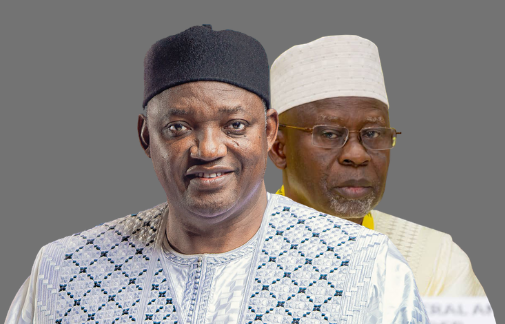
President Adama Barrow has publicly challenged United Democratic Party (UDP) leader Ousainu Darboe to join the National People’s Party (NPP)-led alliance ahead of the December presidential election, warning that refusal could leave the veteran politician politically isolated.
Speaking at the State House following the signing of a memorandum of understanding with Gambia Democratic Congress (GDC) leader Mamma Kandeh, Barrow projected growing confidence in his re-election prospects, citing expanding political support as evidence of momentum in his favour.
Although he described Darboe as “a respected elder”, the NPP leader said the political landscape is shifting, and urged him to join “the emerging national coalition” represented by his grand alliance” or remain in political periphery. He framed the appeal as a call for unity, arguing that national development should take precedence over partisan rivalry.
The president pointed to his past working relationship with Mr Darboe — who served as his vice president and minister of foreign affairs — as a foundation for possible reconciliation.
The appeal came immediately after the NPP formalised its alliance with the GDC, a move Barrow said underscored increasing confidence in his leadership and policy direction. He emphasised that his coalition remains open to additional partners as it consolidates support ahead of the polls.
Barrow recalled his 2016 electoral challenge against former president Yahya Jammeh, presenting himself as a leader defined by resilience and willingness to confront entrenched power.
For his part, Mamma Kandeh defended the GDC’s decision to join the alliance, arguing that it reflected a strategic commitment to national development rather than a retreat from opposition principles. He maintained that past criticisms of the government was intended to promote accountability, not hostility.
The NPP-GDC agreement marked a significant realignment in Gambian politics, intensifying pressure on opposition parties to unify. While Barrow’s camp now presents itself as a broad-based national movement, rival groups continue to explore coalition options in a bid to remain competitive in December.