

By David Kujabi
The transition from cadet to police officer was supposed to feel like a triumph. Instead, my initial months on the job felt like a slow drowning, not in water, but in the weight of a salary so reduced that I often arrived at work with empty pockets, unable to afford breakfast. Yet, despite the financial strain, I was passionate about my new role. I immersed myself in daily trials, learning from colleagues and devouring policing literature. But amid this personal struggle, I noticed a far larger problem: a vast, troubling communication gap between the police force and the public. The police worked diligently to uphold law and order, but the public did not recognise or appreciate their efforts. Somewhere in that disconnect, an idea began to take shape, an idea that would test my resolve, humiliate me in public, and eventually bring me to tears of joy.
During those early reflections, the concept of bridging the gap through a police magazine began to form in my mind. I shared this vision with two colleagues who would become brothers to me: Abdou Bojang and Lamin Njie. They embraced the idea immediately, recognising it as a powerful means of connecting with the public. Together, we composed a detailed proposal outlining our vision for a police magazine and submitted it to Commissioner Abdoulie Sanyang, the officer responsible for reviewing such initiatives.
But then, nothing happened.
For reasons beyond our understanding, our proposal languished in bureaucratic limbo. Along its journey through the chain of command, some individuals questioned our aspirations. Others underestimated our commitment. Days turned into weeks, and weeks into what felt like an eternity. Finally, I decided to approach Commissioner Sanyang personally to inquire if he had even seen our proposal. To my surprise and dismay, he had not. I promptly provided him with a fresh copy.
As he perused our proposal, his demeanour changed. He became visibly excited. Then came the condition: he would support us only if we could guarantee the production and sustainability of the magazine. Without hesitation, I confidently assured him that we could meet this commitment.
True to his word, Commissioner Sanyang secured approval from Inspector General of Police Yankuba Sonko. IGP Sonko not only permitted our undertaking but also extended his unwavering support to the POLISO team throughout his tenure. I hold IGP Sonko in the highest regard and attribute the foundation of my career to his guidance and encouragement.
In May 2011, I was tasked with producing the inaugural edition of the Gambia Police Force Magazine, POLISO. Despite limited resources, our unwavering commitment, supported by the trust and backing of IGP Sonko and Commissioner Abdoulie Sanyang, served as our driving force.
At this time, Lamin Njie was on cadet rotation in Soma, while Abdou Bojang was stationed in Bansang. Despite the geographical distance, these dedicated colleagues actively contributed to our publication’s success. On my end, I served as a one-person team on the ground, operating without a designated office.
Enter Ansumana Kinteh, then a Superintendent of Police and the Commanding Officer in the Human Resource Office. Kinteh was the youngest senior police officer I knew, and he worked tirelessly to ensure the magazine’s success. He hosted me in his office and facilitated the acquisition of a laptop for me to use. Fortunately, the Independent Electoral Commission (IEC) had recently donated a few used laptops to the GPF, ones they had used for voter registration. I was handed a fairly used one. In Kinteh’s office, I had no table; all I had was a chair. I used my lap as a desk. Yet Kinteh made me feel welcome and comfortable, and together, we worked to publish the maiden edition of the police magazine by July 22, 2011.
Another person who proved invaluable was Malick Mboob, a banker and former journalist. He was hired as a consultant to guide us through the journey. For my part, I began compiling stories while simultaneously initiating correspondence. I wrote letters to all police commissioners, seeking their input and support. We also approached various institutions, companies, and organisations, soliciting their interest in advertising in our maiden edition.
During follow-up calls, a painful pattern emerged. Many found the notion of the police producing a magazine incredulous. Some did not hide their scepticism about our capability to undertake such a venture. But rather than dampen our spirits, their cynicism served as fuel. It strengthened our resolve to see the magazine come to fruition. Remarkably, this scepticism was not confined to external stakeholders. Even within the police ranks, significant doubt lingered.
Among the few senior officers who responded positively were Commissioner Mamour Jobe, the Commandant of the Police Training School; Commissioner Aziz Y Bojang of the Peacekeeping Centre; and Commissioner Aminata L Ndour of the West Coast Region. Several other commissioners offered suggestions, but they did not significantly contribute to our cause. Various name suggestions were put forth, “Samakatt,” “Crime Stoppers,” and others, none of which we found particularly appealing. In search of a local and impactful name, we proposed “POLISO.” After careful consideration, my colleagues unanimously agreed that it encapsulated the essence of our magazine perfectly. The name was established.
As we compiled stories and secured advertising support, one incident left a lasting mark on me, a mix of embarrassment and humility. I was working on a story detailing the efforts of Chief Superintendent Landing Bojang, the Operations Commander of Serekunda, in combating crime in the area. I had already interviewed him, but needed photographs of the patrol team.
Accordingly, I sought permission from Officer Commanding Samba Jawo to join the afternoon patrol in Serekunda. A vehicle was en route to Serekunda, which I intended to join. But I knew I did not have sufficient funds to cover my return fare home once my task was completed.
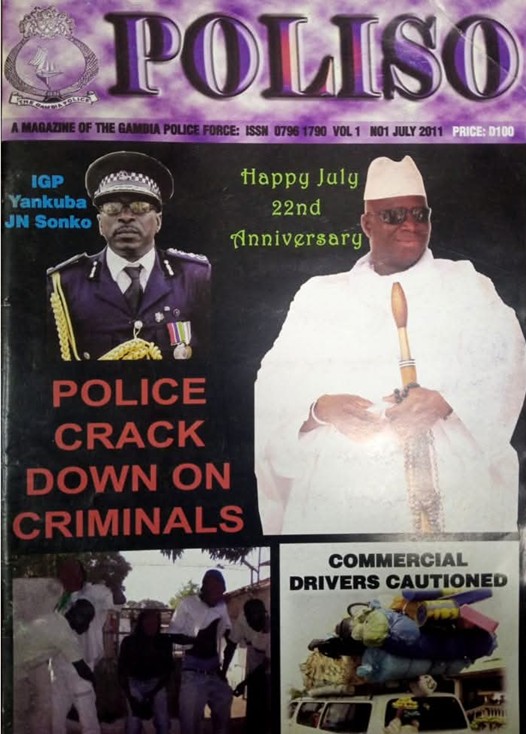
Upon contacting OC Jawo, I specifically requested that Commander Bojang be notified of my need for transportation. I hoped he would provide transport for my return journey. I travelled to Serekunda and participated in a patrol that combed through crime-prone areas like Shanghai and Hannover. The cover photo of our first magazine edition was captured that day – officers searching a group of boys in the Hannover area.
When the patrol concluded, I reported to Commander Bojang, anticipating his assistance. He expressed his gratitude and bid me farewell, without making any transportation arrangements. I then realised that his interpretation of OC Jawo’s request to “provide transport” was limited to allowing me to join the patrol team, not to sending me home. I had only five Dalasis in my pocket. The fare to Lamin was seven.
With embarrassment crawling up my neck, I made my way to the car park, uncertain of my next steps. It was a little after 4 PM, and the park bustled with commuters eager to return home. I approached some drivers and asked if they would accept five Dalasis. The first two firmly stated that the fare was seven. My embarrassment heightened. I began to perspire, still clad in my white police uniform, standing there uncertain and distressed.
Then I felt a gentle touch on my hand. I turned to see a young apprentice, no older than fourteen, who discreetly placed two Dalasi coins into my palm and urged me to board the vehicle. I complied and found a seat in a corner. My face flushed with embarrassment throughout the entire journey back to Lamin.
We completed the magazine by dint of hard work, sacrifice, and great teamwork.
On July 22, 2011, the first edition of POLISO magazine was published. The day I held a printed copy of the magazine, I cried. I wept reflecting on the challenges, the scepticism, the outright predictions of failure, and the two Dalasi from a boy who had more faith in me than I had in myself at that moment.
The first edition received an overwhelmingly positive response and was met with immense pride and joy by police force personnel. Our achievement was a collective triumph. We wasted no time commencing work on the second edition, slated for publication in December.
Eager to outdo AHOOAH, the magazine produced by the Gambia Armed Forces, we aspired to feature an exclusive interview with President Yahya Jammeh in the upcoming edition. We submitted a letter to the Office of the President requesting an audience. In response, we were asked to present our intended questions.
Commissioner Abdoulie instructed us to draft our questions for review. But one question we included led to the shelving of our interview idea entirely. We had inquired whether the president believed that the frequent changes in the Inspector General of Police position hindered the force’s growth, since each new appointment disrupted continuity of vision and plans. While we believed the question was legitimate, we were informed that we could not pose it to the president and commander-in-chief. In hindsight, I understand the command’s decision, which likely preserved the magazine’s existence. At that time, we were too inexperienced to grasp the intricacies of politics and the dynamics within the corridors of power.
Consider the facts: from when Yahya Jammeh assumed power in July 1994 until 2011, there were twelve different IGPs. Some served for less than a year. Pa Sallah Jagne, a former IGP who had served under President Jawara, was removed after the 1994 coup. Rex King, a retired Fire Officer, served from June 1999 to June 2000. Ousman Sonko, a military captain, was appointed IGP in April 2004 and served until September 2007. Musa Mboob, previously the Director General of the Immigration Department, was redeployed as IGP from April 2007 to June 2008. None of these appointees was a career policeman, except Musa Mboob, who had trained in the Gendarmerie, a military force with law enforcement powers. Benedict Jammeh, an Assistant Superintendent of Police, was appointed IGP but served briefly before being replaced. Benn Wilson, a retired military officer, was appointed Commissioner of Police and later served as IGP.
These appointments, often involving non-police personnel, were met with deep disapproval within the police ranks. Officers were preoccupied with the fear of losing their jobs instead of concentrating on their professional duties. Pleasing the whims of the presidency became a priority for most IGPs, leaving them with a nearly impossible balance between what was right and what was desired by the commander-in-chief. It became a running joke among us that Yahya Jammeh never visited police headquarters nor attended any police function, despite numerous invitations. This further fueled the perception that he was not particularly supportive of the police force, unlike his visible interactions with the army.
The birth of POLISO Magazine was never just about printing a publication. It was about proving that a group of young, under-resourced, and often dismissed officers could bridge a gap that others had accepted as permanent. It was about the humiliation of begging for transport fare and the grace of a teenage apprentice who gave me two Dalasis without a word. It was about sceptics who laughed at the idea of police producing a magazine, and the tears I shed when I held proof that they were wrong. POLISO became a household name in The Gambia, not because we had resources or political favour, but because we refused to give up. And in that refusal, we discovered something lasting: the power of a small idea, held firmly, can outlast the doubts of many.