In Plato’s Academy, no fees were charged, but no fools were tolerated. The intellect was sovereign, and rhetoric its steward. The philosopher-king was not a brand ambassador, but a weary soul forged in dialectic. In that tradition, knowledge was sacred. To pretend to it without substance was not only dishonest. It was heretical.
Saint Augustine, writing under the shadow of Rome’s ruin, believed learning to be a form of repentance: a turning away from the self toward the eternal. To study was not to shine, but to shrink, to be confronted by the vastness of what one did not know.
By the 12th century, the great cathedral schools birthed the universities. And with them came hierarchy, method, and order. Degrees were earned in blood and sweat. To be called “Magister” or “Doctor” was to carry the weight of a tradition stretching back to Aristotle and Aquinas. It was not an accessory. It was a vow.
The British took this inheritance and dressed it in their own peculiar solemnity. At Oxford, dons walked in black robes and spoke in riddles. At Cambridge, logic was measured in syllogisms and tea. The purpose was not merely education, but formation: to produce not clever men, but good ones. Men who could govern empires and write sonnets with equal ease.
When Cardinal Newman delivered his lectures on the idea of a university, he was not defending the modern diploma mill. He was arguing that knowledge must serve no master but itself. The university’s dignity resided in its refusal to bend to utility. It was not a training centre. It was a temple.
John Stuart Mill, though more worldly, warned that learning divorced from liberty becomes dogma. And liberty divorced from learning becomes license. For a society to be free, it must be led by minds both educated and honest, not merely credentialed.
And yet, in the late modern era, the university fell. Not all at once, but in stages. First to bureaucracy. Then to commerce. And finally to vanity. The scholar was replaced by the manager. The seminar by the slideshow. The argument by the résumé.
The final insult came when the degree itself, the parchment once guarded by thrones and sealed with Latin incantations, became a product. No longer earned through years of inquiry, but purchased through weekends of attendance. A credential stripped of conscience. A badge for the intellectually insecure.
We now live in the aftermath of that collapse. The ivory tower still stands in shape, but it is hollow. Its windows are lightless. Its libraries have been converted to conference rooms. Its graduates are not thinkers, but influencers, armed not with Socratic doubt, but PowerPoint certitude.
And from the ruins of this once sacred tradition arise the modern parodies, men who invoke Oxford without embodying it, who chant “Harvard” while violating every law of intellect. Men who hold credentials, but not convictions. Profiles, but not character.
PART II
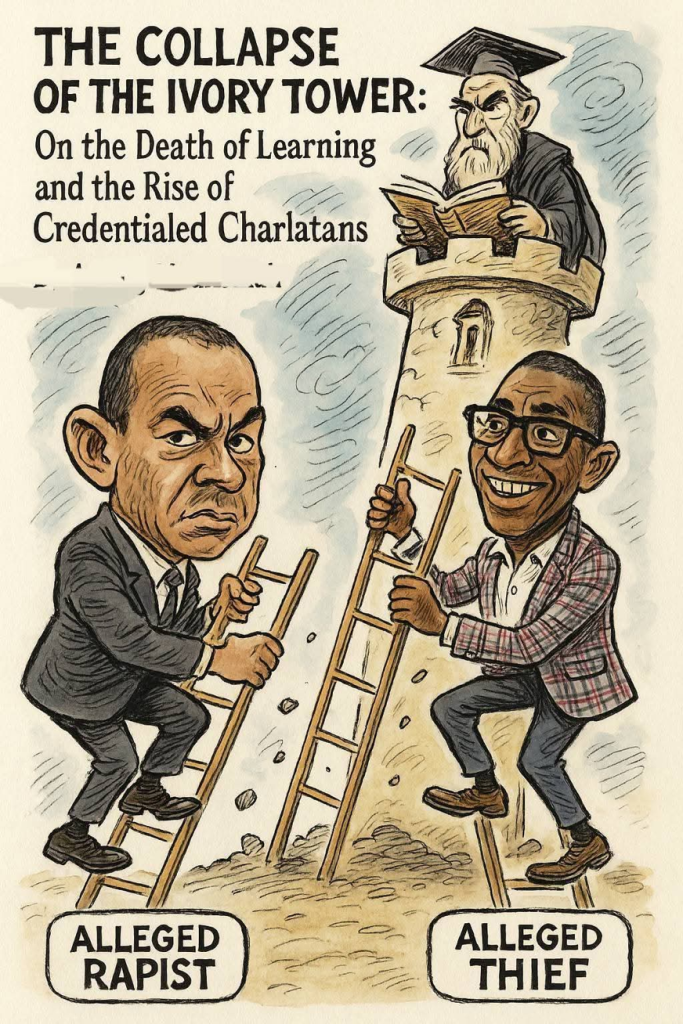
Melville Robertson Roberts and Nyang Njie: The Charlatans Ascend the Tower
It is one thing to lament the decline of the university. It is quite another to watch its ruins being paraded through the market by men who have mistaken the rot for a crown. In this age of screenshot scholarship and Wi-Fi wisdom, we are cursed with graduates who wield their alma mater like a cudgel, not a compass. None are more emblematic of this malaise than Mr. Melville Robertson Roberts and Mr. Nyang Njie, two Gambian gentlemen of considerable noise, but dismal consequence.
Let us first consider Mr. Melville Robertson Roberts, who once trod the stone paths of Oxford, a university whose name he utters with such frequency that one suspects he carries a laminated copy of his transcript in his pocket. But Oxford is a demanding mistress. She requires not merely attendance, but assimilation. And in the case of Mr. Roberts, one is left wondering whether the university entered him at all, or whether he merely passed through her gates like a wind through a lecture hall.
He is trained in the law, or so he insists. Yet when he speaks, one hears less of Blackstone and more of barroom braggadocio. His public interventions, frequent, frantic, and florid, carry the tone of a man convinced that his mere affiliation with an old college excuses him from the burden of coherence. He thunders, but says little. He quotes legal doctrine, but lives outside its spirit. One would not be surprised to find him quoting Magna Carta in defence of jaywalking.
Yet the gravest concern lies not in his language, but in his conduct. Accusations of rape, detailed, damning, and persistent, hang around his neck like a judicial albatross. Though he escaped on the wings of a procedural reprieve at the Ecowas Court, the court did not pronounce him innocent. It pronounced the state incompetent.
And so he emerged not humbled, but emboldened. From the flames of accusation, he has reconstituted himself as a martyr of jurisprudence, speaking in legal tongues to an audience too weary to ask for footnotes. He is no longer a barrister. He is a brand. A man whose law is laced with autobiography. And Oxford, poor, defenceless Oxford, is now dragged into every monologue like an elderly aunt forced to attend her nephew’s nightclub performance.
If this be the fruit of legal education, then let us return to the days of tribal adjudication. At least then, a man’s word was weighed against his walk.
But even Mr. Roberts must bow, from time to time, to his twin in farce, Mr Nyang Njie, a man whose intimacy with Harvard appears to have been forged over hors d’oeuvres at an executive certificate retreat.
Mr Njie did not earn a degree from Harvard University. He did not write a thesis, pass an exam, or submit to the rigours of academic apprenticeship. What he acquired was a certificate, short, sweet, and strategic. The sort issued after three days of keynotes and catered lunches. A souvenir of exposure, not an imprimatur of expertise.
And yet, upon returning home, Mr Njie has styled himself not only as a Harvard man, but as an economic sage, dispensing fiscal prophecies with the assurance of Keynes and the substance of a fortune cookie. He is ever-present, ever-talking, ever-circulating through social media with the fluency of a man who knows that to sound intelligent is, in our age, more profitable than to be so.
It is said, though he denies it with the indignation of a Sunday school boy caught in the brandy cabinet, that Mr Njie is linked to the acquisition of Yahya Jammeh’s looted properties. State vehicles, estates, assets snatched from the treasury during an era of plunder. If the claims are true, then his sermons on reform are no more than theatre. If false, then his Harvard lectures ought to include a chapter on how not to stand so near the fire without smelling of smoke.
What is certain is this: Harvard taught him how to frame his image. It did not teach him how to build a country.
PART III:
The robe in rebellion
A liturgy for the lost university
When institutions fail to guard their own gates, the rabble does not merely enter. It occupies, decorates, and begins issuing decrees. This is the crisis now afflicting our sacred spaces of learning. The robe has rebelled. The gown, once the symbol of Socratic humility, has been tailored into a costume for the intellectually bankrupt.
We were warned. Newman, in the idea of a university, wrote that if the university ever ceased to cultivate moral imagination alongside intellect, it would produce clever devils rather than virtuous citizens. Arnold spoke of “the best that has been thought and said,” not the loudest that has been live-streamed and shared. But who reads Newman now? Who quotes Arnold outside the pomp of speech-day pageantry?
Instead, we quote Harvard and Oxford not for their ideas, but for their marketing. We speak of where a man studied, but not what he learnt, let alone how he lives. The parchment is framed. The principles are forgotten.
In such a climate, men like Melville Robertson Roberts and Nyang Njie are not accidents. They are inevitabilities. They are not the disease. They are the symptom of our collective abandonment of academic seriousness.
They rise not on merit, but on myth. Their success is not earned in scholarship, but in spectacle. And their most loyal enablers are those who, too frightened or too ignorant to challenge them, mistake verbosity for virtue and volume for vision.
But the crisis extends beyond these two individuals. It stretches across our boards, ministries, think-tanks, and classrooms. For every Melville and Nyang, there are a hundred more, less visible perhaps, but equally hollow. They occupy chairs they did not earn, hold titles they do not understand, and shape policies they did not read.
The decolonisation that never happened
The tragedy is made more grotesque by its postcolonial context. For a people who fought, at least nominally, to free themselves from colonial mental chains, we have shackled ourselves anew to imported prestige. Oxford and Harvard have become not partners in learning, but fetishes. Their names do not liberate us. They mesmerise us.
So we must ask: what does it mean to be “educated” in an African republic today? Is it to study Aquinas and then return to silence injustice? Is it to quote Foucault and then become the boot of the state? Or is it, as seems increasingly the case, to attend a two-week programme in the West and then declare oneself the continent’s saviour?
In this warped framework, the Western credential becomes a counterfeit passport to power, a stamp of assumed superiority that overrides local knowledge, cultural empathy, or public service.
It is an insult not only to African intellects, but to the very idea of education.
A call to the true custodians
We must therefore call upon the true custodians of the university, not the vice chancellors with padded CVs, nor the deans chasing donor grants, but the quiet scholars. The men and women who still believe that books are sacred, that citation is not optional, and that to educate is not to entertain.
They must speak. They must write. They must rise. For every minute they remain silent, the charlatan grows louder. For every essay unwritten, a Facebook rant gains an audience.
And we, the public, must change how we listen. We must develop a grammar of suspicion. We must ask: “Did this person publish?” “Was this data peer-reviewed?” “Has he been honest?” “Has he been useful?”
Until then, men will continue to trade in reputations they did not earn, and degrees they do not deserve. They will wave the flag of Oxford or Harvard over scandals that would have made those institutions blush.
A final benediction for the broken tower
We end, as we must, with a lament not for Melville, nor for Nyang, but for the idea of the university itself. For that lonely tower that once stood against ignorance, now painted in the colours of Instagram and nationalism. For the scholar who once lived in the margins, now evicted by the influencer in academic costume.
The tower may still stand in brick and stone. But its foundations are hollow. And unless we reclaim it not with money or slogans, but with rigour, humility, and truth, we shall continue to be ruled by the loud, the branded, and the morally bankrupt.
Let Oxford speak. Let Harvard rebuke. But above all, let Africa rebuild.
Let us honour education not by where it was earned, but by how it is lived.