

By Dr Ebrima Ceesay
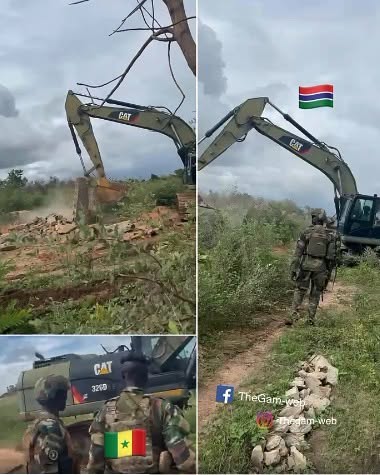
On 16th July 2026, tensions briefly flared along The Gambia-Senegal border when Senegalese soldiers reportedly entered the Gambian military post at Bulock in the Foñi region and demolished part of the perimeter fence surrounding the installation.
The incident immediately triggered diplomatic protests from Banjul and renewed public debate about sovereignty, territorial integrity, and security along one of West Africa’s most unusual international frontiers.
At first glance, the incident appeared to be a straightforward border dispute.
Yet reducing Bulock to a disagreement over a military fence overlooks the deeper historical, geopolitical, and security dynamics that continue to shape relations between The Gambia and Senegal.
The demolition of the fence was not the root cause of the crisis; rather, it was the latest manifestation of longstanding structural issues that remain unresolved.
Understanding the Bulock incident therefore requires looking beyond the immediate event and examining the historical legacy of colonial boundaries, the strategic importance of neighbouring Casamance, the asymmetry between the two states, and the enduring challenge of managing a border that remains, in places, insufficiently demarcated.
The immediate incident
According to the Government of The Gambia, Senegalese soldiers crossed into Gambian territory on 16th July 2026 and demolished sections of the perimeter fence surrounding a Gambian military installation at Bulock.
Banjul condemned the action as a violation of its territorial sovereignty and called for the dispute to be addressed through established diplomatic and bilateral mechanisms.
Senegal presented a different interpretation. Dakar argued that the area has long been subject to an unresolved boundary disagreement and maintained that concerns regarding construction at the military site had been raised previously.
From Senegal’s perspective, the dispute centres on competing territorial claims arising from incomplete border demarcation rather than an attempt to infringe upon Gambian sovereignty.
Although the two governments disagree over the location of the boundary, both have publicly reaffirmed their commitment to resolving the matter through dialogue rather than confrontation.
Let us now go beyond the headlines and ask: Why did Bulock happen?
The demolition of the fence explains what occurred, but not why the dispute emerged at this particular location or why similar tensions have recurred over time.
Several interrelated factors help explain the broader context.
Colonial borders and contemporary realities
Like many African boundaries, the frontier between The Gambia and Senegal was inherited from the colonial period.
It was established through agreements between European powers rather than through local political, cultural, or economic realities.
In the Foñi region, communities have long maintained family ties, customary land rights, farming activities, grazing routes, and commercial networks that extend across today’s international boundary.
For many local residents, the border has historically been far more permeable than modern notions of state sovereignty suggest.
As both governments seek to strengthen administrative and military control over these areas, differing understandings of territory inevitably emerge.
The dispute therefore reflects more than competing legal claims over land; it also highlights the tension between inherited colonial boundaries and longstanding patterns of community life.
Perhaps the most immediate structural cause of the Bulock incident is the incomplete demarcation of sections of The Gambia–Senegal border.
A legally recognised international boundary requires more than historical maps. It depends upon mutually accepted geographic coordinates, modern surveys, physical boundary markers, and political agreement between neighbouring states.
Reports suggest that certain areas near Bulock have remained contested for years, with disagreements over military construction surfacing as early as 2025.
In such circumstances, each government may genuinely believe that it is acting within its own territory.
The dispute therefore stems not only from competing political positions but also from differing interpretations of where the international boundary actually lies.
Casamance: The strategic context
No analysis of Bulock is complete without considering Casamance, the southern region of Senegal that has experienced a decades-long separatist insurgency led by factions of the Movement of Democratic Forces of Casamance (MFDC).
Although the conflict has diminished significantly in recent years, Casamance continues to occupy an important place in Senegal’s national security strategy.
Geographically, Casamance is separated from northern Senegal by The Gambia, making the border especially significant from Dakar’s perspective.
Historically, Senegalese authorities have expressed concerns regarding cross-border movement of armed groups, weapons trafficking, logistical networks, and the use of forested areas for concealment.
Consequently, infrastructure developments near disputed sections of the border are likely to be viewed through a security lens rather than solely as matters of territorial administration.
From this perspective, what Gambian authorities may regard as routine improvements to a military installation could be interpreted by Senegalese security planners as developments with strategic implications.
This does not in itself justify unilateral action, but it helps explain why the dispute was treated as a security issue rather than a purely administrative disagreement.
Divergent understandings of sovereignty
The Bulock incident also illustrates how the two countries approach border management from different strategic perspectives.
For The Gambia, whose territory is almost entirely surrounded by Senegal, questions of territorial integrity carry considerable symbolic and political significance.
Any perceived encroachment naturally raises concerns about sovereignty and national dignity.
Senegal, by contrast, often approaches the border primarily through the framework of regional security, territorial administration, and stability in Casamance.
These differing priorities can produce contrasting interpretations of the same event.
Actions viewed by one side as defending sovereign territory may be perceived by the other as enforcing what it considers to be an established boundary.
Which begs the question: What role does domestic politics play in all this?
Border disputes rarely occur in a political vacuum.
Governments are inevitably mindful of domestic public opinion, particularly when issues of sovereignty and territorial integrity arise.
For Gambian leaders, appearing unable to defend national territory may carry political costs.
Likewise, Senegalese leaders may face criticism if they are perceived as conceding land that they believe falls within Senegalese jurisdiction.
Such domestic pressures can encourage firm public positions even while diplomatic negotiations continue behind the scenes.
This dynamic is common in international boundary disputes, where political messaging and quiet diplomacy often proceed simultaneously.
The Bulock dispute also has an important psychological dimension.
In parts of western Gambia, border incidents resonate beyond their immediate geographic location because they reinforce longstanding concerns about the protection of frontier communities and the defence of national sovereignty.
Conversely, Senegalese officials may view unresolved ambiguities along the frontier as potential sources of gradual territorial encroachment if left unaddressed.
Historical experiences therefore shape contemporary perceptions, making technical disagreements over maps and boundary markers emotionally and politically significant.
Casamance as a strategic multiplier
Importantly, there is currently no publicly verified evidence that Casamance rebels played any direct role in the Bulock incident.
However, Casamance functions as a strategic multiplier.
A disagreement over land near an ordinary border may remain a local administrative issue.
Yet, near Casamance, the same disagreement is more likely to be interpreted through the prism of national security.
As a result, a local land dispute can become a military concern; a military concern can become a sovereignty dispute; and a sovereignty dispute can rapidly evolve into a diplomatic crisis.
This progression helps explain why seemingly minor developments near Bulock attract considerable attention from both governments.
Preventing future incidents will require addressing the underlying structural issues rather than simply responding to individual confrontations.
Several measures could contribute to a more durable settlement.
Complete joint border demarcation: The most fundamental requirement is a jointly agreed demarcation process involving historical documentation, modern geospatial surveys, mutually accepted coordinates, and the installation of permanent boundary markers.
Establish interim confidence-building measures: Pending final demarcation, both governments could agree to refrain from constructing new military infrastructure in disputed areas without prior consultation and commit to resolving disagreements through established bilateral mechanisms rather than unilateral action.
Strengthen bilateral military cooperation: Existing military communication channels could be enhanced through regular joint patrols, coordinated investigations, intelligence sharing, and rapid-response mechanisms capable of resolving incidents before they escalate.
Engage border communities: Local communities possess valuable knowledge regarding historical land use and customary boundaries. Involving traditional authorities, landowners, and community leaders would strengthen both the legitimacy and sustainability of any future settlement.
Distinguish security concerns from sovereignty questions: While Senegal’s security concerns relating to Casamance remain understandable, not every border disagreement should automatically be framed as a security threat. Equally, Gambian authorities must recognise that developments close to Casamance are likely to receive heightened scrutiny from Dakar. Separating these issues wherever possible would help reduce the risk of unnecessary escalation.
In conclusion, the Bulock incident was never simply about a demolished fence.
Rather, it exposed the complex intersection of colonial history, incomplete border demarcation, regional security concerns, power asymmetry, domestic politics, and competing interpretations of sovereignty.
At its core lies an enduring paradox: The Gambia and Senegal are among the most socially and culturally interconnected countries in West Africa, yet portions of their shared border remain insufficiently defined to satisfy the security and administrative expectations of modern states.
Until both countries complete a mutually accepted border demarcation process and strengthen mechanisms for managing sensitive frontier areas, similar disputes are likely to recur.
Bulock should therefore be understood not as an isolated incident but as a reminder that unresolved historical boundaries continue to influence contemporary diplomacy and security.
The fence was merely the visible manifestation of a deeper challenge – the on-going effort to reconcile history, geography, state sovereignty, and regional stability along one of Africa’s most distinctive international borders.
Dr Ebrima Ceesay is a Gambian academic based in the UK and former editor of The Daily Observer newspaper.