

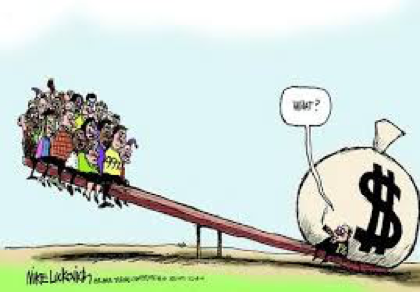
In the quiet hours of dawn, before the city fully awakens, two worlds begin their day—side by side, yet miles apart in lived reality. In one part of the city, a child wakes up in a well-furnished home, prepares for school with a packed meal, and is driven through smooth roads to a well-equipped institution. In another part, not far away, a child rises from a crowded room, uncertain of the day’s first meal, and walks barefoot or boards a dilapidated bus to a poorly funded school. Both children share the same sky, breathe the same air, and inhabit the same nation. Yet their futures are already being written by forces far beyond their control.
This is the stark portrait of our modern world—a world increasingly divided between wealth and want.
As the writer once observed, “Poverty is not an accident. Like slavery and apartheid, it is man-made and can be removed by the actions of human beings.” And yet, despite global progress and technological advancement, inequality has deepened, creating a fragile social order where the middle ground is steadily eroding.
Two lives, one city: The everyday contrast
To understand inequality, one must look beyond statistics and into the lived experiences of people. Consider two hypothetical individuals: Amina and Amadou.
Amina lives in an affluent neighborhood. Her home is powered 24 hours a day, her education is uninterrupted, and her access to healthcare is immediate and efficient. When she falls ill, her parents consult specialists. When she dreams, her ambitions are nurtured with resources and connections.
Amadou, on the other hand, lives in a struggling community. Electricity is unreliable, his school lacks basic materials, and healthcare is often out of reach due to cost. When he falls sick, his family must weigh the urgency of treatment against the reality of limited income. His dreams are not just ambitions—they are battles against circumstance.
This contrast is not unique. It is replicated across cities, nations, and continents. The divide is no longer just economic; it is deeply human—touching dignity, opportunity, and hope.
As another powerful reflection puts it, “The measure of a society is not how it treats its richest members, but how it cares for it’s poorest.”
Education: The great divider or equaliser?
Education has long been seen as the bridge between poverty and prosperity. Yet today, it often mirrors the inequalities it is meant to resolve.
For the wealthy, education is a pathway paved with excellence—private schools, international exposure, digital access, and mentorship. For the poor, it is often a narrow road filled with obstacles—underfunded institutions, overcrowded classrooms, and limited access to learning tools.
In many societies, a child’s educational outcome is less about intelligence and more about income. This reality challenges the notion of fairness and raises a critical question: can education still serve as a true equalizer?
The philosopher once noted, “Education is the most powerful weapon which you can use to change the world.” But when access to that weapon is unequal, the battle for a just society becomes uneven from the start.
Healthcare and the price of survival
Health, perhaps more than any other factor, exposes the cruelty of inequality. For the wealthy, healthcare is a service. For the poor, it is often a privilege—or even a gamble.
In affluent communities, hospitals are well-equipped, professionals are readily available, and preventive care is emphasized. In poorer areas, hospitals may lack essential supplies, and medical attention is delayed or avoided due to cost.
Imagine a mother who must choose between feeding her family and paying for treatment. Imagine a father who watches a preventable illness worsen because he cannot afford a hospital bill. These are not distant tragedies; they are daily realities for millions.
As has been rightly said, “Of all the forms of inequality, injustice in healthcare is the most shocking and inhumane.”
Policy failures, corruption, and the widening gap
While inequality is influenced by global economic forces, it is often deepened by local failures—poor governance, weak institutions, and corruption.
Public funds meant for education, healthcare, and infrastructure are sometimes diverted, leaving systems broken and citizens vulnerable. Policies that should uplift the poor often fail in implementation, while the wealthy find ways to navigate or even benefit from systemic loopholes.
In such environments, inequality is not just a condition—it becomes a cycle. The poor remain trapped, while the rich consolidate their advantage.
A well-known observation captures this reality: “When corruption is a way of life, inequality becomes a permanent condition.”
The fragile dream of upward mobility
At the heart of every society lies a promise—the belief that hard work can lead to a better life. This is the dream of upward mobility. But in a deeply unequal world, that dream is increasingly fragile.
For many, effort no longer guarantees progress. A university degree does not ensure employment. A stable job does not guarantee financial security. The ladder of opportunity appears shorter, and in some cases, broken.
Yet hope persists. It is seen in the young graduate applying for countless jobs, in the market woman striving to educate her children, and in the determined entrepreneur navigating a difficult environment.
The question remains: is the system still fair enough to reward effort, or has the gap become too wide to bridge?
As one thinker poignantly stated, “A dream deferred does not die—it becomes a burden carried by generations.”
A call for reflection and action
A world divided between wealth and want is not sustainable. It breeds frustration, fuels instability, and weakens the moral fabric of society. The consequences are not confined to the poor; they ripple across entire nations.
Bridging this divide requires more than economic reforms—it demands a moral awakening. Governments must prioritise inclusive policies, institutions must be strengthened, and corruption must be confronted with seriousness. Equally important is a collective shift in societal values—toward fairness, empathy, and shared responsibility.
The divide between the rich and the poor is not inevitable. It is shaped by choices—political, economic, and social. And as such, it can be reshaped.
Conclusion: One world, shared destiny
In the end, the story of inequality is not just about numbers or policies—it is about people. It is about the dignity of work, the fairness of opportunity, and the value we place on human life.
We may live in different circumstances, but we share a common humanity. The fate of one is, in many ways, tied to the fate of all.
If the world continues on a path where wealth is concentrated and opportunity is scarce, the divide will only deepen. But if we choose a different path—one guided by justice and inclusion—then perhaps the two worlds we see today can become one.
As a timeless reminder declares:
“We rise by lifting others.”