

By Ebrima Ceesay
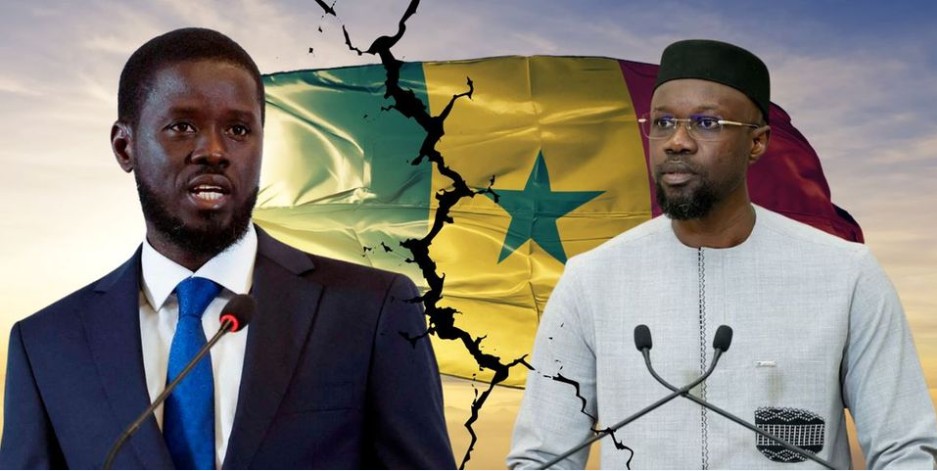
The tensions between President Bassirou Diomaye Faye and former prime minister Ousmane Sonko were almost inevitable from the moment political victory gave way to the realities of governing the state.
What initially appeared to be a unified revolutionary Pastef project has gradually revealed two distinct, and increasingly competing, visions of power, governance, and economic transformation. The deeper issue is not personal rivalry alone, but the collision between two political logics: the logic of movement politics and the logic of state administration.
That contradiction now sits at the centre of Senegalese public life, and the first major fault line is: economic governance.
The earliest and most consequential rupture between President Faye and Ousmane Sonko emerged around economic policy, particularly Senegal’s debt burden and its relationship with the IMF. The disagreement between the two Pastef comrades was never merely technical. It reflected fundamentally different political philosophies.
Ousmane Sonko’s position has consistently been rooted in economic sovereignty: scepticism toward external conditionality, preference for domestically driven restructuring, and a more confrontational posture toward international financial institutions.
Ousmane Sonko’s approach reflects the broader ideological foundations of Pastef’s “rupture” agenda – reclaiming national autonomy from systems perceived as externally imposed or politically constraining.
President Faye, by contrast, has increasingly adopted what has been described by the presidential entourage “as a more institutional and pragmatic posture”. Faye’s emphasis has been on macroeconomic stability, investor confidence, fiscal continuity, and sustained engagement with lenders such as the IMF.
Both approaches respond to genuine constraints – rising debt, fiscal pressure, and limited budgetary space – but they imply radically different methods of governing. One prioritises rupture, symbolism, and sovereign autonomy. The other prioritizes continuity, compromise, credibility, and financial stability.
Two governing instincts inside one coalition
This divergence has produced something unusual within Senegal’s ruling structure: not two competing governments, but two competing governing instincts operating inside the same political bloc.
As president, Faye controls the formal instruments of executive authority: cabinet appointments, fiscal administration, diplomacy, and international negotiations. Sonko, however, even after leaving the premiership, retains enormous political influence through his leadership within Pastef and his authority over parliamentary dynamics as Speaker of the National Assembly.
Executive authority and political authority no longer perfectly overlap. This is what makes Senegal’s current political configuration so distinctive, even for someone like me who has been a student of African politics for the past 30 years. The state is formally unified, but power is increasingly bifurcated.
Senegal’s informal cohabitation
In many respects, Senegal now resembles a form of internal cohabitation. Unlike the French model often invoked for comparison, however, the two poles of power do not emerge from opposing parties. In Senegal, these two poles of power come from the same victorious Pastef movement.
In France, cohabitation functions because institutional rivalry is formalized and constitutionally clear. In Senegal, the tension is far more intimate and ambiguous: it is a struggle within a shared mandate in which neither side fully accepts a subordinate role.
President Faye governs the machinery of the state. Ousmane Sonko, now Speaker of Senegal’s National Assembly, retains the capacity to shape the political environment in which that machinery operates. The result is an emerging dual power structure – one institutional, the other ideological but also parliamentary in nature. The questions arise: why is the IMF watching events in Senegal very closely? The IMF has become one of the most important external observers of this evolving relationship, not because it intervenes politically, but because its programs depend on the assumption that governments can implement the policies they negotiate.
From the fund’s perspective, the central issue in Senegal is not disagreement itself. Democracies routinely contain internal debate. From the point of view of IMF, the real concern is whether commitments made by Senegal’s executive branch can survive internal political contestation.
In other words, the problem is less negotiation than enforcement. Formally, the IMF negotiates with President Faye’s government. In practice, however, it must also evaluate whether the executive possesses sufficient internal cohesion to guarantee policy continuity over time.
Political fragmentation alters the way international programs are designed. Reforms become more incremental, oversight more frequent, and disbursements more conditional. In short, the IMF’s primary concern is not whether Senegal adopts a language of sovereignty or austerity. It is whether fiscal commitments remain enforceable despite tensions within the governing coalition.
Two forms of legitimacy
Beneath these institutional frictions lies a deeper structural question: Can a political movement that wins power through unity successfully transform itself into a differentiated governing system without reproducing internal conflict?
President Faye increasingly embodies the logic of institutional consolidation, stability, compromise, and state continuity, whereas Ousmane Sonko embodies the logic of rapid rupture, mobilisation, and transformative politics. Both forms of legitimacy are real. But historically, they rarely coexist comfortably within the same executive structure for long.
Ousmane Sonko’s shift from government to movement guardian
The transition that elevated Ousmane Sonko to Speaker of the National Assembly crystallised this contradiction rather than resolving it. Sonko’s public statements after assuming office were revealing not because they announced open confrontation, but because they subtly redefined his political role.
By emphasising parliamentary independence and warning against hyper-presidentialism, Ousmane Sonko positioned himself as the guardian of the Pastef movement’s original ethos from within the institutions of the state itself.
The implication was unmistakable: The struggle against concentrated power did not end simply because Pastef captured the presidency.
Paradoxically, Ousmane Sonko’s departure from the premiership may strengthen him politically. Governments absorb blame. Political movements preserve ideological purity.
As Speaker of Senegal’s Parliament, Ousmane Sonko can continue defending the revolutionary narrative, exerting ideological pressure, and criticising moderation without directly carrying responsibility for unpopular economic decisions.
If austerity deepens, unemployment persists, or IMF negotiations force painful compromises, Sonko is structurally positioned to argue that the original rupture agenda has been diluted by technocratic governance.
The incoming cabinet as a map of power
This tension will likely become increasingly visible in the formation of the new cabinet under Prime Minister Ahmadou Al Aminou Lo. The incoming cabinet will represent more than an administrative team. It will function as a political map of the regime’s true balance of power.
Every appointment will quietly answer larger questions: Is Senegal moving toward institutional consolidation? Or does movement politics still dominate the state? Is Faye constructing an autonomous presidency?
The composition of key ministries will be particularly revealing. If prominent Sonko loyalists retain strategic portfolios such as Interior, Justice, Energy, Finance, or Communication, the rupture between the presidency and the movement may remain manageable. If they are systematically sidelined, it would suggest that Faye is beginning to construct a more autonomous executive apparatus independent of the movement’s founder.
Economic and finance ministries and the battle over direction
The economic and finance ministries will carry special significance. Senegal faces mounting pressure related to debt management, investor confidence, subsidy reform, IMF negotiations, and expectations surrounding oil and gas revenues.
Appointing disciplined technocrats would signal a turn toward stabilisation and international reassurance. Appointing militant sovereigntists would indicate that ideological continuity remains the governing priority.
From my perspective, most likely, the administration will attempt to balance these competing imperatives. Yet excessively balanced cabinets often reveal unresolved internal struggles rather than genuine cohesion.
Security institutions and regime stability
The security institutions may become even more sensitive than the economic ministries. In periods of elite fragmentation, the police, intelligence services, and military become essential guardians of continuity.
Senegal’s institutions have historically demonstrated greater resilience than many regional counterparts. Yet dual legitimacy within the ruling coalition creates structural ambiguity.
The presidency may therefore increasingly seek loyal institutionalists in these sectors as protection against future instability.
Hydrocarbons and the sovereignty question
At the same time, Senegal’s emerging hydrocarbon era introduces an additional layer of tension. Oil and gas revenues have intensified public expectations of sovereignty, redistribution, and economic transformation. These sectors represent the symbolic core of Pastef’s political promise: reclaiming national control over resources and breaking dependency structures associated with the old political order.
Control over the energy and petroleum portfolios will therefore shape not only economic policy, but also the ideological credibility of the regime itself.
Ultimately, the deeper issue extends beyond personalities or cabinet appointments. Senegal is confronting the classic dilemma faced by many political movements once they enter power: Can a protest movement become a stable governing order without losing the revolutionary identity that made it politically powerful in the first place?
Historically, political movements often fracture at precisely this stage. One faction prioritises governability, compromise, national reconciliation, institutional continuity, stability, diplomatic pragmatism, and economic stabilisation.
Another prioritises ideological fidelity, permanent mobilisation, rapid reforms, and transformative rupture.
The first speaks the language of administration, while the second speaks the language of historical mission. What makes Senegal distinctive is that both tendencies currently coexist within the same ruling structure.
Movement politics versus state politics
This is why the tension between movement politics and state politics has become the defining axis of contemporary Senegalese politics. Movement politics derives legitimacy from mobilisation, moral confrontation, and activist energy.
State politics derives legitimacy from institutions, constitutional procedure, and administrative competence.
In the past, this tension existed between opposition and government. Today, it exists within power itself.
Ebrima Ceesay is a Gambian born academic who currently lives and works in the UK. He was editor of the Daily Observer newspaper.