

By Ousman M’Bai
Introduction
For years, the Sangomar development was presented as a flagship achievement for Senegal and its international partners. Questions regarding fiscal arrangements, project economics and contractual structures received comparatively little public attention and at worst much less scrutiny under the regime of Macky Sall. Today, however, the position appears markedly different. The government of Senegal is openly reviewing petroleum agreements, questioning cost recovery claims and preparing for potential international arbitration involving some of the world’s largest energy companies, chief amongst them Woodside Energy and BP. In a recent Africa CEO forum in Kigali on 18th May 2026, Khadim Bamba Diagne, Permanent Secretary of Senegal’s Strategic oil and Gas Committee, was unequivocal about Senegal’s intent to initiate international arbitration against Woodside Energy and others to reassess parts of the country’s major oil and gas agreements.
Resource equity, national interest and investor rights
This represents a significant policy shift that could potentially open the door for Senegal to resource equity balancing investor rights against sovereignty over national assets. This has been the mantra of the new regime of President Faye and former Prime Minister Sonko even well before they walked into the Presidential Palace in Dakar in 2024. Sonko, the author of two best sellers on oil and gas exploration in Senegal, is undoubtedly the main architect or the visionary behind this review. Senegal’s energy and mines minister, Birame Souleye Diop said closer scrutiny of the sectors was high on the agenda for Senegal. This will involve “publishing the contracts, carrying out a mining audit, working in the interests of the people and, if necessary, renegotiating all existing contracts,” he said.
“We will strive to promote resources to our partners in a way that is strictly in line with the interests of the Senegalese public,”
Viewed in this light, the rationale behind the Senegalese Government’s position appears understandable, even if reasonable observers may differ on its conclusions. The focus therefore is not whether they are wrong. What matters is that the underlying contracts, accounting methodologies and revenue assumptions are no longer treated as beyond the question. They are being subjected to scrutiny at the highest levels of government. The same house that was once opened for celebration is now being inspected room by room.
The case before the International Centre for Settlement of Investment Disputes
Around the world, disputes between governments and petroleum companies frequently expose information that remains hidden during the development phase of major projects. Questions concerning valuation, reserves, recoverable costs, fiscal exemptions and commercial assumptions often emerge only when contracts are tested through litigation, arbitration or regulatory review. Woodside Energy was of course aware of this, and it was the first to throw the legal gauntlet when on 30th May 2025 it filed a case before the World Bank’s International Centre for Settlement of Investment Disputes (ICSID) against the Government of Senegal. This on its own was enough to draw attention to the case but what may ultimately attract greater attention are the issues raised by Woodside’s claim and the implications that could emerge from the arbitration process.
In 2024, Woodside unexpectedly found itself facing a tax reassessment bill for US$68m by the Government of Senegal. This followed a review undertaken by the new administration which, according to Senegalese authorities, concluded that additional taxes were payable under the applicable contractual and fiscal arrangements. Woodside claimed unfair treatment. The irony of it!
Its position is that much of the tax bill relate to tax exemptions that applied during the project’s development phase. The company maintains that the reassessment violates the fiscal framework governing the project. Its spokesperson was quoted as stating: “Woodside strongly believes we have acted in accordance with applicable regulations… and there are no outstanding taxes payable.”
The battleground is now set as the arbitration proceedings take their course. The first hearing took place in March when the procedural rules governing the case and the timelines and evidence management were laid out.
The location of the Sangomar field
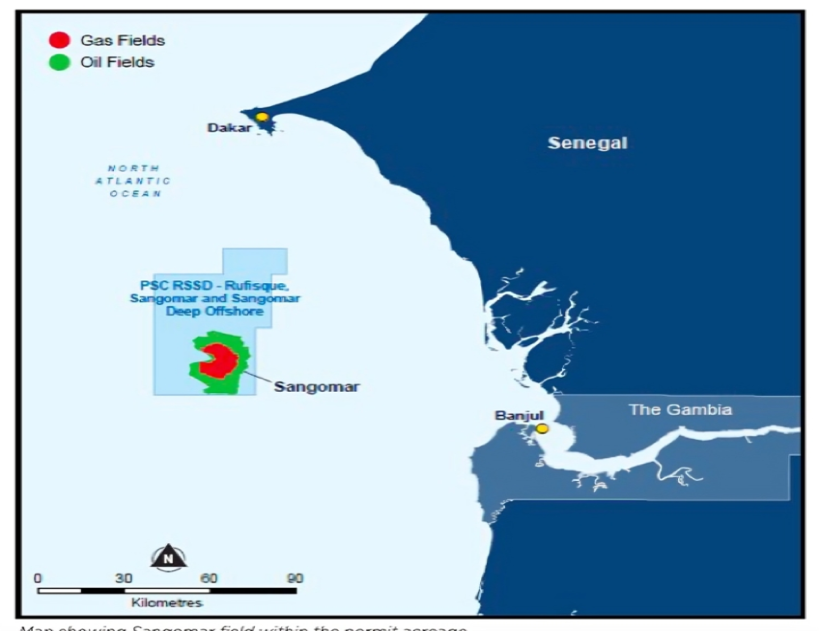
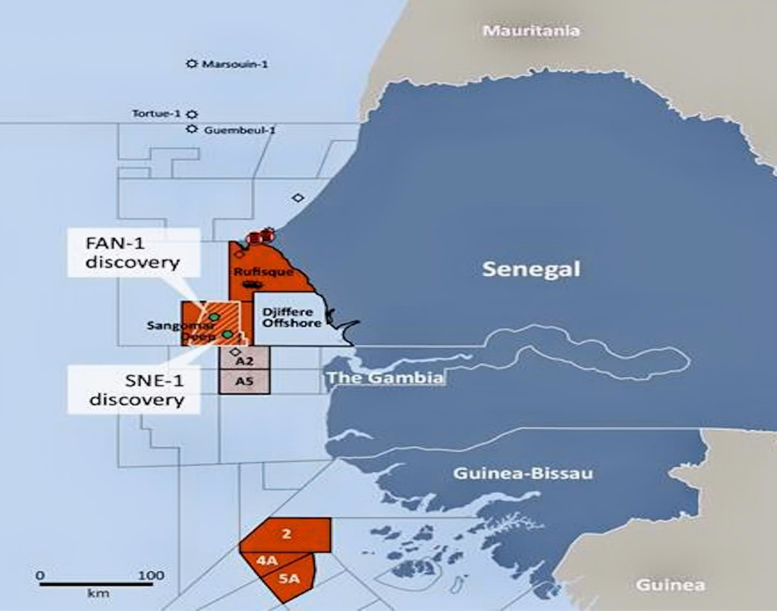
The Sangomar field is located offshore west of the Saloum Delta, a vast 5,000-square-kilometre labyrinth of wetlands, islands and mangrove forests in west-central Senegal. Situated southwest of Kaolack in waters contiguous with The Gambia’s maritime frontier, the field lies within a region shaped by centuries of ecological, cultural and commercial interaction between the two neighbouring states. The primary oil-bearing reservoirs within the Sangomar field consist predominantly of high-quality Early to Late Cretaceous (Albian–Cenomanian) sandstones, many of which were deposited by sedimentary systems associated with the ancient River Gambia. The publicly reported extent of the field terminates at the maritime boundary with The Gambia, notwithstanding the well-established geological principle that petroleum reservoirs themselves are not constrained by political borders. Nature seldom consults cartographers before laying down a reservoir, and oil has never been known to carry a passport. The field originally called SNE1 was renamed Sangomar in 2020 by former Senegalese President Macky Sall (now in self-imposed exile in Morocco) and his explanation was “to better reflect its association with the Serer people of Senegal”. It appears the possibility that this view may equally apply to people in The Gambia was discounted, but this may also offer an insight into how the field was being conceptualised politically at the time, namely as a distinctly Senegalese national asset.
The celebration of Sangomar
At the time of this change of name, Woodside partner FAR Ltd highlighted that “the Sangomar field development will deliver key benefits to the country via revenue generated throughout the life of the project, vital for the country’s 2030 Emergent Plan for development”.
Greg Mogan, Vice President of Woodside stated, “This is a very exciting milestone for Woodside as operator of the Sangomar Field Development.”
“It’s the culmination of years of work by the Woodside teams in Perth and in Dakar.
“Our teams have worked tirelessly with the joint venture, contractors and the Government of Senegal to find the optimal commercial solution to develop the rich oil resources of the Sangomar Field.”
The execute phase of the Sangomar Field Development includes the drilling of 23 wells, construction and installation of the subsea network and the construction and installation of the FPSO.
The Phase 1 development would support more than 20 years of oil production and revenue linked to a network of subsea infrastructure designed to enable future expansions and tieback opportunities.
A milestone was reached in January 2020 when the Final Investment Decision was approved. The occasion was celebrated in Dakar by Woodside Energy, its joint venture partners and representatives of the Senegalese Government. At the time, Sangomar was presented as a model of successful cooperation between investor and state. Today, however, parts of the same project are the subject of arbitration and renewed scrutiny.
Woodside and its partner Far Ltd
Woodside as the majority partner holds 82% of the field’s production while State own enterprise Petrosen holds 10%. How Woodside acquired that holding is by itself an exciting story. The field was initially developed with Cairns 10% (the designed operator that drilled all the wells) and junior partner Far Ltd which held 13% stake. In 2020 cash strapped Far Ltd defaulted on its capital call to pay up its share of the development cost. At risk of forfeiture of its entire stake without compensation, FAR Ltd was forced to sell its entire stake to Woodside who by then had held 68% of the stake. Woodside reportedly paid $500m less debt settlement and a contingent payment on production volume fixed at US$55m up to 2027. The transaction was completed on 7 July 2021 and Far Ltd walked away with a cash sum of US$127m. Today, Far Ltd continues to receive yearly contingent payments from Woodside since production commenced in 2024 linking its continued interest in the viability of the field even after it surrendered its acreage across the line in The Gambia. In its 2025-year end Annual Report Far Ltd announced:
“Woodside advised the ASX on 28 January 2026 that Sangomar produced 29,703 MMboe of crude in 2025, with 28,462 MMboe of sales. Based on this, FAR estimates that the Contingent Payment which is payable to it with respect to the 2025 calendar year is approximately US$23.7 million. FAR announced on 16March 2026 that it had reached agreement with Woodside for Woodside to make a provisional 2025 Contingent Payment of US$23.7 million which is expected to be received by FAR in April 2026”.
Sangomar production level and profit margin
The field started production in June 2024, and it performed better than initially forecast with larger daily production. Publicly available production reports appear to indicate that output has exceeded some earlier expectations. However, Sangomar project capital expenditure is high, and Woodside’s cash flow is reported already strained. A protracted dispute might affect expenditure levels on other high-potential assets in its portfolio. It will be worse for Woodside if Senegal wins as it would be forced to settle a hefty tax bill. This will erode its profit margin. A prospect not likely to whet the appetites of its salivating investors.
Access to production data and Senegal’s legal strategy
Woodside must tread carefully because while previous African generations did not have the data to determine the true value of their natural resources, data sharing in extractive industries is now a core element of these agreements. Senegal has access to Woodside’s operational data, and the government’s recent actions may indicate a willingness to revisit earlier assumptions regarding fiscal returns and contractual entitlements. Given Woodside’s substantial interest in the project at 82%, some may regard Senegal’s concerns as deserving careful consideration.
What this means for The Gambia
For The Gambia, these developments are particularly relevant because the country’s offshore acreage lies adjacent to the producing Sangomar field. Over several years, concerns have been raised regarding exploration results, geological interpretations, licensing decisions and the broader implications of transboundary petroleum resources. Those concerns are as potent today as they have been and they deserve objective examination supported by evidence and transparency.
At the centre of this unfolding drama stood Far Ltd, its subsidiary Far Gambia Ltd and PC Gambia Ltd, an alleged subsidiary of Petronas. Both Far Gambia Ltd and PC Gambia Ltd were special purpose vehicles incorporated in Tax haven Mauritius before being registered in the Gambia as foreign corporations. This was a strategic corporate structure to facilitate holding of Gambian acreage at minimal cost.
Far Ltd.’s limited financial capacity to independently develop its interests in the blocks was apparent as early as August 2018. Its initial 80% holdings in both blocks were acquired from the Government of the Gambia for US$20m. A give away at that price! It subsequently acquired the remaining 10% interest from a third-party holder for a further US$4m. Far Ltd subsequently farmed in Petronas, which acquired a 40% interest in both A2 and A5 in exchange for funding 80% of the exploration costs together with a cash consideration of US$6 million.
Thus, at the time Far Ltd held a 13% interest in the Sangomar field, it also held a 50% interest in The Gambia’s adjacent A2 and A5 blocks through subsidiary Far Gambia Ltd, with the remaining 50% held by PC Gambia Ltd for Petronas.
The Bambo-1 Well
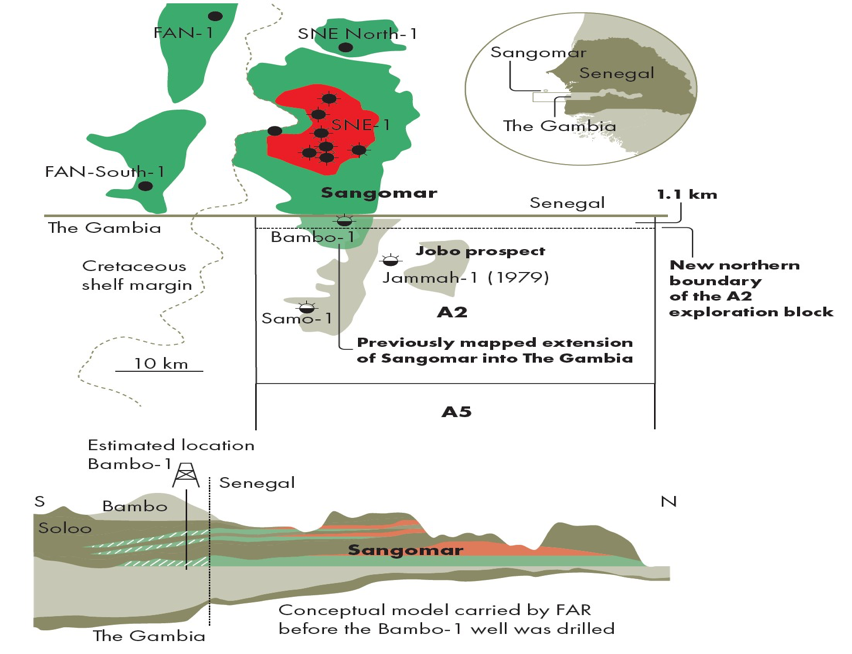
Whilst Far Ltd was engaged in direct negotiations with Woodside over its default capital call and subsequent sale it was at the same time in preparation to drill the Gambia’s Bambo 1 well in the A2 block, with its logistic team based in and coordinated from Dakar, capital of Senegal. This well lies less than 500 meters from the Sangomar field and according to statements attributed to Far Ltd.’s chief geologist, the possibility of Sangomar reservoir continuity into Gambian waters was not regarded as contentious within the industry. He further suggested that this interpretation was widely understood among participants involved in the project.
Drilling logistics
The planned depth for the well was 3450 meters MDBRT (measured depth below the rotary table). Drilling commenced on 22 December 2021. Far Gambia Ltd, a junior that had up till then never drilled a successful well was designated operator (instead of the more experienced Petronas). The drilling did not go according to plan. The Stena IceMax Drill ship it had hired with its unnamed drill team, reportedly suffered fluid loss during drilling of the well and was forced to stop at a depth of 3216m. It then reportedly proceeds on a sidetrack well (a re-entry) which it later abandoned at 3317m less than 133 meters before the targeted reservoir zones.
Abandoning a well less than 153 metres before the target reservoir is akin to a treasure hunter turning back within sight of the cave entrance and then declaring with certainty that no treasure lies beyond. Some observers may question whether the prospect of complex unitisation discussions created commercial incentives to minimise attention on the transboundary implications of the acreage.
The results
Far Ltd declared the well a tight hole, promptly sealed it and made no real-time public disclosure of the underlying drilling data. No pressure data, no core logs, no reservoir samples and no precise well coordinates were placed before the Gambian public. According to public filings, the company concluded that the well did not contain commercially recoverable quantities of hydrocarbons. Though it maintains in subsequent filings with the Australia Securities Exchange that oil shows were found at several reservoir levels and these were lateral equivalents of the primary reservoirs in the Sangomar field. Far’s public disclosures were not entirely consistent with the simple narrative of a failed well. In reporting to shareholders, the company acknowledged that “several target intervals in the well had oil shows, confirming a prolific oil source is present in the area”. It further stated that oil shows encountered in Bambo-1 and its sidetrack had “highlighted updip potential to the south in the A2 Block that is mapped as the new Panthera prospect”
Far’s subsequent assessment became even more striking. In its ASX announcement of 26 August 2022, the company stated that laboratory work had confirmed oil at multiple levels and that it “supports the pre-drill model that the Sangomar oil extends into Gambia”, although it maintained that reservoir quality rendered the accumulation non-commercial.
Immediately after the drilling campaign, the Gambia Ministry of Energy and Petroleum announced that no live oil columns had been encountered at the Bambo-1 location, whilst acknowledging the presence of oil shows, potential reservoirs and further hydrocarbon potential elsewhere within the A2 and A5 blocks. Whilst the Ministry confirmed the presence of oil shows and potential reservoirs, the statement did not disclose the underlying technical data upon which those conclusions were based. No pressure data, core analyses, wireline logs or detailed formation evaluation results accompanied the announcement. In the absence of such information, independent scrutiny of the well’s significance remained impossible, making the subsequent alteration of the block boundary under the 2023 Block Demarcation Regulation all the more troubling.
Despite formal letters sent to Far Ltd and Petronas in June 2024 seeking disclosure of the technical basis for their conclusions and clarification of the underlying seismic and geological data, no substantive formal public response has been forthcoming. Petrosen has likewise remained silent. Woodside Energy was the only party to provide a written response. In a letter dated 13th June 2025, the company stated that its acquisition of Far Senegal RSSD SA’s participating interest in the RSSD joint venture “is not in any way related to any of FAR’s assets in The Gambia”. The response substantially repeated Woodside’s earlier public position communicated in September 2024. Notably, the response did not engage with the specific questions concerning due diligence, reservoir continuity or the possible implications for adjacent Gambian acreage.
Timeline Graphic

Regulatory developments
In August 2022, exactly a year after the sale of Far Ltd to Woodside, and 8 months after the supposedly failed bamboo 1 well drill was announced, Petronas PC Gambia Ltd sold its stake back to Far Gambia Ltd and PC Gambia Ltd was immediately dissolved. Far Gambia Ltd then held 100% of the licences over the A2 and A5 blocks. By this time, several senior executives of both Far Ltd and Far Gambia Ltd had by then departed. Far Gambia Ltd sought and obtained from the Government of The Gambia, with the consent of the Petroleum Commission and the Ministry of Petroleum and Energy, two key contractual deeds of waiver in August 2022 and September 2023 that removed the drilling obligations and associated penalties otherwise applicable under the licence. The penalty exposure alone exceeded US$22 million. Far Gambia Ltd was therefore able to relinquish its licences without incurring the drilling penalties that would otherwise have arisen under the original contractual framework.
The unanswered question of the 2023 demarcation regulation
On 31 December 2023, FAR Ltd reported its exit from the Gambia to its shareholders. In the Chairman’s review it stated:
The Company successfully negotiated with The Gambia Government for an extension to the permit term of Blocks A2 & A5 for an additional 12 months, a substantial reduction in the permit statutory costs, and no obligation for expenditure on the licences for a 12-month period commencing on 1st April 2023.
The Company undertook a remarketing of Blocks A2 and A5, with the substantially lower fixed permit statutory cost structure. The marketing efforts were unsuccessful, and after year end, the Company has surrendered Blocks A2 & A5 and closed its office in The Gambia.
It also reported to have drilled three wells (adding the Bamboo 1 side track as a standalone well and not a re-entry) in fulfilment of its contractual term to drill a total of three wells each year for the 3-year term.
Just as Far Gambia Ltd was exiting The Gambia by surrendering its licenses over both blocks in 2023, the Government of the Gambia was busy quietly working on changing the coordinates of blocks A2 and A5. In a letter dated 3rd September 2023 from the Attorney General Chambers marked ‘Extremely Urgent’ and addressed to the Managing Director of the Gambia Printing and Publishing Corporation it read:
‘We have been directed by the Ministry of Petroleum and Energy to forward to your Office a copy of this Block Demarcation Regulation, 2023.
Please find attached a copy of the aforementioned Regulations signed by the Honourable Minister of Petroleum and Energy. Kindly cause the same to be published in the Gazette as a legal notice.
The then Minister Abdoulie Jobe, signed the Regulation on 26th September 2023 and it was gazetted on 20th October 2023. Jobe, now redeployed to the Ministry of Culture and Tourism was in 2025 alongside other senior government and banking figures the subject of a damning parliamentary inquiry into an unrelated US$30m petroleum scandal, also known as the ‘Russia-fuel’ sale scandal.
The regulation quietly altered the northern boundary of the A2 by 1.1km south. To many observers, the exercise resembles removing a crucial piece from a jigsaw puzzle precisely at the moment the picture begins to emerge. The effect of this was to excise from the A2 the very area into which some geological interpretations suggest the Sangomar reservoir may extend. By this act alone, the Bambo 1 well deemed not commercially viable, the Soloo Deep and the Panthera prospects estimated to hold over 1.12 billion barrels of oil are excised from the A2 block and now fall outside the currently defined licensed acreage, raising questions regarding their regulatory status. There was no Parliamentary debate over this boundary change neither were the people of the Gambia informed. None of this significant development was reported in any of the annual filings of the Gambia Petroleum Commission from 2022 to 2025. As it stands the Government of The Gambia and its Petroleum Commission have to date failed to give any technical or legal justification for the change. Until a satisfactory explanation is provided, legitimate questions will continue to arise.
The A2 and A5 blocks have now so it appears been licensed away to an unnamed company with unidentified beneficial ownership by the Government of the Gambia in March 2026. That such a decision could be made amid such a serious lack of transparency over the management of the multibillion reserves in these blocks raises serious questions regarding transparency and accountability.
Unitisation and the concept of equity and fair play
Against this backdrop is the troubling absence of any unitisation discussions involving The Gambia. Substantial geological indicators suggest the strong possibility of reservoir continuity across the maritime boundary, raising legitimate questions as to whether unitisation discussions ought to have been considered. If reservoir continuity were established, international law principles concerning cooperation in the management of transboundary resources could become highly relevant. Such an arrangement is not new in the region. There is one in place between Senegal and Mauritania and between Senegal and Guinea-Bissau all within the MSGBC. In light of the available geological evidence, it may be asked why neither Senegal nor the Gambia thought it appropriate to adopt a unitisation protocol for the mutual benefit of their people. Woodside and Far Ltd given their predominant preoccupation with investor returns may not always share the same incentives as states seeking to maximise long-term sovereign resource value for their people.
If these issues remain unresolved, The Gambia risks emerging as the party most adversely affected. If sovereignty justifies scrutiny in Senegal, why should transparency and accountability not receive equal emphasis in the Gambia?
It seems the issue is not hostility towards investors. Every nation benefits from responsible investment. The issue is whether citizens possess sufficient information to understand how decisions affecting strategic national resources have been made and whether those decisions adequately protected the public interest. It also raises a broader question about corporate ethics, resource exploitation in underdeveloped countries with weak institutions.
Judicial accountability
Courts exist precisely because some questions cannot be resolved through press releases, political statements or commercial assurances. Where legitimate concerns arise regarding the management of national resources, judicial scrutiny provides an essential mechanism for ensuring accountability, transparency and public confidence.
Senegal’s reassessment does not necessarily mean previous agreements were improper. It does, however, demonstrate that mature societies periodically revisit strategic resource arrangements to ensure they continue to serve the public interest. Thus, the significance of the current disputes involving Senegal, Woodside and BP extend far beyond taxation or contract interpretation. They illustrate a broader truth: major petroleum projects are not immune from scrutiny simply because they are large, technically complex or commercially successful. For several years, the Government of the Gambia, its Petroleum Commission and Ministry of Energy dismissed questions about Sangomar, A2 and A5 as non-existent isolated concern maintaining Far Ltd.’s script that there is no commercially viable oil reservoir. The current developments in Senegal show that scrutiny of petroleum governance is now occurring at the highest levels of government within the region.
Conclusion
Across Africa, governments and citizens are increasingly asking whether resource agreements have delivered the transparency, accountability and national benefit originally promised. Former Prime Minister Sonko and the Government of Senegal stand to exemplify that those entrusted with safeguarding national offshore resources must be prepared to ask questions about resource equity and sovereignty. The Gambia should be no exception.
If Senegal is prepared to re-examine the assumptions underlying some of its most celebrated petroleum projects, then Gambians are entitled to ask equally serious questions about the management of their own offshore resources. In the stewardship of shared natural resources, The Gambia and Senegal should be each other’s brother’s keeper.