

By Aminata Kuyateh
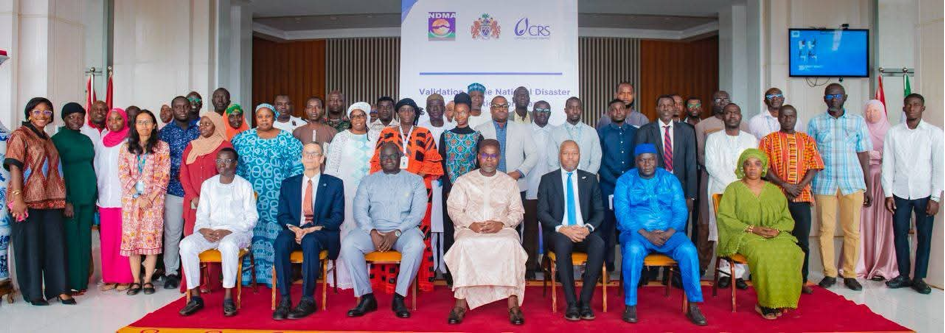
The government in collaboration with Catholic Relief Services, CRS on Wednesday validated a new National Disaster Risk Mitigation Plan (NDRMP) 2025-2033, aimed at building the country’s resilience against the increasing frequency and intensity of natural disasters.
The framework, launched at a high-level ceremony in SDKJICC, sets out strategic interventions for preparedness, mitigation, response, recovery, and sustainable financing to safeguard lives and livelihoods.
VP Muhammad BS Jallow, reaffirmed government’s political commitment to disaster resilience.
“This document has been prepared through wide consultations and careful analysis. Its true value depends on collective ownership and action,” he said, urging ministries, regions, communities, and development partners to ensure the plan is fully implemented.
VP Jallow called on bilateral and multilateral partners, civil society, and the private sector to support the implementation of the plan through “pooling of resources, expertise, and solidarity,” warning that “the cost of inaction is far greater than the cost of preparedness.”
”As part of ongoing efforts, the government has already initiated key projects, including the West Africa Coastal Areas Resilience Project, aimed at protecting communities against coastal erosion and flooding. Budget allocations have also been strengthened to support capital projects that reduce vulnerabilities and enhance preparedness”, VP Jallow concluded.
Executive Director at NDMA, Sanna Dahaba emphasised the significance of the validation, calling it “a shift from a culture of reaction to a culture of prevention, preparedness, and resilience.”
He underscored the importance of aligning the plan with international frameworks such as the Sendai Framework for Disaster Risk Reduction, the Sustainable Development Goals, and the African Union’s Agenda 2063.
ED Dahaba stressed that “validation must be followed by action — through budgeting, policy implementation, education, and empowering the most vulnerable.”
Dr Jude Marie Bannatte, Regional Director for Central and West Africa at Catholic Relief Services (CRS), highlighted the organisation’s contribution through its empowered initiative, which provided technical and financial support to the NDMA.
“CRS remains committed to strengthening local leadership, enhancing institutional capacity, and supporting community-led disaster response,” Bonaja stated.
According the regional director, CRS funded the development of the plan and trained over 40 NDMA staff and community coordinators in emergency preparedness.
Binta Sey Jadama, a senior official at NDMA, described the plan as “a comprehensive framework designed to address The Gambia’s vulnerabilities to climate-induced hazards such as floods, windstorms, droughts, fires, coastal erosion and disease outbreaks.”
She noted that these disasters have consistently undermined socio-economic development, deepened community vulnerabilities, and destroyed critical infrastructure.
The NDRMP is anchored in the Recovery-Focused National Development Plan and seeks to mainstream disaster risk planning into key sectors, including agriculture, infrastructure, and environmental management. It places particular focus on vulnerable groups such as women, children, and persons with disabilities.