

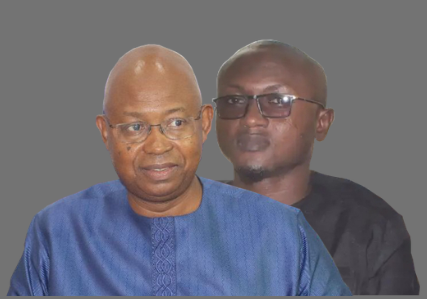

By Tabora Bojang
Alpha Kapital Advisory and Alpha Barry have filed a suit at the Supreme Court of The Gambia seeking among others an order to set aside all the findings, orders and recommendations made against him and his company by the Special Select Committee that investigated the disposal of former president Jammeh’s assets.
Alpha Kapital, was hired by the government to take over and liquidate assets of the former president following the termination of the contract of the previous receiver Augustus Prom in 2019.
In its report adopted by the National Assembly in March, the Special Select Committee recommended that Mr Barry be permanently prohibited from conducting any business with the government and that criminal investigations be initiated against him for conspiracy to defraud the state.
The report also ordered the government to terminate Alpha Kapital’s receivership contract as well as conduct criminal investigations to ascertain whether his appointment by the former attorney general Abubacarr Tambadou involved any form of corrupt practices.
The committee accused Mr Barry of financial irregularities alleging that his firm collected a total inflow of D1,719,455,187.21 from the sales of assets from June 2019 to December 2025 but only D1,253,430,000.00 was deposited to the Central Bank leaving a discrepancy of D466,025,187.21 attributed to unaccounted expenses, fees, and unidentified transactions.
Dissatisfied with these findings and recommendations, Mr Barry, the 2nd plaintiff and Alpha Kapital Advisory, 1st plaintiff, filed a suit seeking for annulment of the findings against him.
In his statement of case, Barry who is represented by Counsel Ida Drammeh argued that the parliamentary committee, despite not having found any fraud by him or Alpha Kapital, made recommendations without any basis in law or in the facts that usurped the powers of the director of public prosecutions and the police by directing that criminal investigations be initiated against him and hi company adding that there is no basis for such investigations.
He further argued that the distinctions between legislative, executive and judicial functions in the constitution were “disregarded” by the parliamentary committee in the manner of its operations and in the report that was published. “The constitution made it clear that judicial powers lay with the Judiciary and not the National Assembly and was at all times inconsistent with any intention that should pass to be or be shared by the executive or the legislature,” Barry submitted.
Barry said in his affidavit that the report caused him “great embarrassment, prejudice” and has “affected” both himself and his family “negatively.”
In view of these claims, he is seeking a declaration that the parliamentary committee acted in “excess of its jurisdiction” when it purported to make orders and recommendations against him and the firm. He also wanted the Supreme Court to declare that the committee had no power or authority to abrogate to itself duties and powers vested on the director of public prosecutions.
The plaintiff also sought relief for the court to declare that the parliamentary committee had no regard for the doctrine of separation of powers and a declaration that the committee could not exercise any powers or functions that were given to the Judiciary or which otherwise contravened the laws of the Gambia.
Barry and Alpha Kapital further want the Supreme Court to declare that the parliamentary committee does not also have the power to make any of the findings and recommendations it made and that it does not have power to direct Mr Barry to submit a report detailing all sales made between November 10, 2025 and March 10 2026.
The National Assembly in its preliminary objection to the suit argued in an affidavit sworn by the Clerk of the National Assembly Kalipha MM Mbye that the Court lacks jurisdiction to adjudicate upon matters raised by Alpha Barry and Alpha Kapital Advisory. The Assembly avers that this suit seeks to challenge matters of parliamentary oversight and internal proceedings of the parliament which are non-justiciable and that the reliefs sought by the plaintiffs do not disclose any bona fide or justifiable constitutional question warranting the invocation of the original jurisdiction of the Court.
According to the Assembly’s objection, the proceedings, reports, findings and recommendations of the National Assembly as well as its committees are clothed with parliamentary privilege adding that any exercise by the Supreme court to inquire into, review, quash or otherwise impugn proceedings, reports, findings or recommendations of the Assembly may be inimical to the doctrine of separation of powers and may constitute an impermissible encroachment upon the constitutional privileges of the 1st defendant.
The Assembly averred that it is within its function to recommend the conduct of investigation be it criminal or otherwise by the government. It further argued that the Assembly’s recommendations do not constitute criminal conviction, a judicial order or a determination of any legal right. “It is a policy proposal to the government which the government is at liberty to adopt or otherwise,” the Assembly stated.
The Assembly affirmed that the suit is “incompetent and contrary to the public interest and the spirit and letter of the constitution.” It asks the Court to dismiss the suit in its entirety and award substantive costs in its favour.
Following the submission of their preliminary briefs, both parties are expected to return to the Court on June 16.