

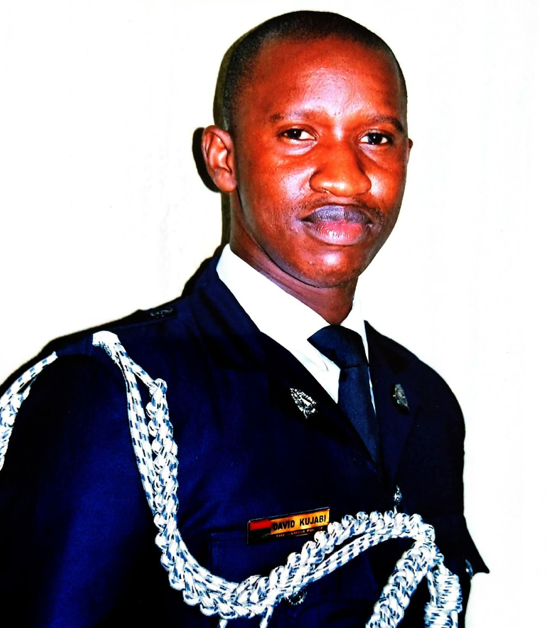
The phone rang on my first official evening as Police Relations Officer. I had no formal training in journalism or public relations. I had attended exacly one lecture on the subject during our officers’ course in Ghana. Yet here I was, holding my personal mobile phone, which now contained the official PRO SIM card with the number 9968885. The caller was a reporter from Radio France International. She asked for information about the execution of nine death row inmates at Mile Two Central Prisons. That execution had happened the previous night, and I knew nothing about it. Not a single detail. I sat in stunned silence, the phone pressed to my ear, realising that and more. The baptism by fire had begun.
We, the Commissioned Officers appointed by the President of Ghana, returned to our homeland still bearing the title of Cadet Officers until 2013. During this transformative year, I received a surprise appointment as the Public Relations Officer of the Gambia Police Force. Although my passion for writing and my past success with the POLISO project were well known, I lacked a formal background in the field. My sole exposure to Public Relations was a single lecture during our officers’ course in Ghana. To this day, I remain uncertain who proposed my appointment. But I owe a debt of gratitude to that individual. That decision set the course for much of my career. From the outset, I was determined to give my best and honour the trust bestowed upon me.
However, my journey as a PRO was not without its share of challenges. I stepped into the role when it was vacant, lacking mentorship or formal training. The previous PRO, Yorro Mballow, had been reassigned before our return from Ghana. Approximately a week after my appointment, Yorro formally handed over the office to me and provided an overview of my responsibilities. At that time, this seemed adequate. In hindsight, it was fraught with challenges. No clearly defined Terms of Reference existed for the Office of the PRO or the PRO position. Nor were there Key Performance Management Indicators.
All I was told was that I was the voice of the Gambia Police Force. My duties included conducting press briefings, addressing media inquiries, and participating in traffic radio talk shows. Yet my role extended beyond being a mere spokesperson. It encompassed projecting and promoting a positive image of the force. Despite the absence of formal guidance, I persevered. I learned on the job. Over time, I made significant strides in enhancing the relationship between the police and the public.
My entry into the PRO role was a true baptism of fire. While I cannot recall the precise day of my appointment, as someone conveyed the news verbally rather than through a formal letter, I vividly remember the day former PRO Mballow officially passed the torch to me. Among the items he transferred was a mobile SIM card with the official phone number for the Police PRO. That number, 9968885, would become my direct line to the nation. I recall that the date was August 27, 2012. I remember it not because of the handover but due to the momentous events that transpired later that day.
After concluding my workday, I replaced my personal SIM card with the official PRO’s SIM card. I had no dedicated phone, so I used my own device. Shortly after that, the phone rang. An international call. Filled with trepidation, I answered in what I hoped was an appropriately official tone. On the other end of the line was a lady who identified herself as a reporter from Radio France International. She sought information about the execution of nine death row inmates at the Mile Two Central Prisons the previous night. That execution had occurred on Sunday, August 26, 2012.
Initially, I knew nothing about the matter. I conveyed as much to her. In that moment, the daunting and perilous nature of my role as Police PRO truly hit me. I realised I would be tasked with addressing many sensitive national security issues. I quickly learned what to say, what not to say, whom to communicate with, and how to convey information. There was no manual for this. There was no training. There was only the ringing phone and the expectant voice on the other end.
The following week, The Gambia experienced unusual events. Three murder cases transpired in a single night. These included the gruesome murder of a lady by her sister-in-law in Brusubi, a young man killed in London Corner, and the death of a 15-year-old male burglar. My responsibility was to report these incidents to the media. Despite my inexperience with television and radio appearances, the entire Gambian media turned to me for information. I had no time to be afraid. I had only the truth to tell and a duty to tell it right.
Entering the world of public relations as a novice devoid of formal training, I successfully met the demands of my role. My tenure saw significant enhancements in the relationship between the police and the public. I introduced several radio programs, including the pioneering “Community Policing Hour” on television. The improved relationship with the media ensured that information related to crime and policing reached the public quickly and accurately. This positive engagement with the public inspired many young people, particularly university and college graduates, to consider joining the police force. I navigated both rewarding and challenging moments in this role. I have numerous stories and experiences from that time, though some remain bound by the oath of secrecy.
During my officer’s course at the Ghana Police College, a lecturer made a statement that resonated with me throughout my tenure as a public relations officer in the security sector. He said, “There is a lot of news in the bosom of the police.” While this statement holds great appeal for journalists, it poses serious challenges for communications and public relations practitioners. Our job was to promote the positive image of a security institution. Not all news is marketable. The intricacies of security provision, particularly in relation to fundamental human rights, often generate a mix of good and bad news. More often than not, negative news garners greater public interest. This creates situations that PR professionals would rather avoid.
Another challenge lies in navigating confidential information with national security implications. This highlights the delicate balance between the right to access information and the duty to safeguard national security. I could not simply answer every question. Neither could I hide behind silence. I had to learn where to draw the line, and I had to defend that line publicly.
Communications and PR in the security sector demand tact, caution, and a nuanced understanding of what information to share, when to share it, and how to convey it. Effective communication requires strong listening skills, patience, tolerance, and adaptability. In some instances, written communication proves more prudent than verbal discourse. A well-crafted statement allows me to control the narrative and avoid unwelcome questions. Additionally, wit, charm, and the ability to build rapport are indispensable skills. These tools can positively influence communication in the security sector in ways that policies alone cannot.
One of the significant challenges I faced was the absence of true friends within the media fraternity. Each journalist sought an exclusive scoop. It was imperative never to let my guard down. A casual remark could become a headline. A moment of honesty could be twisted into a scandal. Furthermore, the role of a PR professional representing the Gambia Police Force meant assuming the mantle of the force’s image, both professionally and personally. Every word and every action was scrutinised not as David Kujabi but as the Police PRO. I learned to live with that scrutiny. I learned to dress differently, speak differently, and even think differently. The badge was not just on my uniform. It was in my name.
Despite the myriad challenges, I embraced the job with enthusiasm. One of the most exhilarating aspects of my role was the opportunity to network and establish relationships with individuals from diverse backgrounds. Over the years, I discovered that my role not only allowed me to promote and enhance the organisation’s image but also empowered me to instil confidence and hope in my audience. It facilitated mutual understanding and trust. People expressed profound gratitude for this, a deeply satisfying aspect of my work. In numerous instances involving unpleasant issues typical of the security sector, I endeavoured to allay fears, restore hope, instil confidence, and assure justice. The sense of satisfaction derived from the public’s reassurance, coupled with the enhancement of my institution’s reputation and the cultivation of public trust, brought me immense joy.
I remember one particular media interaction when a journalist asked a pointed question about a high-profile case. The room fell silent. Cameras focused on me. I took a breath and answered honestly but carefully, revealing nothing confidential but reassuring the public that justice would follow its course. After the briefing, several journalists approached me privately. They said they had not expected such transparency. That moment taught me something important. Trust is built in small increments. Each honest answer, each clear explanation, each respectful interaction adds a brick to the wall of public confidence.
The phone rang on my first evening as Police PRO, and I answered it with fear in my heart. By the time I left that role, I answered every call with something closer to conviction. I learned on the job. I made mistakes. I grew. I transformed from a cadet officer who had attended one lecture on public relations into a voice that the Gambian public trusted. That transformation did not happen because I was the most qualified person for the role. It happened because I refused to be silent, refused to hide behind bureaucracy, and refused to treat the public as an afterthought. The badge gave me authority. But the people gave me purpose. And in the end, that purpose mattered more than any title or territory. The voice of the force was not mine alone. It belonged to every officer who served with integrity and every citizen who believed that the police could be better. I was simply the one who spoke. And I am grateful for every moment of it.