


By Aminata Kuyateh reporting from URR
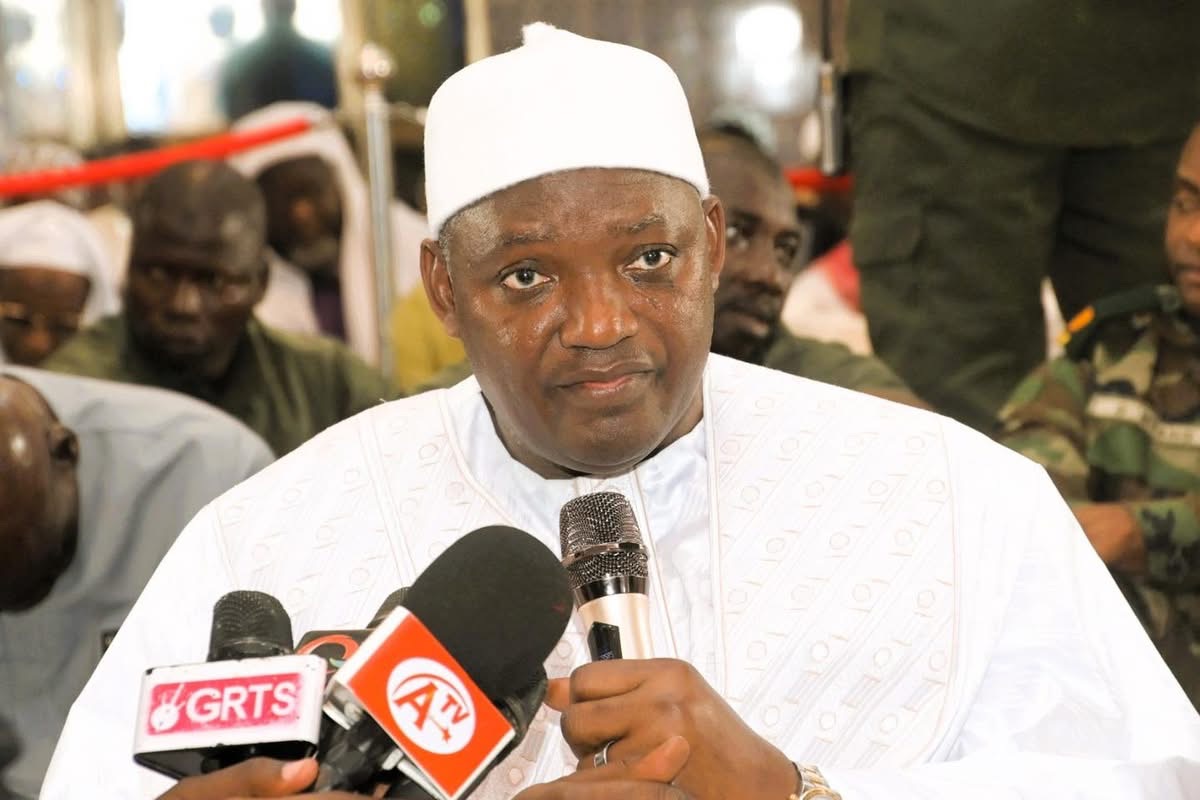
President Adama Barrow on Friday began an extensive foundation-laying tour across the Upper River Region and Central River Region, continuing Saturday with the laying of foundation stones for the Mankamang–Julangel road, the Kaba Kama Governor’s Office, the MRC–Suduwol road, and the Suduwol–Tinkinjo stretch before holding a major joint meeting in Tinkinjo, Tumana.
President Barrow declared that his government’s development agenda is a national obligation aimed at transforming agricultural communities and closing long-standing infrastructure gaps rather than a personal quest for recognition.
Speaking to residents, Barrow said every Gambian has a right to development and assured the people of Jimara and Tumana that his administration will continue working to provide the infrastructure they were denied for decades. He urged patience, saying meaningful national transformation is gradual but deliberate.
He said his government is strictly implementing the National Development Plan, with road infrastructure as a major priority through a target of 1,500 kilometres of roads. He added that the over D20 billion project is being funded through innovative financing strategies using local resources.
Barrow said his government’s achievements in road construction over the past nine years are unmatched in Gambian history, arguing that the combined road records of former presidents Sir Dawda Jawara and Yahya Jammeh totalled about 800km, while his administration alone has delivered 1,500km. He described this as a historic milestone that demonstrates his government’s aggressive commitment to national development.
He stressed that poor infrastructure over past decades left many communities isolated, but the government is now aggressively pursuing innovative financing using local resources to address those deficits.
He said the road network is central to economic growth, security, agriculture, and social inclusion, ensuring “no one is left behind”.
Beyond roads, he highlighted broader development projects, including schools, hospitals, electricity, agricultural modernisation, and office infrastructure, describing them as part of a simultaneous nationwide transformation.
Barrow described his current achievements as only the beginning, promising that more development is on the way and recounting praise from a recent visitor who, according to him, said his work had already surpassed what future governments might have taken decades to accomplish.
Barrow said even his fiercest critics are benefiting from the roads, bridges, and electricity projects his government has built, noting that opposition parties themselves use this infrastructure during campaign tours.
He alleged that some political opponents resorted to “black magic” and ritual practices, including the killing of black cows, in attempts to obstruct his government’s road infrastructure projects. Citing the Hakalang road as an example, Barrow claimed that despite alleged spiritual interference, the project was successfully completed and inaugurated “by God’s grace”.
He maintained that the development achieved under his administration over the past nine years is only “the tip of the iceberg”, assuring Gambians that even more projects are still to come.
He also urged Gambians to register and vote ahead of the 2026 presidential election, warning against political coalitions built on short-term promises. Barrow maintained that leadership choices will shape the country’s future and call on citizens to preserve peace, stability, and unity while supporting continued development.