

By Dr Jimmy Hendry Nzally
From 9–11 April 2026, scholars from across the world convened in Lisbon, Portugal, for the international congress on Tourism and Colonial Heritage: The Re-encounter of Cultures, hosted at the School of Arts and Humanities, University of Lisbon. The gathering brought together academics, researchers, and practitioners to critically examine how colonial histories are remembered, represented, and reinterpreted in contemporary tourism and heritage discourse.
At a time when debates about restitution, representation, and historical justice are gaining global urgency, the congress provided an important platform to rethink the relationship between colonial pasts and present-day identities. Discussions highlighted how tourism continues to shape narratives about formerly colonised societies, often privileging external interpretations over local voices.
It was within this global conversation that I had the privilege of representing The Gambia through two academic contributions.
Reclaiming Gambian narratives
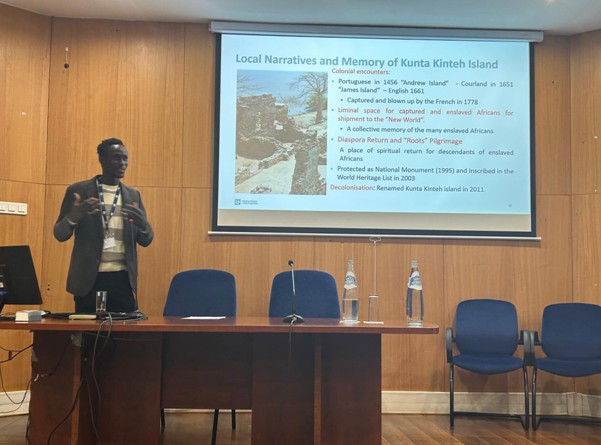
My first presentation, titled “Decolonising The Gambia’s Colonial Heritage: Integrating Local Narratives,” focused on the urgent need to reposition Gambian voices at the centre of heritage interpretation. Too often, the stories told about our historical sites—whether on James Island (Kunta Kinteh Island), Albreda, or Bathurst (Banjul)—are framed through colonial archives and external perspectives.
The paper argued that decolonising heritage is not merely about revising historical facts, but about restoring agency to communities whose histories have long been mediated by others. This involves incorporating oral histories, community memory, and indigenous knowledge systems into how heritage is preserved and presented.
For The Gambia, this shift is particularly critical as tourism remains a key economic sector. A more inclusive and locally grounded narrative not only strengthens cultural identity but also offers visitors a more authentic and ethically responsible experience.
Decolonising Cocoa and Shared African Histories
In a second presentation, co-authored and delivered on “Decolonising Cocoa: Revisiting Underrepresented Heritage and Knowledge Systems in São Tomé and Príncipe,” we explored how plantation economies—deeply rooted in colonial exploitation—continue to shape heritage narratives in African island states.
The study examined how local knowledge, labour histories, and cultural practices linked to cocoa production have often been marginalised in favour of Eurocentric interpretations of plantation heritage. By revisiting these narratives, the research called for a broader rethinking of how African contributions to global commodities are recognised and valued.
This comparative perspective resonates strongly with Gambian experiences, particularly in how agricultural histories and labour systems are documented—or overlooked—within national heritage frameworks.
A Global Shift in Heritage Thinking
A key takeaway from the congress was the growing consensus that colonial heritage cannot be treated as a static or neutral legacy. Instead, it must be understood as contested, layered, and deeply political. Scholars emphasised that tourism has the power either to reinforce outdated narratives or to serve as a tool for education, reconciliation, and empowerment.
Importantly, there was a strong call for collaboration between academics, local communities, policymakers, and cultural institutions. Without this inclusive approach, efforts to decolonise heritage risk remaining purely theoretical.
What this means for The Gambia
For The Gambia, the implications are clear. As the country continues to promote cultural tourism, there is an opportunity—and responsibility—to ensure that heritage interpretation reflects the voices and experiences of Gambians themselves.
This means investing in local research, supporting community-led heritage initiatives, and re-evaluating how historical sites are presented to both domestic and international audiences. It also requires integrating heritage education into national development strategies, ensuring that future generations understand and engage critically with their history.
Conclusion
Participating in this international congress was both an honour and a reminder that The Gambia has an important voice in global conversations about heritage and decolonisation. Our histories, experiences, and perspectives are not peripheral—they are central to understanding the broader legacy of colonialism.
As these discussions continue worldwide, it is essential that The Gambia not only contributes to them but also leads in shaping a more inclusive and representative approach to heritage.