


By Amadou Jadama in Beijing
Qinghai Shengyuan Carpet Group (SYG), one of China’s largest and leading Tibetan carpet manufacturers, is driving a 100 million RMB export business with women at its core, who make up 70 percent of its workforce.
The company employs 350 people, the majority drawn from Tibetan and Tu communities in Qinghai Province, and shared its growth story with African journalists during a media engagement on Thursday.
From small startup to global exporter
Founded in 2007 by Xue Ting, a graduate of Shanghai University of Finance and Economics, SYG began with just over 20 workers in Xining. It has since expanded into a major exporter, supplying Tibetan carpets to more than 40 countries.
About 80 percent of its products are exported to Europe, North America, South America, the Middle East, Australia, and parts of Africa, including South Africa, Egypt, and the Democratic Republic of Congo.
The United States remains its largest market, accounting for 60 to 70 percent of total sales, with clients ranging from luxury hotels and cruise ships to major installations such as Dubai International Airport and hospitality venues in Las Vegas.
Blending technology with tradition
Tibetan carpet weaving, a 2,000-year-old craft originating from the Qinghai-Tibet Plateau, is recognised as a national intangible cultural heritage in China.
SYG combines industrial efficiency with artisanal skill. Its machines produce up to one million square metres of carpet annually, equivalent to roughly 10,000 pieces per day, while hand-knotted production reaches 50,000 square metres each year.
“A machine-woven Axminster carpet costs about 100 RMB per square meter, while a hand-knotted piece averages around 20,000 RMB,” said Ian Wang, International Sales Manager.
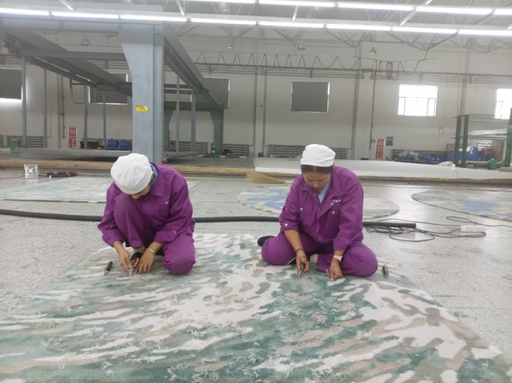
He added that machines handle base weaving, while skilled artisans complete the finishing to preserve the carpets’ distinctive character.
Women driving production
The company’s workforce is overwhelmingly rural, with 90 percent coming from nearby communities and 70 percent being women. Many were trained through local Tibetan carpet skill programmes.
“Most of our workers are women from surrounding villages,” Wang said.
The model provides stable income opportunities without requiring migration, while enabling the company to preserve traditional craftsmanship and meet growing global demand for natural wool and yak hair carpets known for durability and rich texture.
Growth anchored in heritage
Beyond commercial production, SYG also produces culturally significant pieces, including carpets inspired by the Chinese zodiac.
With annual sales exceeding 100 million RMB, the company positions its growth strategy around cultural preservation, innovation, and rural economic empowerment.