

By Sirrah Touray
The National Water and Electricity Company has broken ground on the largest water project in Gambian history — a €59.1 million, French-funded offensive to eliminate the dry taps crippling daily life across the Greater Banjul Area.
The Water Supply Project in the Greater Banjul Area, WASIP, has moved from planning to active construction in Latrikunda, Serekunda, and beyond. Cranes, steel panels, and new pipelines now signal a hard pivot for communities battered by years of intermittent supply.
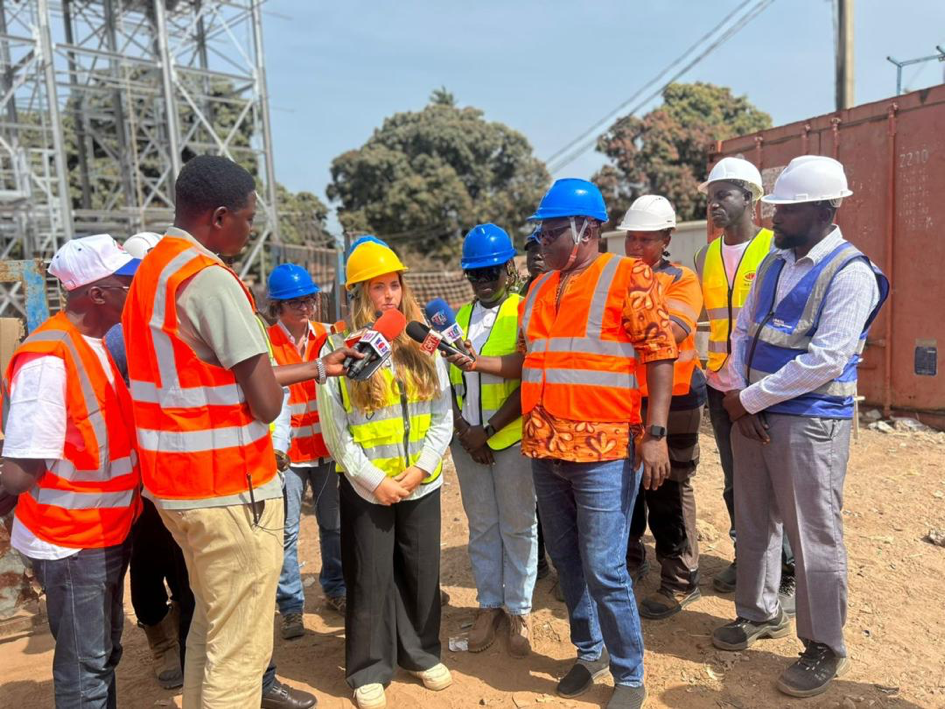
“This is a turning point,” Senior Water Asset Manager Sainabou Jagne said at the Latrikunda site. “What was happening in the back offices is now happening on the ground.”
Behind her, crews were seen erecting a new 500-cubic-meter elevated tank to replace the obsolete “cedar club tank” that has failed Latrikunda and Dippa Kunda for decades. For residents, the impact is non-negotiable: water at the tap, even when the power fails.
Project Coordinator Omar Sanneh, who heads Nawec’s water and sewerage business unit, said the tanks will sever the direct link between power failures and water cuts.
“Right now we are sending water directly into the system. We don’t have a buffer,” Sanneh said. “Anytime there is a break in power supply from the grid, the pumps go down and people experience lack of water.”
With storage in place, gravity will force water through the network during outages. These tanks end the dry periods that have defined daily life for thousands of families,” he said.
WASIP is financed entirely by a grant from Agence Française de Développement, the French government’s development arm. Project Officer Lorane Rebot confirmed the terms: “This is a government priority. It was requested directly by the Government of the Gambia. The financing is grants — money given by the French state to The Gambia.”
AFD has imposed international consultants and contractors to enforce global safety and sanitation standards. After a financing gap emerged last year, the European Investment Bank stepped in with additional funds for future phases.
Crews are replacing tanks in Latrikunda and Serekunda, rehabilitating facilities in Gunjur, Farato, and Yundum, and upgrading transmission pumps in Serekunda that supply the entire capital.
“There are no boreholes in Banjul,” Sanneh said. “All the water going to Banjul is coming from this water treatment plant. That makes these activities in Serekunda critical.”
Serekunda will get a new 1,000-cubic-meter ground reservoir, doubling storage once the existing 900-cubic-metre tank is refurbished.
The project will drill 16 new boreholes, including four “Maastrichtian” wells between 450 and 600 metres deep — two in Sukuta, one in Brikama, one in Serekunda. Nawec currently draws from shallow aquifers at 60 to 80 metres, increasingly contaminated by surface settlement.
The Maastrichtian aquifers are protected from surface activity and contain naturally occurring minerals. “If this works, this is the way forward for us to supply water to our communities in the country,” Sanneh said.
Construction is advancing despite procurement delays. The Latrikunda tank structure is complete; final pipeline connections await steel pipes already shipped. Crews will then mobilise to Serekunda for tank replacement and reservoir work.
Short-term works will now finish between December 2026 and January 2027, revised from the initial October deadline. Medium-term components are slated for Q1 2027.
The €59.1 million grant is the single largest water investment Nawec has ever secured. Management says coordination among donor, government, and contractor teams remains tight.
Work Supervisor Roheyatou Dibba was direct: “New buffers, upgraded pumps, expanded networks, and secure deep aquifer sources.”
If WASIP delivers, she said, “the days of empty taps when the power cuts are over in The Gambia.”