


By Olimatou Coker
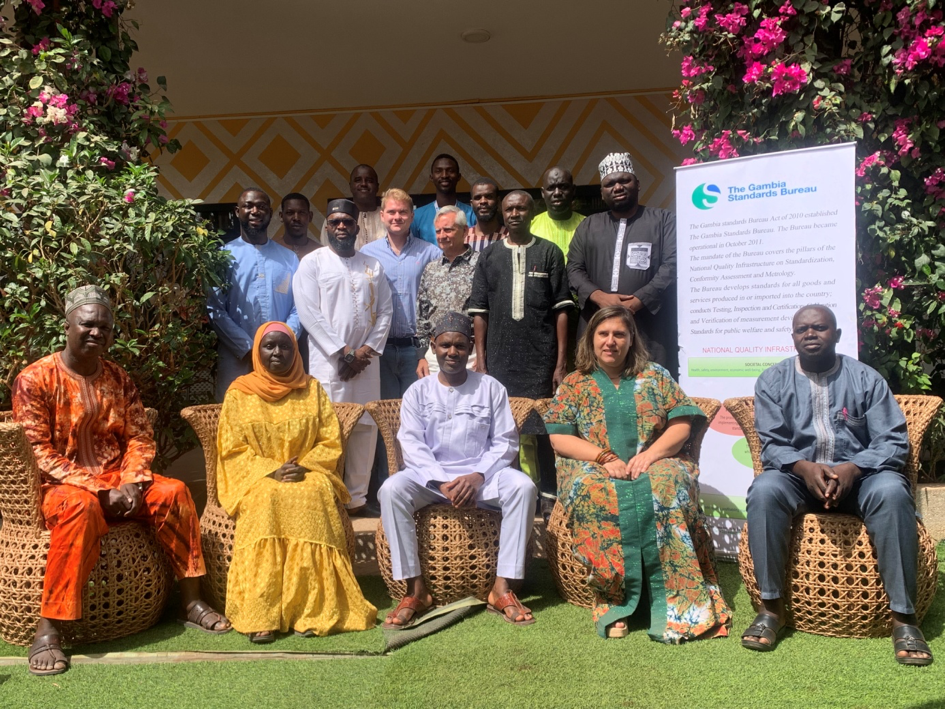
Stakeholders on Friday held the inaugural meeting of a subcommittee to develop national standards for organic fertilisers in The Gambia. The meeting was hosted at Bakadiji Hotel.
The subcommittee marks a key step toward regulating organic fertiliser production and use. The initiative is implemented under a service agreement between The Gambia Standards Bureau, Mbolo Association, CISS, and WasteAid. It is part of the EU-supported Civil Society Green Advocacy for Organic Fertilisers Programme.
The collaboration will strengthen the regulatory and technical framework for organic fertilisers. It aims to scale up conversion of organic waste into certified, high-quality fertiliser, enhance standards development, promote sustainable farming, and support fertiliser research to improve soil health and long-term food security.
Dr Faye Manneh, Chairperson of the Food and Agricultural Committee, said organic fertiliser is critical to restoring soil fertility and boosting crop yields. “The organic matter content of Gambian soils is very low. Continuous application of inorganic fertiliser is causing soil pollution and degradation,” he said.
He said demand for organic fertiliser is rising, but wide varieties are entering the country without verified content or application rates.
“Without standards, farmers cannot know the nutrient levels or correct application rates. We must establish reliable standards to protect users, promote quality, and support sustainable agricultural practices,” Manneh said.
He urged members to draw on their expertise to ensure the standards are clear, practical, and effective. “This will help farmers know the constituents and determine rates,” he said.
Emile Henri Vancaenegem, Program Officer at the European Union, said The Gambia has a clear need for organic fertiliser. “Soils here are very sandy, with low water retention, nutrient retention, and organic matter. This creates a strong need to adopt organic fertilisers to improve soil quality,” he said.
He said farmers are shifting to organic fertiliser because it is more affordable than chemical fertiliser and creates income through waste valorisation. “Farmers can reuse vegetable and livestock waste to produce compost, which can activate future batches. It is a perfect circular economy model that supports income generation and produces healthier, larger crops,” he said.
He stressed that organic farming has no harmful side effects and supports long-term soil health. “The EU remains committed to supporting the initiative,” he added.
Papa Secka, Director General of TGSB, said the standard will give government a clear, objective basis for procurement.
“Government has procured organic fertiliser, but the basis is not systematic and not based on a uniform specification,” Secka said. “The new standard will set a consistent, measurable framework. Government can then procure locally or from importers against clear requirements, and suppliers can prove compliance.”
Secka said the meeting launched a specialised subcommittee under the Technical Committee on Food and Agriculture to focus on organic fertiliser standards. He said organic fertiliser is a specialised area that requires continuous review to align with international best practices, so the subcommittee will be permanent, like those for horticulture and cereals.
He said all stakeholders across the value chain were invited, and any omitted parties are welcome to join. “Standardization is inclusive and consensus-based. All stakeholders must contribute to ensure broad acceptance and ownership,” Secka said.
“Standards must be practical and usable, and must balance the expectations and needs of all parties.”