


By Omar Bah
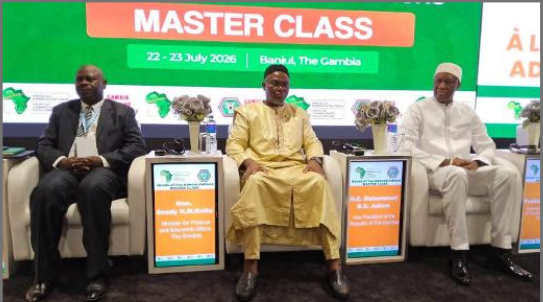
Tax chiefs from across Africa converged in the Gambian capital yesterday, confronting a mounting threat to national revenues and charting a new push to strengthen homegrown tax systems.
The continent loses an estimated $88–$148 billion annually to corruption and illicit capital outflows. The African Development Bank estimates total annual leakages—including multinational profit-shifting and risk-management losses—exceed $580 billion. These losses, together with shrinking aid, undermine African governments’ ability to finance schools, hospitals and infrastructure.
The Banjul summit seeks to reverse that trend by deepening cross-border cooperation, modernising tax administrations and broadening the domestic tax base. Delegates said success in Banjul could free billions of dollars for development and increase fiscal independence for countries long reliant on external support.
Speaking on behalf of the President, Vice‑President Muhammed BS Jallow said changing global realities, economic uncertainty and pressure on traditional development financing—make stronger domestic revenue systems essential.
“No nation can truly own its development if it cannot finance its ambitions,” he said.
Jallow framed tax administrations not merely as revenue collectors but as strategic institutions that support growth, public services and national transformation. He praised the African Tax Administration Forum (ATAF) for facilitating cooperation, technical support and peer learning among African revenue authorities.
The Vice‑President highlighted reforms at the Gambia Revenue Authority (GRA), crediting investments in digitalisation, improved compliance and stronger risk management with measurable revenue gains. He commended GRA Commissioner General Yankuba Darboe for driving those reforms.
GRA Commissioner General Yankuba Darboe called hosting the continental meeting a national honour and said the gathering underscored the importance of collaboration in tackling shared challenges. He lauded ATAF for turning the Heads of Tax Administrations Master Class into a practical platform for South‑South cooperation and policy transfer, and noted that lessons from prior editions informed reforms at the GRA.
Darboe emphasised that technology alone does not secure reform. “Technology can modernise systems, but leadership sustains reform,” he said, adding that meaningful changes often provoke resistance.
“If nobody resists your reform, it may not be ambitious enough.” He stressed that political backing is vital, adding that institutional transformation requires commitment from both technical leaders and policymakers.
Finance Minister Seedy Keita said Gambia’s reform agenda raised the tax‑to‑GDP ratio from 9% in 2022 to 13% in 2026. He translated that increase into concrete outcomes: a 60% cumulative civil‑service salary rise over three years, construction of Hakalang and Kiang West roads from domestic funds, and expanded energy access to over 90% of Gambians with partner support.
“These gains did not come from raising rates,” Keita said. “They came from improved compliance, digitalization and better tax policy.”
Keita credited strong political will and institutional leadership for progress.
“Nobody will develop our country for us,” he quoted the President, and praised the GRA team for transforming revenue collection—what once took a year to raise is now collected in a month.
He also acknowledged ATAF’s role since 2009 in providing peer learning and technical support in data analytics, transfer pricing, VAT on digital services and audit strengthening. “Small nations can make significant fiscal progress when guided by strong institutions and political commitment,” he said.