


By Olimatou Coker
Dawda Foday Saine, marine biologist and fisheries expert, has urged The Gambia and Senegal to deepen cooperation to secure sustainable fisheries management and guarantee that small-scale fishers have a decisive role in policy-making.
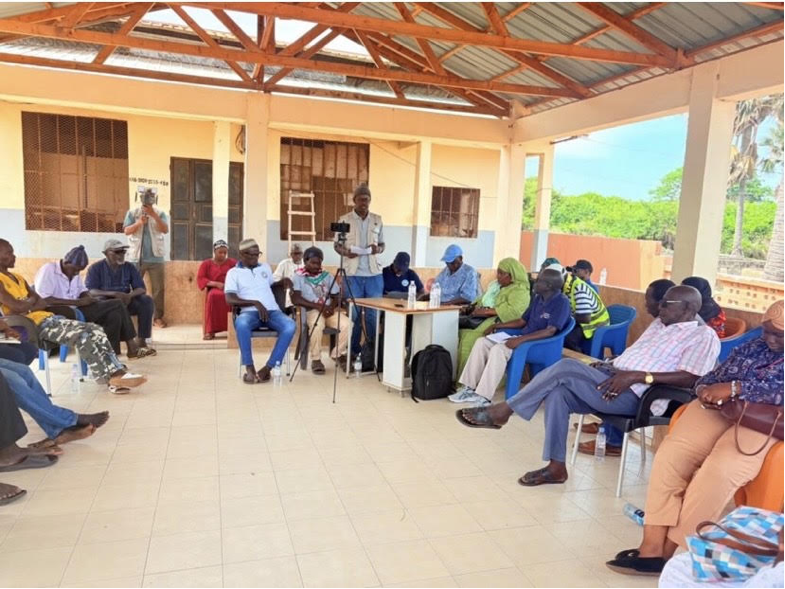
Saine made the call at the Brufut Fish Landing Site during a bilateral meeting of fisheries organisations from both countries, including The Gambia’s National Association of Artisanal Fisheries Operators (NAFO) and Senegal’s umbrella fisheries organization, HANAPAS. The meeting focused on challenges facing artisanal fisheries and concrete areas for collaboration.
“The objective is not token attendance; fishers must participate meaningfully in policy formulation, fisheries agreements, and implementation,” Saine said.
He stressed the urgent need to inform fishing communities about the 2023 fisheries agreement between The Gambia and Senegal, noting that many artisanal fishers remain unaware of key provisions such as quotas for small pelagic species, including sardinella.
Saine warned against the rapid expansion of fishmeal factories, which he said directly compete with local communities for fish critical to food security and nutrition. He highlighted species such as yaboy for their high omega-3 content, which supports children’s brain development.
Saine identified three principal threats to the sector: competition between artisanal fishers, industrial fleets, and fishmeal factories; intra-sector competition caused by declining stocks; and “competitive exclusion,” where small-scale fishers are pushed out by larger operations.
He also raised alarm over illegal fishing and poaching, particularly when industrial vessels encroach on zones reserved for artisanal fishers. Such incursions damage gear, spark conflicts at sea, and destroy breeding grounds vital for stock replenishment.
“Fish do not recognise borders,” Saine said, noting that The Gambia and Senegal share many stocks, especially small pelagics. He called for joint resource management and harmonised fisheries data, pointing out that catches taken in Gambian waters are frequently landed in Senegal, producing inaccurate statistics.
Saine highlighted the coordinating role of the seven-member Sub-Regional Fisheries Commission, which includes The Gambia, Senegal, Mauritania, Guinea-Bissau, Guinea, Cabo Verde, and Sierra Leone.
Referencing a Food and Agriculture Organisation reports, he warned that global fisheries continue to decline, with many stocks overfished or vulnerable despite existing laws and management measures.
“The state of our fisheries is alarming,” Saine said. “Without stronger regional cooperation, rigorous enforcement, and sustainable management, stocks will keep collapsing.”
Participants pledged to sustain dialogue and intensify collaboration to protect fisheries that underpin livelihoods across the sub-region.